loaction
SNU professor Park Byung-Woo’s research team developed a technology that raises lithium air battery efficiency through breathing electrodes
-
작성자
관리자
-
등록일
2018.01.15
-
조회수
1,193
SNU professor Park Byung-Woo’s research team developed a technology that raises lithium air battery efficiency through breathing electrodes
-joint research of SNU, Kyonggi University and Korea Institute of Machinery & Materials
-receiving attention as a next generation lithium air electrode material

▲ SNU Department of Material Engineering Professor Park Byung-Woo’s joint research team:
(From Left) Prof. Park Byung-Woo, Prof. Park Yong-Joon of Kyonggi Univ., Dr. Nam Seung-Hoon of KIMM, Dr. Kang Joon-Hyun of SNU
SNU College of Engineering (Dean Lee Kun-woo) announced that Joint research team of SNU Department of Material Engineering Professor Park Byung-Woo, Kyonggi Univ. Professor Park Yong-Joon, KIMM (Korea Institute of Machinery & Materials) Dr. Nam Seung-Hoon and SNU Dr. Kang Joon-Hyun has developed a technology that raises Lithium air battery’s performance and efficiency through titanium oxide.
Lithium air battery is 5~10 times bigger than the currently commercialized lithium ion battery, and is thought as the next generation environment-friendly secondary battery as it uses the oxygen in the air. However it has been pointed out that its energy efficiency is low due to the overvoltage during charging, and that the battery life is rapidly reduced as used.
Carbon has hitherto been holding the limelight as the lithium air battery’s electrode material due to its excellence in electric conductivity and ease to control surface area, but it was considered a hindrance to commercialization of lithium air battery due to its adverse reaction with the electrolyte solution and reduction is lifetime.
The research team was interested in alternative materials for carbon that could solve these problems. Using the titanium oxide developed in this research, not only the adverse reaction with electrolyte was suppressed, but also the battery life was maintained even after hundreds of times of charging and discharging. The reason for this high efficiency is the material and structure of the electrode.
The research team developed a black titanium oxide through a simple reduction heat treatment method to improve the electric conductivity, and formed a porous electrode structure permeable to oxygen, an active material of the lithium air battery, based on the structure and function of the lungs.
SNU Professor Park Byung-Woo said, “The newly developed black titanium oxide electrode is relatively easy to manufacture, and is innovative in that it is based on cheap titanium oxide.” In addition, “it can provide a technical basis for the lithium air electrode in that it has confirmed an alternative oxide of titanium oxide.”
The result has been published as a cover paper on ‘Advanced Energy Material’
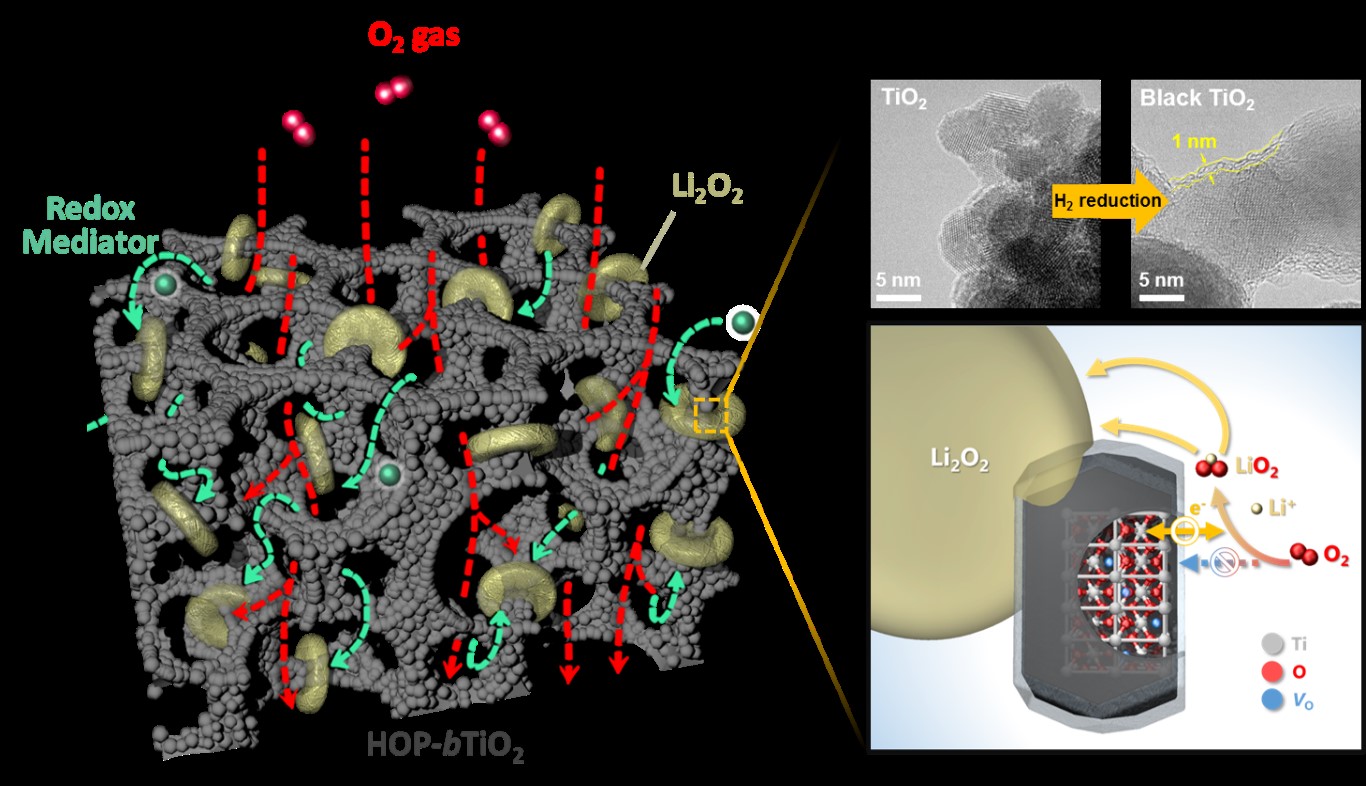
▲ Diagram of lithium oxide production mechanism in porous titanium oxide electrode