loaction
SNU Professor Park Namkyoo’s Research Team, First to Demonstrate Light with Globally Pure Transverse Angular Momentum
-
작성자
관리자
-
등록일
2018.06.11
-
조회수
1,028
SNU Professor Park Namkyoo’s Research Team,
First to Demonstrate Light with Globally Pure Transverse Angular Momentum
- Applied the Topology of Light’s Momentum to Designing Light Materials
- First in the World to Develop a Metamaterial that Can Freely Demonstrate Light’s Transverse and Longitudinal Spins

▲ (From Left to Right) SNU Department of Electrical and Computer Engineering Professor Park Namkyoo, Post-doctoral Researchers Piao Xianji and Yu Sunkyu
On May 21st, SNU College of Engineering (Dean Cha Kook-Heon) has announced that the research team led by Professor Park Namkyoo of the Department of Electrical and Computer Engineering has developed a new metamaterial that can manipulate the angular momentum of light in transverse direction instead of the conventional longitudinal direction.
Whether a wave is transverse or longitudinal depends on the displacement of the medium and the direction of wave propagation. For instance, a guitar string that oscillates up and down while energy transports perpendicular to that motion is a transverse wave. A spring that vibrates parallel to energy transport is a longitudinal wave. Electromagnetic waves (light waves) are transverse waves with electric and magnetic fields perpendicular to the propagation direction.
Property of light is defined by various physical quantities of the photon. For example, frequency is how often light oscillates in a given time and momentum is how often light oscillates in a given space.
Recently, the spotlight is on the spin angular momentum (SAM) of light. Spin is a physical quantity that quantizes the property of rotation. A longitudinal spin is when the direction of wave propagation is in the same direction to the spin axis (top image of Figure 1). A transverse spin is when the direction of wave propagation is perpendicular to the spin axis (bottom image of Figure 2).
In classical optics, transverse waves like light were known to only have a one-dimensional longitudinal spin that is parallel to propagation direction in vacuum. This is very limited compared to electron’s spins in three spatial dimensions suggested by quantum mechanics.
Recent researches in nano-optics have revealed that a spin pair of transverse spins in opposite directions can be obtained locally when light is confined. However, these spins offset each other; thus, a spin in a single direction can neither be obtained nor be observed.
Hence, Professor Park’s team has introduced topology, a concept that won the Nobel Prize in Physics 2016, to the spin of light. Noting that the distribution of angular momentum of light is dependent on the property of medium, the team has hypothesized and proved that at the interface between two different mediums that give different topological information (left image of Figure 2), a purely transverse spin can be obtained.
In addition, in order to demonstrate this phenomenon realistically, the team has integrated a metamaterial popular in recent optics and wave science – the near-zero refractive index hyperbolic metamaterial (right side of Figure 2).
The first author of this study, Doctor Piao Xianji explains, “The combination of mediums with different topologies and the angular momentum of light have allowed an access to a new spin property. This research may be the key to resolving the Abraham-Minkowski controversy concerning light’s momentum within dielectric media.”
Professor Park adds, “The study has demonstrated a method to design the longitudinal and transverse spins of light top-down. Implications of this study range from quantum simulation to fluid mechanics.”
The research findings have been published online on the prestigious journal “Physical Review Letters” on May 15th.
This research has been carried out by SNU Professor Park Namkyoo and Post-doctoral researchers Piao Xianji and Yu Sunkyu from the Department of Electrical and Computer Engineering. It was funded by the Global Frontier Projects (Center for Advanced Meta-Materials, CAMM) and the Korean Research Fellowship (KRF) of the Ministry of Science and ICT and the Presidential Postdoctoral Fellowship Program of the Ministry of Education.
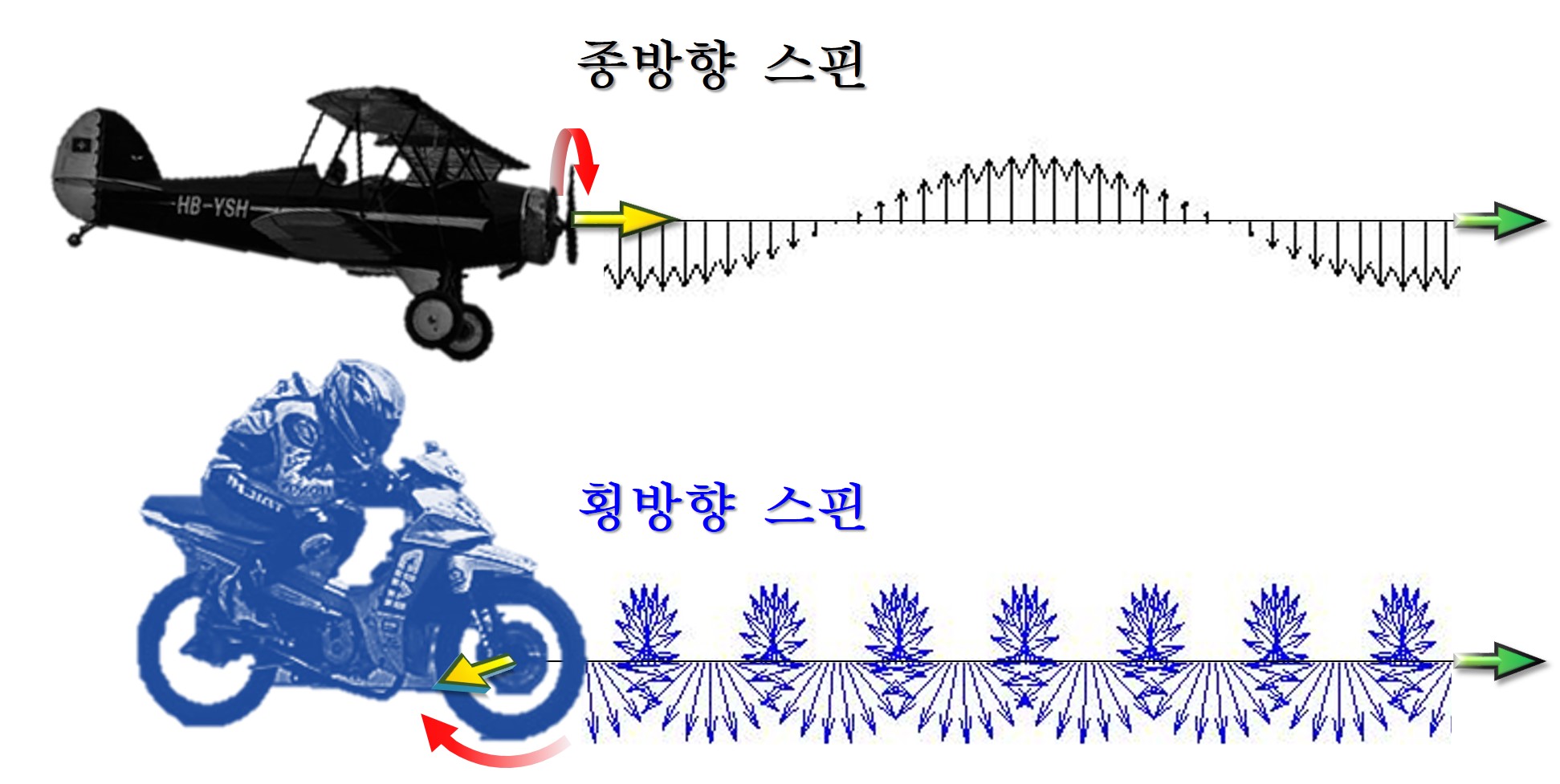
▲ Figure 1. Diagram of the Longitudinal and Transverse Spins of Light
*Green Arrow: Direction of Light Propagation, *Red Arrow: Spinning Direction of Particle, *Yellow Arrow: Direction of Spin Axis
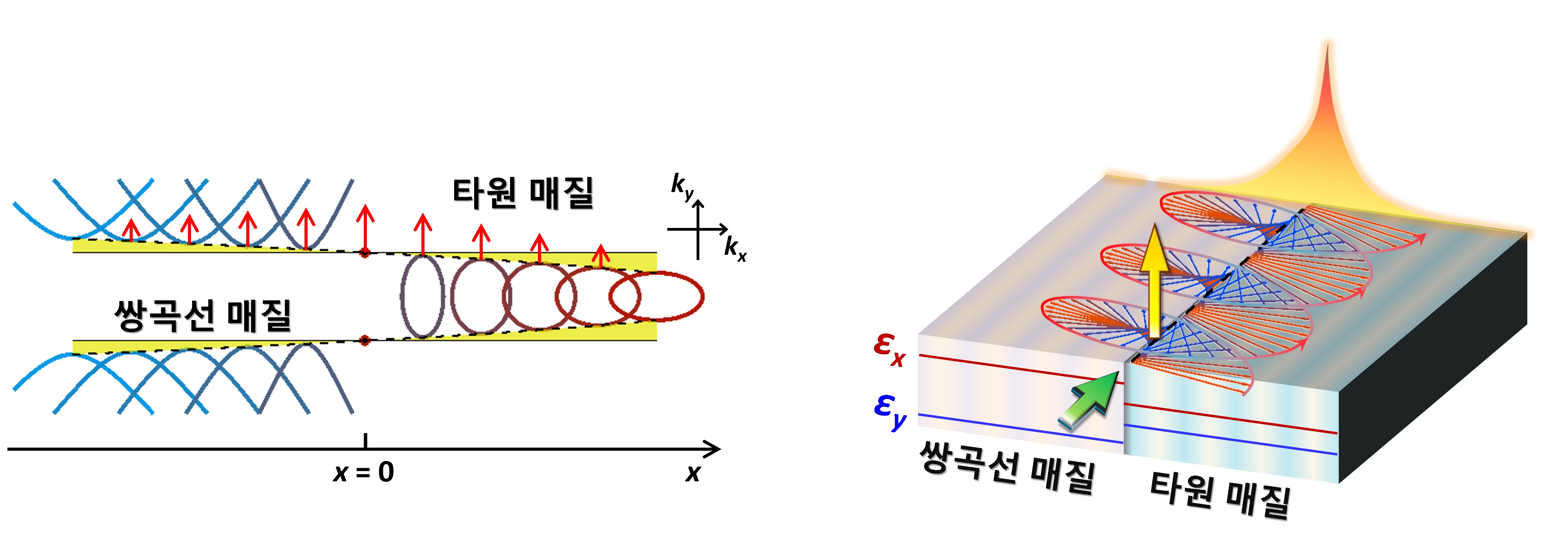
▲ Figure 2. Combination of Mediums with Different Topologies (Left), Transverse Spin at the Interface between Hyperbolic Metamaterial Layered with Metal and Dielectric and Elliptic Metamaterial Layered with Isotropic Dielectric (Right)
*Green Arrow: Direction of Light Propagation, *Yellow Arrow: Spinning Direction
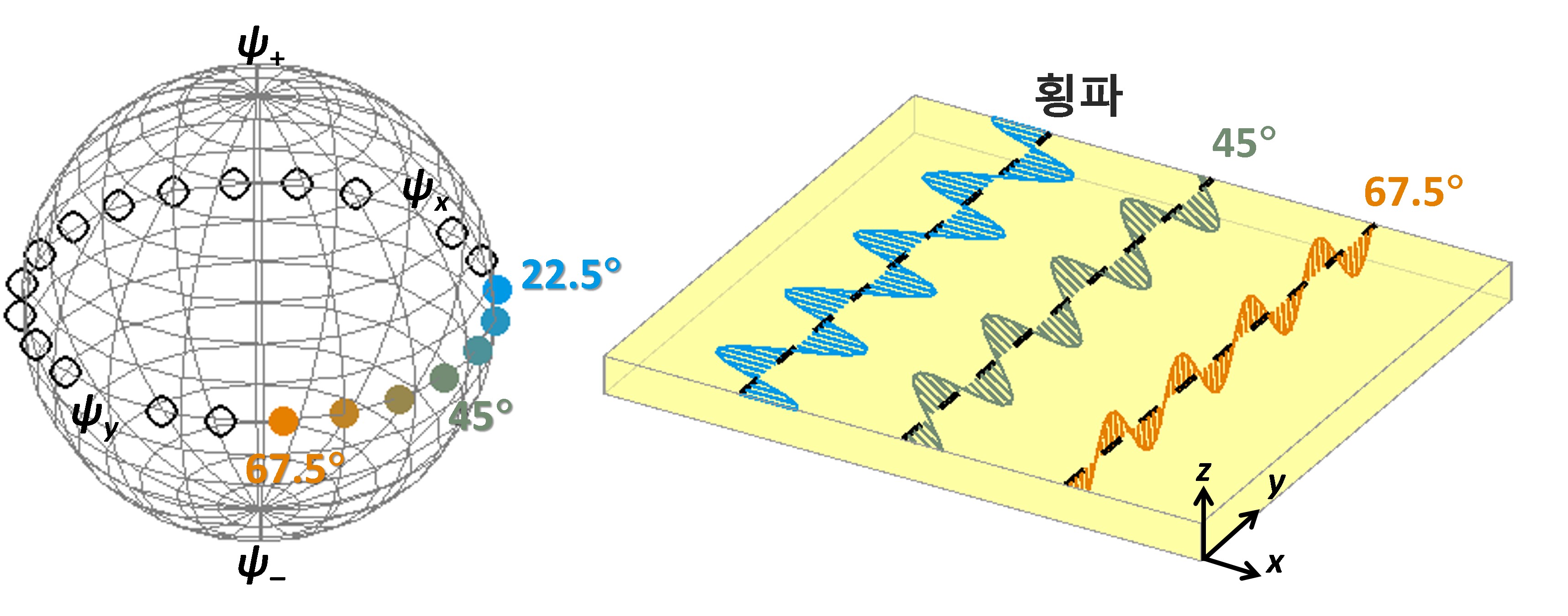
▲ Figure 3. Near Longitudinal Light Wave Demonstrated with this Technology.
At vacuum, the direction of electric field has a tilt of 45 and 67.5 degrees from a transverse wave to have both transverse and longitudinal components.
[Glossary]
1. Medium: substance that allows the transfer of energy from one location to another
2. Nano-optics: study of the behavior of light on nanometer (one billionth of a meter) scale
3. Metamaterial Technology: Meta means “beyond” This technology involves assembling materials of different properties to create metamaterials with properties that are not found in nature (“beyond” nature). It is often used in invisibility cloak technology and superlens/hyperlens technology.
4. Hyperbolic Metamaterial: displays a hyperbola on the iso-frequency contour (curve that shows the momentum of light at a fixed energy). It can have a very high momentum.
5. Elliptical Metamaterial: displays an ellipse on the iso-frequency contour (curve that shows the momentum of light at a fixed energy). Its dielectric property is dependent on the direction.
6. Abraham–Minkowski Controversy: concerns the electromagnetic momentum within dielectric medium. Abraham focuses on the momentum of light itself while Minkowski concentrates on the relationship between light and medium. It is still unclear which side is more valid.