loaction
SNU Professor Lee Tae-Woo’s Research Team Develops World’s First Doping Technique for Stable Graphene Using Non-Volatile Polymeric Acid
-
작성자
관리자
-
등록일
2018.06.11
-
조회수
1,127
SNU Professor Lee Tae-Woo’s Research Team Develops
World’s First Doping Technique for Stable Graphene Using Non-Volatile Polymeric Acid
World’s First Doping Technique for Stable Graphene Using Non-Volatile Polymeric Acid
- Graphene Electrode that Maintains Doping Effect in Air for More Than Two Months
- Resolves the Main Issue of Doping Stability of Graphene Electrode
- Published on the Prestigious “Nature Communications”
- Resolves the Main Issue of Doping Stability of Graphene Electrode
- Published on the Prestigious “Nature Communications”
On May 24th, SNU College of Engineering (Dean Cha Kook-Heon) has announced that the research team led by Professor Lee Tae-Woo (Department of Materials Science and Engineering) has developed a new method that enhances the doping stability of graphene electrode using non-volatile polymeric acid to a commercializable level. Applying the new technique, they have also produced high-efficiency, flexible and light-emitting diodes.
Graphene is an allotrope of carbon composed of a single layer of carbon atoms arranged in a hexagonal lattice. It is also the thinnest conductor. Graphene is used in numerous fields including flexible display, solar cell, and battery. Its unique electric, optic, and mechanic properties has allowed it become a transparent and flexible electrode material that can replace oxide electrodes like indium tin oxide (ITO).
Conventional chemical doping using small molecules obtains a high electrical conductivity by exposing conductive polymer to an oxidant, but quickly loses effect as it is exposed to react with the ambient moist. Hence, the research team developed a new doping technique that involves non-volatile polymeric acid. Using this new technique, not only does the conductivity increase, stability in air can be maintained for more than 60 days and the doping is secure against high temperature of 300 degrees and acidic and organic solvents.
In other words, the team has proven through the production of highly-efficient organic light-emitting diodes that this doping technique can be applied in organic electronics.
Based on the successful commercialization of conductive polymer by switching over from small molecule doping to polymeric acid doping, the researchers of this study believed that researches on graphene doping should also replace small molecule dopants with polymer dopants. Therefore, taking note of graphene’s doping properties, they have applied the chemically-stable fluorinated polymeric acid as graphene’s new dopant.
Unlike when small molecules are used as dopants, using fluorinated polymeric acid on graphene has demonstrated ambient stability for more than two months and a high chemical and thermal stability. Especially, while doping with conventional dopants is vulnerable to heat, polymeric dopants can enhance thermal stability. Hence the team created highly-efficient organic light-emitting diodes (OLED) by replacing this newly doped graphene as the electrodes of the OLED.
The research findings have been published on the world prestigious journal “Nature Communications” on May 23rd.
The corresponding author of this study, Professor Lee Taewoo states, “This research has highly enhanced the stability of graphene doping, which used to be the biggest impediment to practical application of researches on graphene electrodes and flexible, organic photoelectric devices. This work shall lay a solid platform for further researches on flexible graphene electrode-based organic photovoltaics. It probably has also advanced the commercialization of graphene electrode to flexible display and solar cell.”
This multidisciplinary research has been conducted by the two first authors, POSTECH doctor’s degree Kwon Sung-Joo and SNU Doctor Han Tae-Hee, POSTECH Professor Ryu Sunmin’s team, SNU Professor Hong Byung Hee’s team, and UNIST Professor Kim Kwang Su’s team. It has been sponsored by the Leading Researcher Program and Nano Material Technology Development Project of the Ministry of Science and ICT and National Research Foundation of Korea (NRF), the Future Growth Engine Program of the Ministry of Trade, Industry and Energy, and the LG Display-SNU Incubation Program.
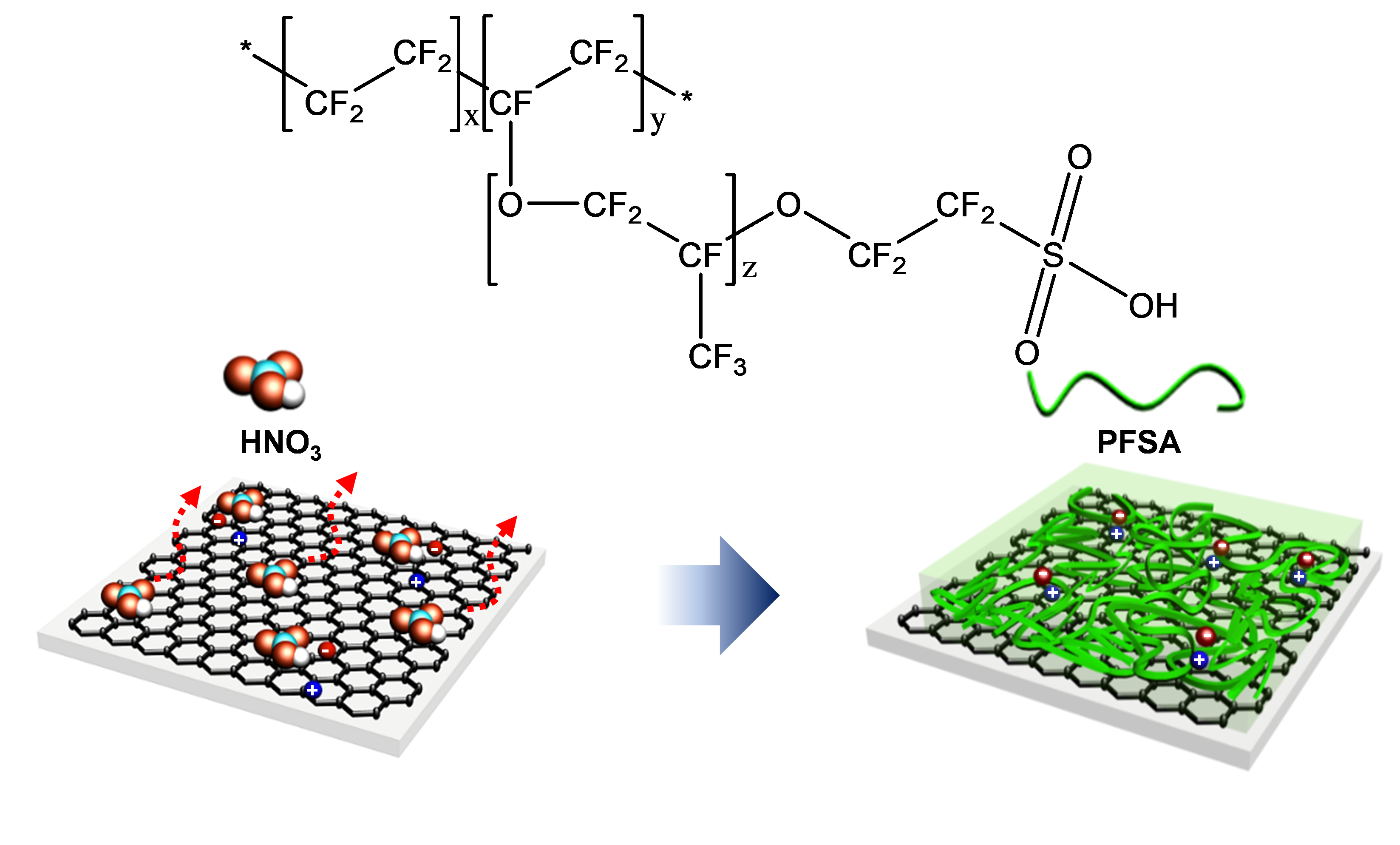
▲ Chemical Structure of Fluorinated Polymeric Acid Used by Professor Lee’s Team (Top),
Graphene Doping with Small Volatile Molecules Replaced by Fluorinated Polymeric Acid (Bottom)

▲ (From Left to Right) SNU Department of Materials Science and Engineering Professor Lee Tae-Woo (Corresponding Author), POSTECH Doctor’s Course Kwon Sung-Joo (First Author), SNU Doctor Han Tae-Hee (First Author)