loaction
SNU Professor Park Tai Hyun Develops an Artificial Photoreceptor that Substitutes Damaged Retina
-
작성자
관리자
-
등록일
2018.07.02
-
조회수
972
SNU Professor Park Tai Hyun Develops an Artificial Photoreceptor that Substitutes Damaged Retina

▲ SNU Department of Chemical and Biological Engineering Professor Park Tai Hyun
Korean researchers have developed an artificial photoreceptor that can replace the actual photoreceptor of a damaged retina. They have demonstrated experimentally that this human-like photoreceptor can detect color and light spectrum that closely resembles those of an actual eye.
SNU College of Engineering (Dean Cha Kook-Heon) announces that Professor Park Tai Hyun of SNU Department of Chemical and Biological Engineering, with Doctor Jae Hun from the Sensor System Research Center of the Korea Institute of Science and Technology (KIST) and Dr. Song Hyeongseok of the Korea Basic Science Institute (KBSI), have succeeded in creating an artificial photoreceptor that can not only differentiate light but also color.
The research findings have been published in the Advanced Materials (IF: 19,791, JCR), an international journal on materials science, on May 18th.
The eye is a crucial sensory organ of our body. Whilst the eye’s retina is prone to deterioration from accident, disability, macular degeneration and diabetic retinopathy, there is still no medical solution on retina to recover or restore eyesight.
Heated researches on artificial retina that can replace the damaged retina are conducted to have them be transplanted into patients for the treatment of eyesight.
The retina consists of cone cells and rods. The cones split to three types that each absorb either red, green, or blue of the visible wavelengths. The rods are composed of photoreceptive proteins that mainly differentiate the shades of bright and dark.
The researchers have succeeded in producing the artificial photoreceptor cell by imputing the three types of photoreceptive proteins found inside cones (blue-1SW, green-1MW, red-1LW) and the 1Rho-gene of rod’s photoreceptive protein into the human embryonic kidney cell line (HEK-293). Each photoreceptor has been combined with electrochemically-sensitive graphene to capture and analyze the biochemical changes caused by the absorption of red, blue and green LED lights by artificial receptor in means of electrochemical signals.
As a result, it has been found that the artificial photoreceptor reacts to a spectrum of light that closely resembles the human visible spectrum, perceives the three primary colors and shades of light, and is able to differentiate the types of colors.
This research will be the groundwork for future researches aiming to provide better treatment for patients suffering from retina-related diseases and disorders.

▲ (Left) Cell Producing Human Photoreceptor (Green),
(Middle) Nano-sized Vesicle Form Photoreceptor Produced by the Above Cell,
(Right) Material Made from Laminating Photoreceptor on to Graphene Surface
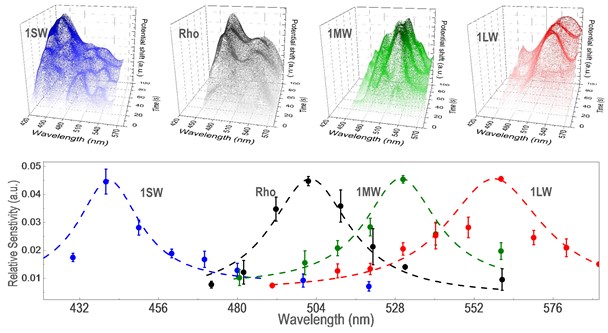
▲ Human-Like Spectral Sensitivities Demonstrated by Artificial Photoreceptors Made from 4 Photoreceptive Proteins Blue-1SW, Green-1MW, Red 1LW (in charge of color) and Rho (in charge of shades)