loaction
SNU College of Engineering Enhances Basic Science Education for Undergraduates to “Rear Well Grounded Engineers”
-
작성자
관리자
-
등록일
2018.07.03
-
조회수
950
SNU College of Engineering Enhances Basic Science Education for Undergraduates to “Rear Well Grounded Engineers”
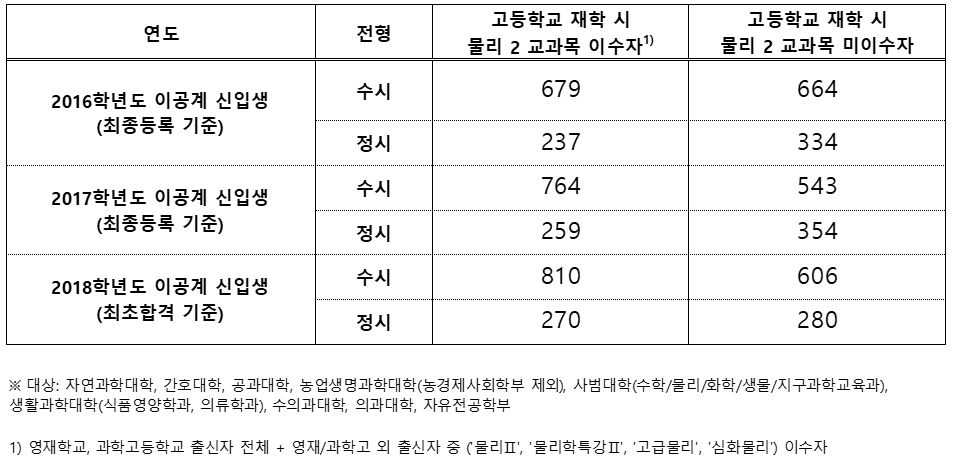
▲ Number of SNU Freshmen in Natural Sciences and Engineering Who Have Completed Physics II in High School
# A 18-year-old student (referred to as Kim) attending “K” high school in Seoul wishes to major in engineering but concerns that not a lot of peers are selecting physics in high school. His school does not offer the Physics II course due to the small number of students registering and Kim is left to self-study. He states, “I heard that STEM colleges require a firm grasp of fundamental physics but status-quo makes it challenging for me to do so. His school has suggested to open the Physics II course with 3 neighboring schools, but as a senior due to time-constraint, moving around between classes is also an issue.”
SNU College of Engineering (Dean Cha Kook-Heon), with College of Natural Sciences and Faculty of Liberal Education, announces to provide a strengthened basic science education for undergraduate freshmen with various learning backgrounds in math and science, including the students like Kim.
Majority of engineering departments put math and science as mandatory first year courses as these build the foundation for later courses that deal with 4th Industrial Revolution related technologies. However, referring to the table above, which logs the newly admitted students in natural sciences or engineering from the recent three years, 1813(45%) out of 4066 rolling admissions, 968(56%) out of 1734 regular admissions, and 2781(48%) out of 5800 total students have not completed the Physics II course in high school. Excluding the 1128 students from science high schools or elite schools that underwent advanced curriculum, 2781(60%) out of 4672 regular school students, or simply 6 out of 10 did not take Physics II.
Professor Choi Sunghyun (Department of Electrical and Computer Engineering), the Vice Dean for School Affairs of the College of Engineering states, “It is of paramount importance for students who major in mechanical engineering, electrical and computer engineering, or any other related fields that handle classical mechanics, thermodynamics and electromagnetics to take Physics II.” However, he finds students reporting that, “Grades received in Physics II often contradict the time and effort dedicated; thus, students choose alternative courses that are relatively easier and advantageous to college application.”
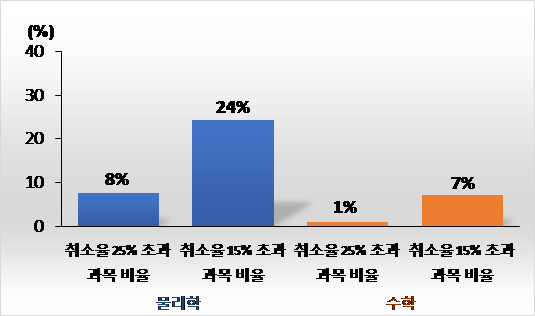
▲ Cancellation of Course Registration for Physics During Recent 5 Years
Students that lack in physics and other basic sciences often find it challenging to keep up with their major courses to end up losing interest in the major itself. Of all the physics courses opened in SNU during the last 5 years, the percentage of physics courses with course cancellation rate that exceeds 15% is 24%. This is 3 times greater than math which records 7%. The percentages of courses with course cancellation rate that exceeds 25% for physics and math are respectively 8% and 1%, which is an even greater gap. In addition, there are also cases where students give up their engineering route due to the sudden increase in the level of difficulty of college physics. Some even make up the lecture during summer or winter sessions or at upper grade levels just to satisfy their graduation requirements.
SNU College of Engineering tackles this issue by calling the curriculum committee to amend the course track to require students who have not taken Physics II in high school to take “Introduction to Physics” instead of “Physics” in the first year. Students who have taken Physics II are allowed to take “Physics” and students of schools providing advanced curriculum are eligible to take “Advanced Physics” after evaluation test.
Professor Kang Hyungu, the Director of SNU Innovation Center for Engineering Education, states, “Basic science education is essential for undergraduates. We are planning to provide fundamental courses of different levels with the Faculty of Liberal Education to rear talented individuals in math and physics for the 4th Industrial Revolution.”
College of Engineering Dean Cha Kook-Heon comments, “Computer-related knowledge is also important for the 4th Industrial Revolution. We are also preparing to introduce new courses on Internet of Things (IoT), Artificial Intelligence (AI), and Big Data for not only college of engineering students but also students in colleges of humanities and social sciences.