loaction
SNU Professor Thomas Kang Receives Royalty from a Leading Company in Post-Tension through Patent and Technology Transfer
-
작성자
관리자
-
등록일
2018.07.30
-
조회수
1,555
SNU Professor Thomas Kang Receives Royalty from a Leading Company in Post-Tension through Patent and Technology Transfer
- Signs Global License with World Class Company in Post-Tension
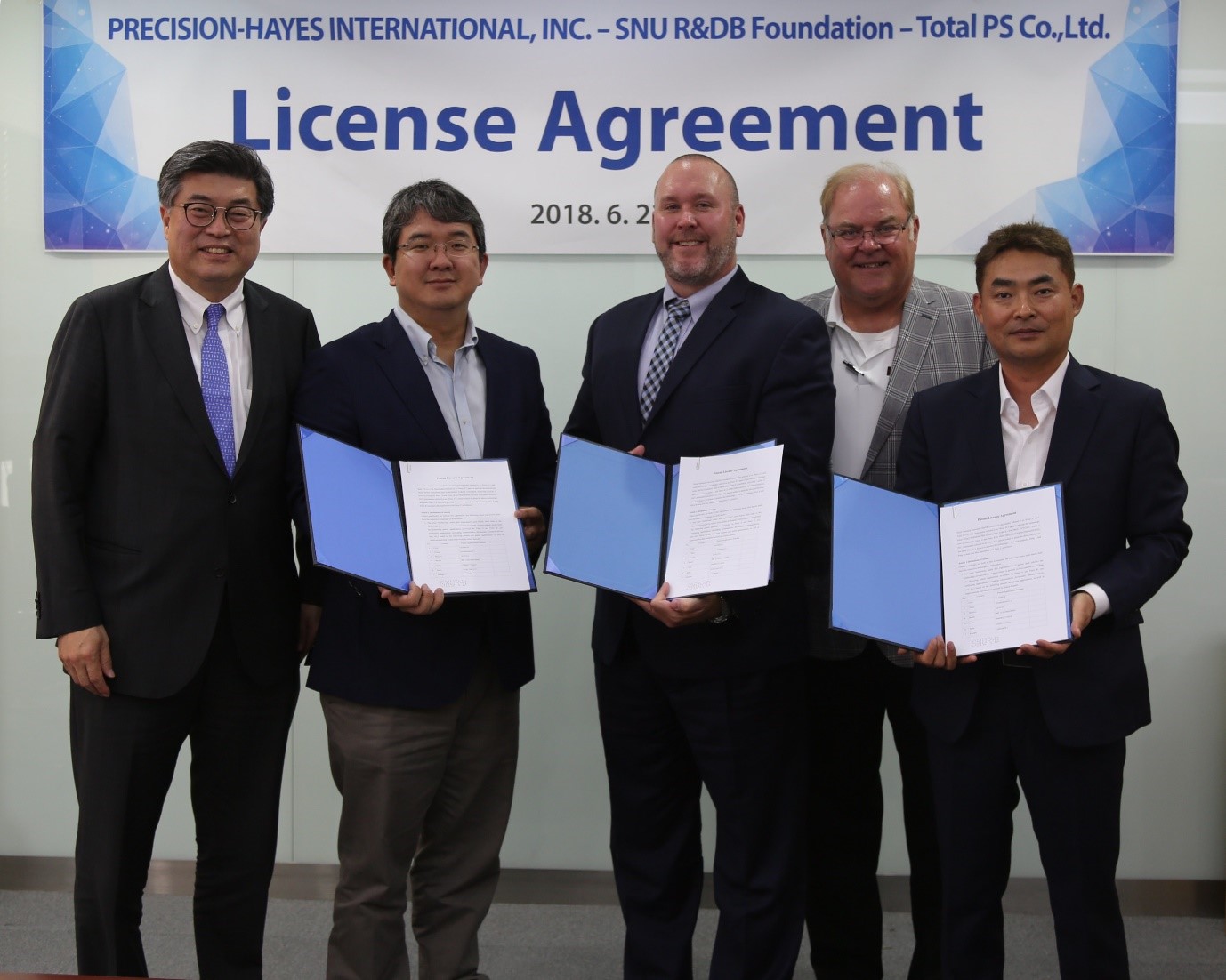
▲ Professor Kang After Signing License Agreement with Precision-Hayes International (Second from Left)
SNU College of Engineering (Dean Cha Kook-Heon) announced on 9th that Professor Thomas Kang from the Department of Architecture and Architectural Engineering has signed a license agreement with Precision-Hayes International, a leading post-tension company.
Precision-Hayes International is an American company committed to the field of post-tension. This technology transfer (TT) agreement covers all equipment, construction, service and software on this corresponding technology of Precision-Hayes International and its holding and affiliated companies. However, for the protection of Korean industries, Korea was excluded from this contract.
Post-tensioning is a construction method to reinforce concrete used in complex structures like buildings with few interior columns, mushroom buildings with thin floor-slabs, long span bridges, cable-stayed bridges with large gap between columns, and observatories built far out from canon. In addition, it is also needed in constructing nuclear hangar, storage tank, anchor sheathing, or any work that requires strong hold and stressing. Since the late 20th century, the demand of structures requiring post-tensioning has increased exponentially and now it is almost always applied in all construction sites of long span bridges, cable-stayed bridges, and nuclear hangars.
Conventional post-tensioning lacked in managing the pulling of individual cables. Thus, the stretched cables had to be physically measured and recorded after the pulling job. It is Professor Kang’s team who has tackled and resolved this problem.
The smart post-tensioning is a 4th Industrial Revolution method that has minimized unnecessary processes to maximize the efficiency of conventional post tensioning. Its reliability has largely increased through the raise of its economic feasibility while guaranteeing an accurate measurement and detailed management. Another strength, in these days when legal disputes are frequently heat up, is that this technique can clarify the cause of construction defects and flaws.
This technology has been selected as one of National Academy Engineering of Korea (NAEK)’s “Top 100 Future Technology” of 2018 to already be applied in numerous Korea’s construction fields. Professor Kang has also submitted patent application for this technique, which is under joint ownership with a new SME (small and medium-sized enterprise) Total PS, to US, Europe, China, India, Brazil, Australia, UAE, Mexico, and etc. The patent registration in Korea has been completed in 2016.
Professor Kang comments, “It is of paramount importance to possess source technologies in all industrial fields. It will be a great honor as an engineer for me if this technique that I developed is to be applied in all post-tensioning processes. I will devote to the further development of new technology.”
Dean Cha Kook-Heon states, “This contract with a leading American company is a demonstration that our technological prowess is being recognized. SNU College of Engineering professors including Professor Kang will strive to develop new global patents to sturdy Korea’s foundation for researches.”