loaction
AIRS Medical Founded by Graduate Students of SNU College of Engineering Significantly Reduces MRI Screen Time
-
작성자
관리자
-
등록일
2018.10.16
-
조회수
1,520
AIRS Medical Founded by Graduate Students of SNU College of Engineering Significantly Reduces MRI Screen Time
- Reduces Inconvenience for Patients and Enhances Profitability for Hospitals
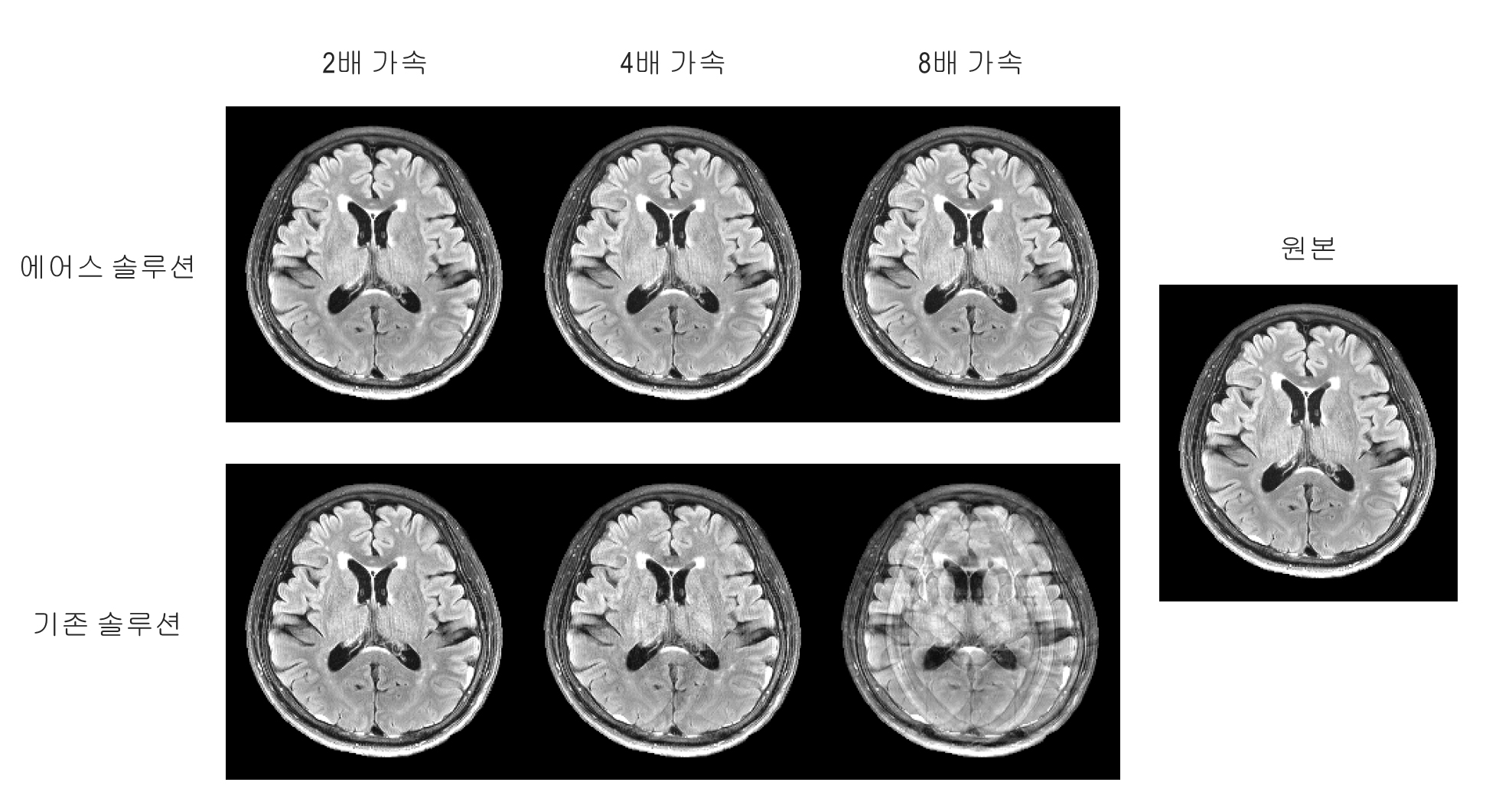
▲ Comparison of MRI Scan Results of Conventional and AIRS Medical MRI
Graduate students of SNU College of Engineering have developed a technology that can significantly reduce the scan time of magnetic resonance imaging (MRI). This new technology can be immediately applied to current MRI machines.
SNU College of Engineering (Dean Cha Kook-Heon) announces on 8th that AIRS Medical (CEO Ko Jingyu) founded by the students of the Laboratory for Imaging Science and Technology (LIST, Professor Lee Jongho) under the Department of Electrical and Computer Engineering has integrated AI (artificial intelligence) technology to cut the MRI screen time to 1/4 without any degradation in image resolution.
The recent report of the Ministry of Health and Welfare extends the health insurance plan to cover MRI tests. As a result, the pressure of medical expenses on patients has largely decreased, but hospitals have been forced a heavy burden. This AI technology developed by AIRS Medical is the solution to this new issue.
AIRS Medical allows a real-time, high-speed image reconstruction through applying AI into the conventional reconstruction technique that is based on a mathematical modeling. While conventional scans are prone to serious distortions when the screen time is sped up to 4 or 8 times, the new technology of AIRS Medical maintains the resolution of original video despite fast forwarding.
Although MRI is an essential machine in diagnostic procedures, patients have to endure inconvenience due to its long scan time. Patients are trapped motionless for 30~40 minutes in a closed, narrow space as any movement of the body asks for a rescan. Also, MRI are restrictively operated due to its high expense, which contrasts with its relatively high demand, and there are patients on pending of 2~3 weeks for their turn.
The application of the new technology is anticipated to reduce such inconveniences that patients undergo. Reducing the screen time to 10 minutes shortens patients’ waiting time, which ultimately also secures the profitability of hospitals.
Professor Jang Jin-Hee from the radiology department of Seoul St. Mary’s Hospital comments, “Using this technique, hospitals can provide faster and more accurate medical imaging services to their patients. This solution assures hospitals’ providence of high quality, flexible MRI scans.”
Meanwhile, the product that embeds this technology of AIRS Medical will begin its marketing at next year’s meeting of International Society for Magnetic Resonance in Medicine (ISMRM) hosted in Montreal, Canada after completing its trial services at Seoul National University Hospital (SNUH).

▲ Logo of AIRS Medical