loaction
SNU-Sungkyunkwan U Joint Research Team Unravels the Origin of the Instability of Quantum Dot Light-Emitting Diodes
-
작성자
관리자
-
등록일
2018.11.09
-
조회수
729
SNU-Sungkyunkwan U Joint Research Team Unravels the Origin of the Instability of Quantum Dot Light-Emitting Diodes
Injection Influences Not Only the Luminous Efficacy, but Also the Operational Stability

▲ (From Left to Right) SNU Ph.D. Candidate Chang Jun Hyuk, SNU Department of Chemical and Biological Engineering Professor Char Kookheon, SKKU Nano Science & Technology Professor Bae Wan Ki
SNU College of Engineering (Dean Char Kookheon) announces on 25th that the joint research team of SNU-Sungkyunkwan U (Lead Author Chang Jun Hyuk, SNU Ph.D. Candidate; Corresponding Authors Char Kookheon, SNU Professor, and Bae Wan Ki, SKKU Professor) has unraveled the reason for the degradation of quantum dot based light-emitting diodes (LED).
The quantum dot LED is a light-emitting diode (LED) that uses its quantum dot as its emitting layer. It is looked upon as the next generation LED after the OLED for it can be solution-processed and has a high luminous efficacy and color purity.
However, prior to the practical use of this quantum dot LED, its short lifetime must be resolved. Majority of the research conducted currently focuses on enhancing the luminous efficicacy of the quantum LED and little research has been done on its operational stability. This is probably due to the complexity of quantum dot LED’s degradation process, which is known as the cause of its instability.
The team combats this tricky degradation process by analyzing its causes via spectroscopic and electrical means. First, the electrical properties have been examined by operating the quantum dot LED. Then, the emitting layer of the quantum LED has been inspected using spectroscopic devices.
Consequently, the team has discovered two main reasons for the degradation of the quantum dot LED. At early stage, the efficacies of the diode and the emitting layer deteriorate at almost an equal rate. This is due to the additional electrons that accumulate on the emitting layer to lower the luminous efficacy.
The initial degradation occurs at a steep rate, but the luminous efficacy of the emitting layer recovers when a counter potential is applied to remove the piling electrons. However, at later degradation, while the efficacy of the diode decrease, almost no decline can be spotted at the emitting layer.
This observation hypothesizes that the degradation of the diode happens not at the quantum dot but another layer. A follow-up test to investigate the change of the organic hole transport before and after operation has been conducted to finally unravel the cause of this complex degradation. That is, firstly the later degradation of the diode occurs at a slow rate and secondly it refuses to recover with the counter potential. Although the two reasons have different rates and reversibility, they come toward a single final reason: the insertion of additional electrons is the ultimate cause of quantum dot LED degradation.
Professor Bae Wan Ki states, “We have confirmed that the electron and hole injections not only affect the efficacy of quantum dot LED, but also its stability. An enhancement of the injections can definitely raise the efficiency of the diode.”
This research has been conducted with the support of the Individual Basic Science & Engineering Research Program and the Nano-Material Fundamental Technology Development Program of the National Research Foundation of Korea (NRF) and the Core Material Fundamental Technology Development Program of the Ministry of Trade, Industry, and Energy. The research findings have been published on an international journal called ACS Nano on October 10th.
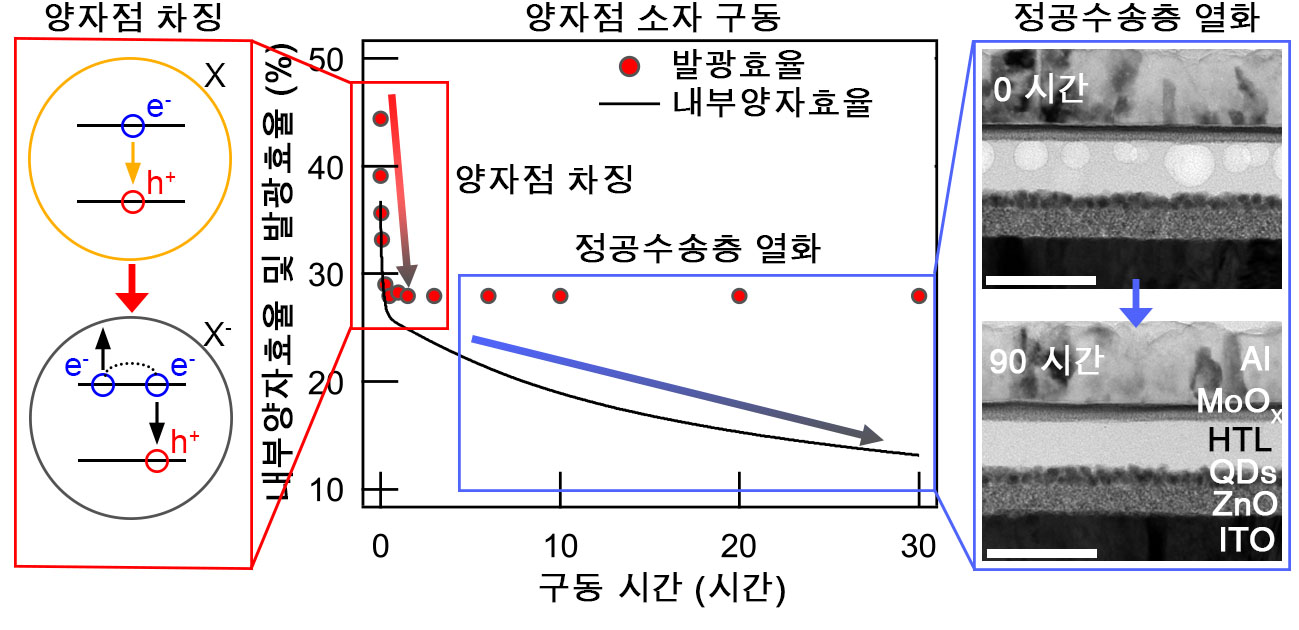
▲ Degradation Process of Quantum Dot LED’s Electrical Characteristics Caused by Degradation of Hole Transport Layer and Charge Accumulation at Emitting Layer Due to Imbalanced Injection