loaction
Research Team Led by SNU Professor Byung-Gon Chun Develops a Fast and Flexible Deep Learning System “JANUS”
-
작성자
관리자
-
등록일
2019.01.24
-
조회수
808
Research Team Led by SNU Professor Byung-Gon Chun Develops a Fast and Flexible Deep Learning System “JANUS”
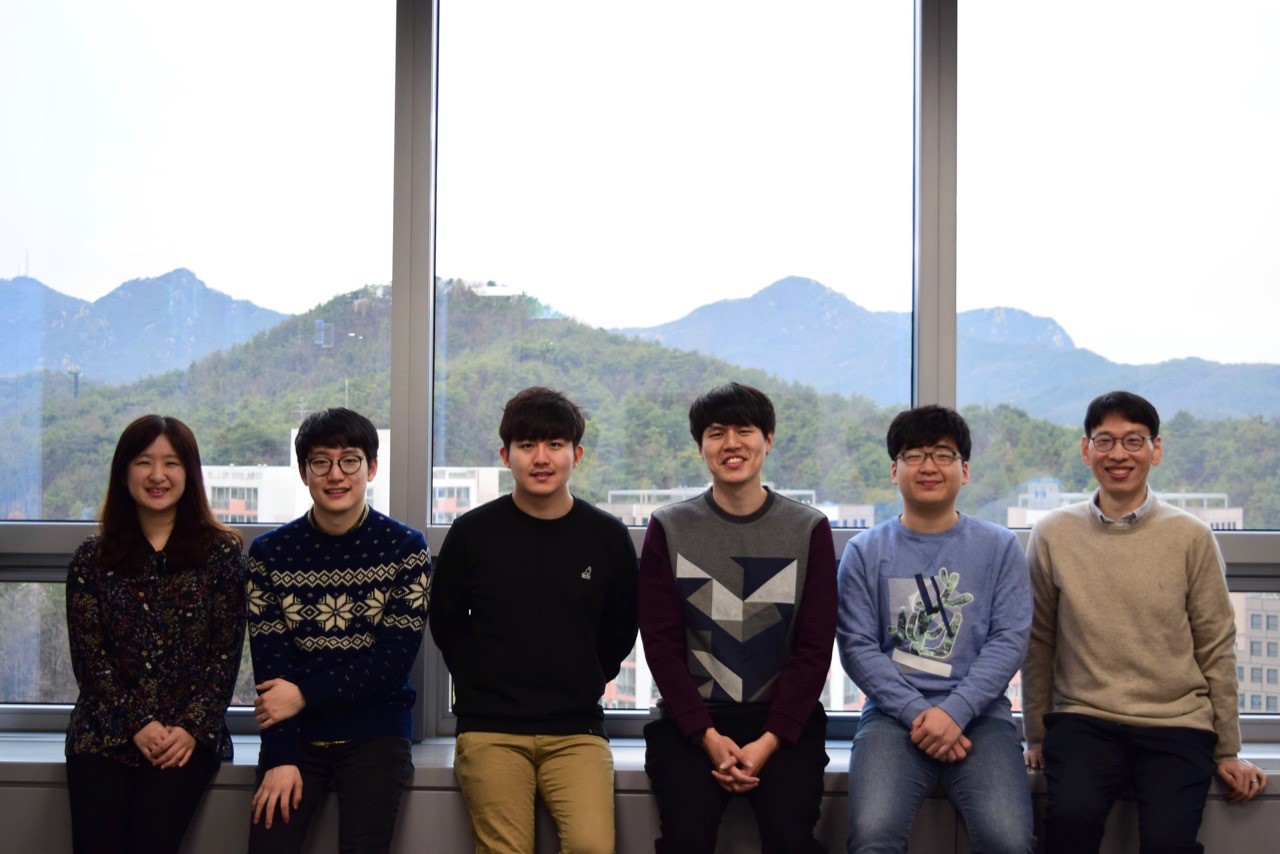
▲ (From Left to Right) Eunji Jeong (Ph.D.), Sungwoo Cho (M.S.), Gyeongin Yu (Ph.D.), Joo Seong Jeong (Ph.D.), Dong-Jin Shin (M.S.), and Professor Byung-Gon Chun of the Department of Computer Science and Engineering
SNU College of Engineering announced on 18th that research team led by Professor Byung-Gon Chun of the Department of Computer Science and Engineering has developed a new system called “JANUS” that can easily and quickly create deep learning models.
Deep Learning is currently considered one of the core technologies of the Fourth Industrial Revolution. Deep learning systems express, learn and infer models according to the demand of the developer. Conventional deep learning systems specialized in either simplifying and expressing models or learning models at a fast speed.
Symbolic graph system, mainly represented by the TensorFlow, can learn a model of fixed structure at a fast pace but lacks in expressing models of various structures. Oppositely, the imperative system, represented by the PyTorch, easily create various models but requires a long time to learn them.
Hence, the research team overcame such limitations of the conventional systems suggesting their JANUS system, which both expresses new models flexibly and learns them quickly. While the JANUS maintains the simple programming models like conventional imperative systems, it internally auto-converts imperative programs to symbolic graphs for optimization.
The result was that JANUS learned 48 times faster than conventional imperative systems to near the performance of symbolic graph systems. This finding precedes those of Google, Facebook, and Amazon.
The team explained, “We developed a new system that combines only the strengths of conventional deep learning systems based on TensorFlow or PyTorch. JANUS, which easily and quickly applies deep learning technologies, will contribute to the technological development of the Fourth Industrial Revolution, specifically in image processing, speaker recognition, automatic driving, etc.”
The research findings will be presented at the NSDI (USENIX Symposium on Networked Systems Design and Implementation), one of the leading symposiums on the field, hosted at Boston coming February.
[Reference]
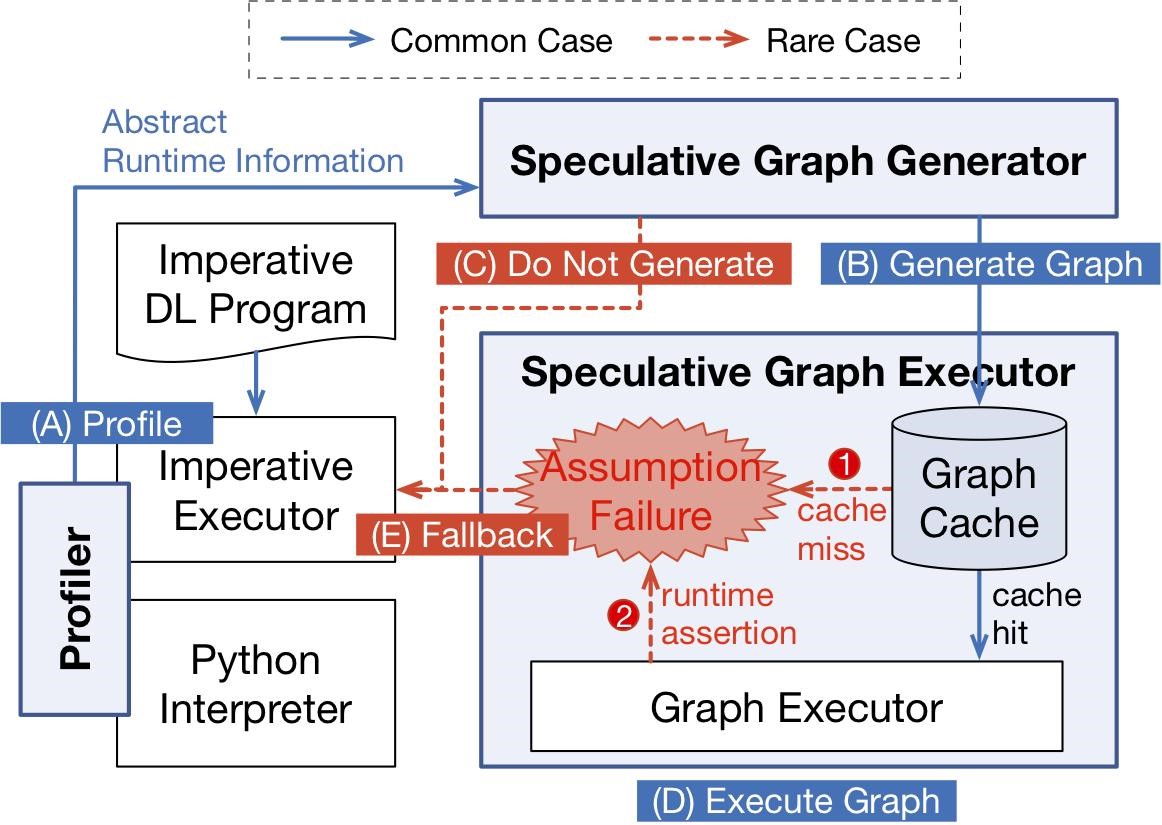
▲Entire System Structure of JANUS
Information on the characteristics of the program are gathered at the profiler to be made into effective symbolic graphs. When the characteristics of the program change whilst processing, the original imperative program is again operated to guarantee accuracy.