loaction
SNU-KAIST Joint Research Team Developed Machine Learning Based Intention Prediction Technology for Wearable Robotic Gloves
-
작성자
관리자
-
등록일
2019.03.19
-
조회수
1,182
SNU-KAIST Joint Research Team Developed Machine Learning Based Intention Prediction Technology for Wearable Robotic Gloves
- Published as Focus Article of Science Robotics
▲ Credit: (Human Centered) Soft Robotics Research Center
SNU College of Engineering announced on 31st that the joint research team under Professor Kyu-Jin Cho of the Department of Mechanical and Aerospace Engineering (also the Head of the Soft Robotics Research Center) and Professor Sungho Jo of KAIST (Korea Advanced Institute of Science and Technology) has developed a new intention prediction model for wearable robotic gloves using deep learning. The joint research team is composed of co-first authors Daekyum Kim (KAIST) and Byunghyun Kang (SNU), co-authors Jeesoo Ha (KAIST), Hyungmin Choi (SNU) and Kyu Bum Kim (SNU), co-corresponding authors Professor Cho and Professor Jo, and designer Jong-Ryul Song.
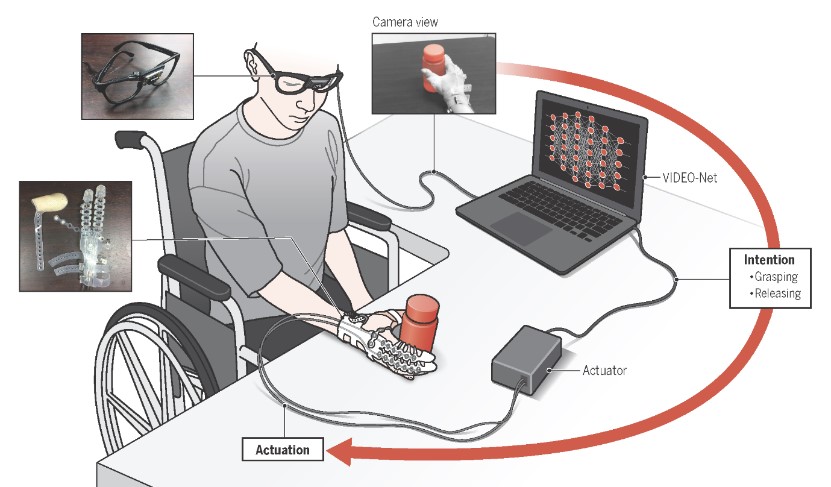
The “X-glove” previously created by the team is a wearable robotic glove that helps those with hand disabilities. This research moved away from the conventional user intention measurement method using bio-signal and sensors to comprehend the user’s intention to grab a certain object with just machine learning and a camera.
The team suggested a deep learning model called “Videonet” that predicts the intentions of users by analyzing behavioral patterns. The “Videonet,” which figures user’s intension through the camera attached to glasses, consists of space information that identifies the relationship between the hands of people with spinal cord injury and the object and time information that identifies the movement of arm. As human and robot synchronize like a single object, the user does not have to press a separate button to communicate his or her intention to the wearable robotic glove.
Professor Cho stated, “So far, there has not been any soft wearable robots that include a technology that analyzes the user’s intentions. With this technology, those with hand disability due to spinal cord injury can eat and drink at a café independently without any help.”
The research findings have been acknowledged internationally to be published as the focus article of Science Robotics.
[Reference]
- Video: https://youtu.be/Bif0RTdRKDw
https://www.dropbox.com/sh/b64i5mqcrok4mbs/AADB80FWRoAG3fCRe6kr0UtXa?dl=0 )
- Article: https://www.dropbox.com/s/wh5487h1kxg27t7/Eyes%20are%20faster%20than%20hands.pdf?dl=0
- Photo: https://www.dropbox.com/sh/c4wy4l929yh6ywb/AADDWUCQvCVwL3A2rQuQVDm5a?dl=0
- Link to News in English: https://www.dropbox.com/s/eg0p5ofewowcw2n/Press%20Release-EGP%20ML%20%281%29.docx?dl=0
Professor Kyu-Jin Cho
Head of Soft Robotics Research Center
Cho received the IEEE RAS Early Career in 2014 for his achievements in the field of soft robotics and biomimetic robotics design. He developed the “robotic water strider,” which was introduced on Science in 2015. In 2016, Cho was applauded for developing the “Exo-Glove Poly,” a soft robotic glove for the disabled, uncased at the American Association for the Advancement of Science (AAAS). In April of the same year, the “SNUMAX” won the Soft Robot Challenge hosted at Pisa, Italy.
Professor Sungho Jo
1999, Bachelor of Engineering at Department of Mechanical Engineering, SNU
2001, Master of Engineering at Department of Mechanical Engineering, MIT
2006, Doctor of Engineering at Department of Electrical Engineering and Computer Engineering, MIT
2008~Present, Associate Professor at KAIST
Jo majors in robotics, brain-machine interface, and intelligence system.