loaction
Research Team Led by SNU Professor Yongtaek Hong Develops a Technology that Builds Tailored Wearable Devices to Kickstart the “DIY Wearable Generation”
-
작성자
관리자
-
등록일
2019.04.09
-
조회수
1,027
Research Team Led by SNU Professor Yongtaek Hong Develops a Technology that Builds Tailored Wearable Devices to Kickstart the “DIY Wearable Generation”

▲ SNU Department of Electrical and Computer Engineering Research Team Led by Professor Yongtaek Hong: (From Left to Right) Professor Hong, Ph.D. Candidate Jaeyoung Yoon, Doctor Yunsik Joo, and Doctor Junghwan Byun
Korean researchers developed a core technology that allow users to build tailored wearable devices.
SNU College of Engineering (Dean Kookheon Char) announced on 12th that the research team led by Professor Yongtaek Hong of the Department of Electrical and Computer Engineering, consisting of Ph.D. Candidate Jaeyoung Yoon and Doctor Junghwan Byun, has developed a technology that assembles Soft Modular Electronic Blocks (SMEBs) to construct high-performance, body-attached wearables.
Wearable device, which attaches to the body to detect movement of muscles and joints, had always depended on electrodes placed on a flexible circuit board that maintain their function despite bodily movements. However, as the structure and size of body vary by gender and race, this method faced technological limitation as an entirely new system that suits the user had to be redesigned every time.
Hence, the research team developed a technology that allows the user to self-modify the size and position of sensors and electrodes to fit his or her body part. The technology involves the development of SMEBs that are modularized to signal processing circuit, LED display, highly-sensitive sensor, stretchable electrode, etc.
For the flexible circuit block, the team printed silver electrodes onto a plastic circuit board through inkjet printing and added semiconductors and LED. They finished the block by implementing a bending sensor on a flexible circuit board to detect joint movements.
In addition, they also created other flexible modularized blocks including the signal processing circuit block, display block, bending sensor block, and stretchable electrode block. Thus, they introduced their method using the blocks and adhesion technique via oxygen plasma etching to assemble an entire wearable device within few minutes. These devices can be used by various users regardless of their joint position and hand size. The team’s device demonstrated higher precision and performance in joint movement detection compared to conventional devices.
Professor Hong stated, “This research was launched as an attempt to overcome the limitation of conventional body-attached devices – that is, an entire system had to be designed and built for every individual with different body ratio and size. This tailored device will open a new generation of DIY (Do It Yourself) wearable technology.”
The research findings were not only published online on the prestigious Advanced Science but was also selected as its cover image. This research was conducted with the support of Center for Advanced Soft Electronics and the Soft Robotics Research Center.
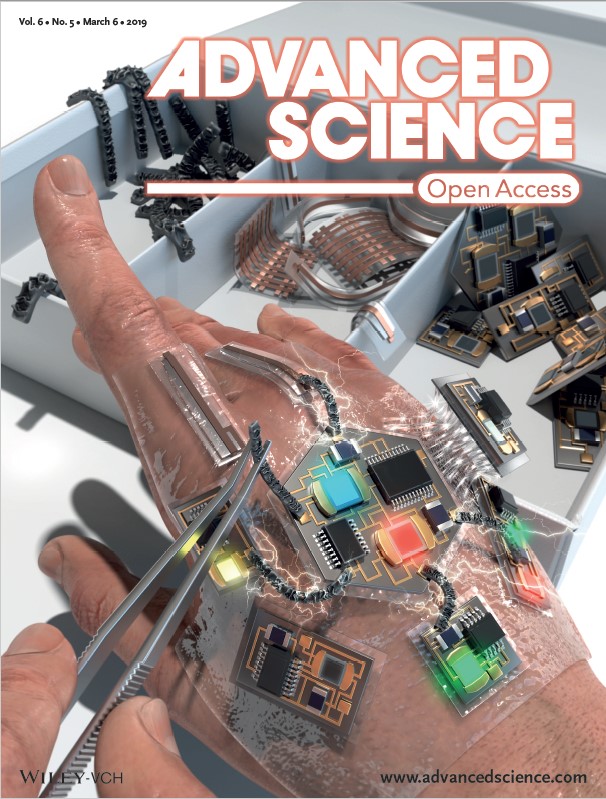
▲ Cover Page of Advanced Science
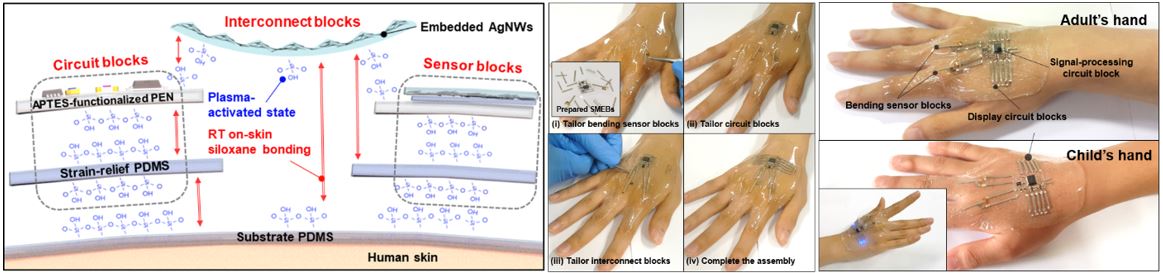
▲ (From Left to Right) Cross-sectional Diagram of SMEB Modularized via Oxygen Plasma Etching / Steps to Build Device with Prepared Modularized Blocks on an Actual Hand / Body-attached Device Worn on Different Sized Hands