loaction
SNU Professor Yongtaek Hong's Team Develops Thermal Electric Devices 'Attached to the Skin' that Generate Electricity Only from Body Temperature
-
작성자
관리자
-
등록일
2021.01.15
-
조회수
951
SNU Professor Yongtaek Hong's Team Develops Thermal Electric Devices 'Attached to the Skin' that Generate Electricity Only from Body Temperature
- "Expected to accelerate the commercialization of battery-free self-powered wearable devices."
- Possibility of mass production of 'Green Energy Harvesting Devices', marketability ↑

▲ Professor Yongtaek Hong‘s Team of the SNU Department of Electrical and Computer Engineering:
(From Left) Professor Yongtaek Hong, Dr. Byeongmoon Lee, Researcher Hyeon Cho
- Possibility of mass production of 'Green Energy Harvesting Devices', marketability ↑
▲ Professor Yongtaek Hong‘s Team of the SNU Department of Electrical and Computer Engineering:
(From Left) Professor Yongtaek Hong, Dr. Byeongmoon Lee, Researcher Hyeon Cho
"Energy Harvesting", a technology that is very closely attached to human skin to self-generate energy using body temperature, has been developed by domestic researchers. It is a key technology that can be used in many ways, such as in operating wearable devices without batteries.
SNU College of Engineering (Dean Kookheon Char) announced on December 1 that Professor Yongtaek Hong's research team (Dr. Byeongmoon Lee, Researcher Hyeon Cho) of the Department of Electrical and Computer Engineering, has developed a flexible thermoelectric device with high power generation performance, known for being the next-generation energy harvesting device for their maximum flexibility and heat transfer efficiency through joint research with Dr. Seungjun Chung of the Soft Convergence Material Research Center at the Korea Institute of Science and Technology (KIST). In particular, the research team is expected to serve as a catalyst for research on self-generated wearable electronics that produce and operate their own energy by enabling large-area thermoelectric device manufacturing and mass production through automated processes including printing processes.
Thermoelectric devices are energy conversion devices that utilize voltages generated by temperature differences on both ends of materials, and are considered to be eco-friendly energy harvesting devices in that they convert discarded heat energy into electrical energy that can be utilized in real life. Recently, flexible thermoelectric devices have been actively reported for their conversion of waste heat from various forms of heat sources into electrical energy. When these flexible thermoelectric devices are attached to the skin, body temperature alone can operate wearable devices without batteries.
However, in the case of flexible substrates, which are mainly used for flexible thermoelectric devices, the thermal conductivity is so low that heat energy cannot be efficiently transferred to thermal materials, and the flexibility is limited due to the use of hard and thick metal electrodes. To address this, the development of highly flexible organic material-based thermoelectric materials is actively being investigated, but due to their remarkably low performance compared to conventional inorganic-based thermoelectric materials, it has been difficult to apply them to real wearable devices.
The research team maximized the flexibility of thermoelectric devices by connecting high-performance inorganic thermal materials with flexible electrodes. The flexible electrode, which consists of a combination of silver nanowires and flexible substrate materials, has a low Young's Modulus, similar to that of rubber, and maintains a high electrical conductivity even if pulled or crumpled, helping the thermoelectric device to operate reliably even in bending or folding environments.
In addition, the team improved the heat transfer capability of flexible substrates by 800% by using a composite material that optionally formed a heat transfer path. This improved heat transfer capability allowed the efficient transfer of heat energy to thermal materials, and the use of soft heat conductors developed in this study alone produced more than three times as much power.
As a result, thermoelectric elements of the research team, which not only perfectly adhere to the skin but also minimize the loss of thermal energy, showed the world's best power generation efficiency using body temperature.
"This study is meaningful in that it has developed a practical and flexible thermoelectric device that can operate actual wearable devices by simultaneously increasing flexibility and thermal efficiency," said Professor Hong. "It will greatly contribute to popularizing battery-free self-generated wearable devices, securing marketability in the future," he added.
The study was published online on November 23 in the international journal Nature Communications. The research was conducted with support from KIST's major projects and Future Material Discovery Projects of the Ministry of Science and ICT (Minister Kiyoung Choi), Creative Convergence Research Projects, Research and Development Support Projects of the Korea Electronics and Telecommunications Research Institute as well as from Global Frontiers.
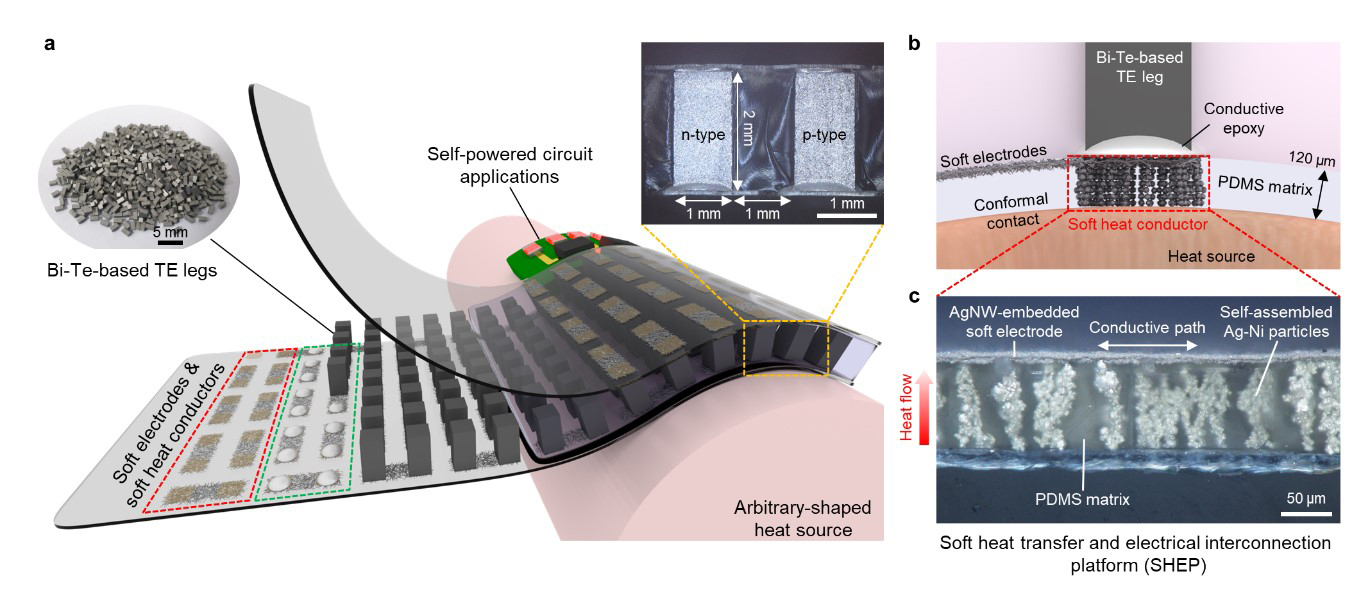
▲ Picture 1: (a) Schematic diagram of a highly flexible, high-performance thermoelectric device (b) Schematic diagram of a soft electrode platform with excellent heat transfer abilities (c) Metal particles arranged within the soft platform forming a heat transfer path
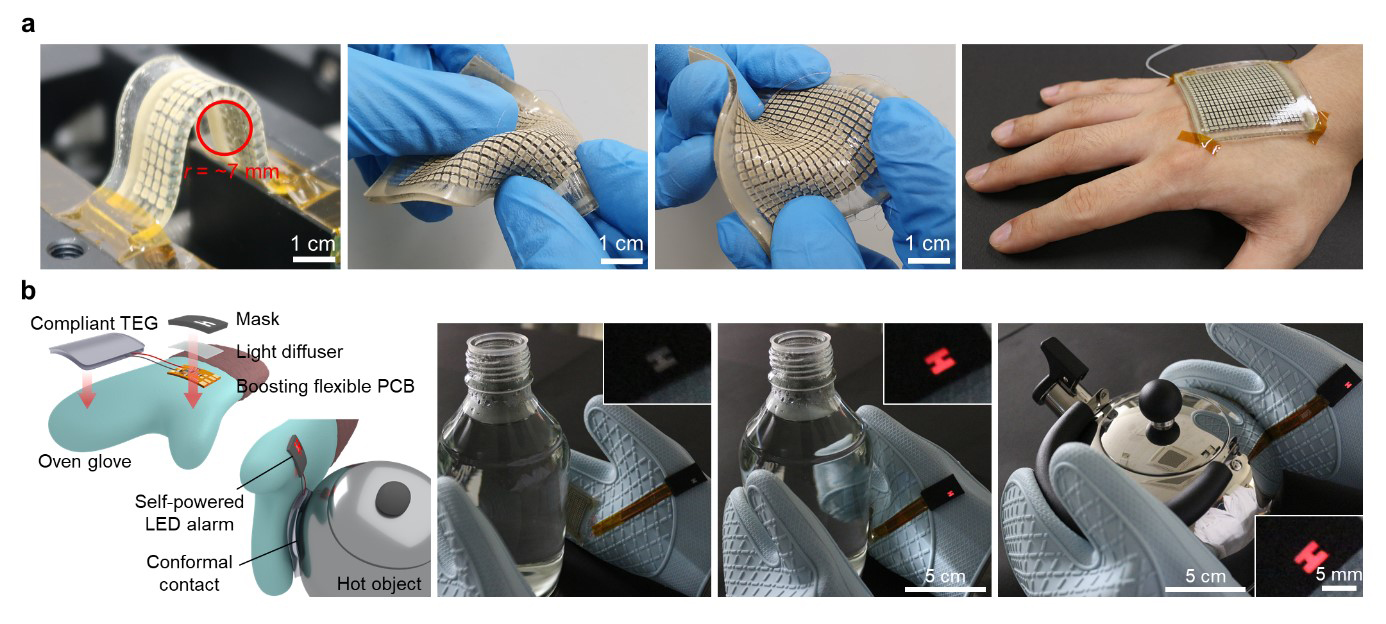
▲ Picture 2: (a) Appearance of highly flexible thermoelectric elements that can be freely transformed in shape (b) A self-powered glove that warns of hot objects by connecting flexible thermoelectric elements with light emitting elements