loaction
Professor Namkyoo Park’s Team Identifies the Fundamental Principles of 'Disorder' Used for Optical Devices that is to be the Core of Future Materials Industry
-
작성자
관리자
-
등록일
2021.01.27
-
조회수
978
Professor Namkyoo Park’s Team Identifies the Fundamental Principles of 'Disorder' Used for Optical Devices that is to be the Core of Future Materials Industry
- The review paper was published in the world-renown journal 'Nature Review Materials'
- They have proven that the designed disorder of wave mechanics independently controls the characteristics of light

▲(From left) Professor Namkyoo Park, Professor Sunkyu Yu of the SNU Department of Electrical and Computer Engineering
Professor Namkyoo Park's team of the SNU College of Engineering bring research results that have proven to have opened a new field of optical and material science research and illuminate its value as a key source technology for the future material industry.
SNU College of Engineering (Dean Kookheon Char) announced on December 17 that Professor Namkyoo Park and Sunkyu Yu's research team of the Department of Electrical and Computer Engineering succeeded in establishing the concept of "designed disorder" in wave mechanics and have identified the operating principles of various optical phenomena and devices. This research is a study demonstrating that artificially designed disorder can independently control multiple features of light.
Invited by the most renowned journal in the field of physics, material science and chemistry - Nature Reviews Materials - this study is the result of Professor Namkyoo Park and Sunkyu Yu's collaboration with world-class researchers. The research results were published on December 9 as an invitation review paper.
The question of how atoms are arranged is an important factor that determines the various properties of a medium. For example, an orderly medium that is periodically arranged is called a crystal structure, and it has unique properties, such as being the standard for classifying conductors, semiconductors and non-conductors according to its crystal structure, or as a mirror reflecting light in all directions.
On the other hand, a completely disordered medium standing at the counterpoint clearly distinguishes itself from the crystal structure as it gathers light into a specific area or shows beautiful colors of wide viewing angles like butterfly wings. The study regarding complete order and disorder demonstrate their importance as subjects of study by their receiving of Nobel Prizes in Physics in 1915 and 1977, respectively.
Meanwhile, between complete order and disorder, there exists an 'intermediate domain' which has infinite number of degrees of freedom (Figure 1). These intermediate domains do not simply show intermediate characteristics that are in between complete order and disorder, and are the basis of future material development by enriching the freedom of any medium to have characteristics, such as having only their specific wave characteristics, selectively. The importance of intermediate domains has already been demonstrated in network science and to provide an example, the structural characteristics of social networks or brains have evolutionarily controlled disorder characteristics that are neither completely orderly nor completely disorderly.
The utilization of the intermediate domain between complete order and disorder is a major research topic in recent physics and material science. In particular, the exploration of the domain's core principles is actively undertaken worldwide to simultaneously control the various physical properties of light, and efforts continue to be made to "design" certain disorderly states, especially by introducing engineering design techniques. However, intermediate domain disorder states are considered to be difficult to define or strictly quantify, and because of the variety in possible degrees of freedom, design techniques were not intuitive, making them difficult to utilize.
This review paper has SNU researchers at its center (Corresponding author: Professor Namkyoo Park, First author: Professor Sunkyu Yu) and was published through their collaboration with Professor Salvatore Torquato of Princeton University, a world-renown scholarly body in the field of material science (Co-corresponding author: Salvatore Torquato), and Professor Cheng-Wei Qiu of the National University of Singapore and Professor Yidong Chong of Singapore's Nanyang Technology Institute.
SNU researchers have been actively conducting research on independent control and disorderly optics of waves using meta-materials, and have emerged as a global research hub in the field of disorderly optics.
Professor Namkyoo Park who took lead in the review paper's topic and direction said, "This review paper is significant in that domestic researchers have led the research as corresponding authors and first authors to identify key principles in the emerging fields of wave dynamics and optical research to explore their applicability. This achievement signifies that domestic optical research is being recognized worldwide. In particular, the understanding of disorder is valuable as a core source technology of future materials industry in that it opens a new field of optical and material science research using artificial intelligence, as shown in other recent research results."
"Disorder is a platform that can independently control the characteristics of light such as momentum, energy, and polarization that is extremely diverse, and at the same time difficult to handle. Recently, research has been actively conducted around the world, and the introduction of a multidisciplinary perspective will surely open up new possibilities in the designing of medium," said Professor Sunkyu Yu, the first author of the paper.
This study was conducted with the support of the Global Frontier Project (GFP) of the Ministry of Science and ICT and the Post-Doc. Fellowship Task (PPD) project of the Ministry of Education.
[Photo Material]
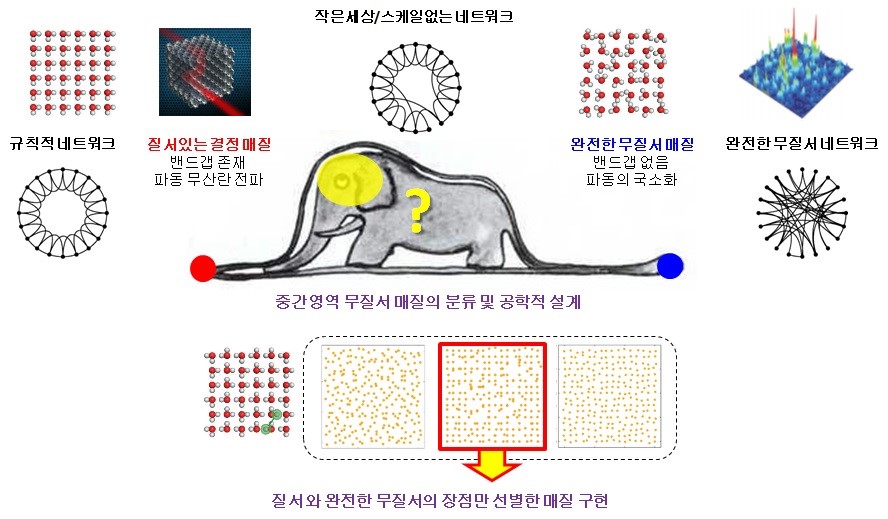
[Picture 1] Order (Red dot, boa constrictor’s tail) and complete disorder (Blue dot, boa constrictor’s head 머리) refers to medium that are strictly defined physically and statistically. In the middle domain (inside the boa constrictor’s stomach), there exists a gray area (the elephant) with many degrees of freedom. The goal of disorderly optics is to classify these intermediate domains and to functionally identify "smart" mediums (the elephant’s head) and implement several engineering functions. To this end, physical concepts such as electronics and quantum mechanics, and techniques such as network theory and machine learning are being actively used.
[Explanation of Terminology]
1. Nature Reviews Materials
A world-renowned international journal in the fields of physics, material science and chemistry, publishing only invited review papers (Impact Factor : 71.189)
2. Metamaterial
It refers to material that is designed to have characteristics that do not exist in the natural world through the arrangement structure of an artificial medium. It is applied to concepts like invisible cloaks.