loaction
SNU Professor Tae-Woo Lee Develops the World's Highest-Efficiency Perovskite Light-Emitting Diode
-
작성자
관리자
-
등록일
2021.02.22
-
조회수
1,431
SNU Professor Tae-Woo Lee Develops the World's Highest-Efficiency Perovskite Light-Emitting Diode
- Development of the composition and defect control methods for next-generation 'ultra-high-definition display' materials
- Research results published in <Nature Photonics>, the world renown international journal

▲ (From left) SNU Professor Tae-Woo Lee, Professor Andrew M. Rappe of the University of Pennsylvania in the U.S, Dr. Young-Hoon Kim of Seoul National University, Seoul National University student Sungjin Kim, Dr. Arvin Kakekhani of the University of Pennsylvania. This joint research team developed the world's highest efficiency perovskite light-emitting diode
- Research results published in <Nature Photonics>, the world renown international journal
▲ (From left) SNU Professor Tae-Woo Lee, Professor Andrew M. Rappe of the University of Pennsylvania in the U.S, Dr. Young-Hoon Kim of Seoul National University, Seoul National University student Sungjin Kim, Dr. Arvin Kakekhani of the University of Pennsylvania. This joint research team developed the world's highest efficiency perovskite light-emitting diode
Professor Tae-Woo Lee of the Department of Materials Science and Engineering,Hybrid Materials at the Seoul National University College of Engineering and Professor Andrew. M. Rappe of the University of Pennsylvania in the U.S. had their joint research team develop the world's highest efficiency light-emitting device using the metal halide perovskite. The research results were published in the world renown journal <Nature Photonics> on January 4.
Perovskite light-emitting device consists of organic elements, metals and halogen elements. Along with having excellent color purity and being low in its material costs, it also has the advantage of being easily adjustable in its colors. Since Professor Tae-Woo Lee's development of the world's first visible light field multicolored light emitting diode at room temperature in 2014, the perovskite light-emitting device has received the spotlight for being the next-generation display material to replace quantum dots and organic light emitting bodies that are currently used in displays.
In 2015, Professor Tae-Woo Lee reported to the <Science> journal that the efficiency of perovskite light-emitting devices is 8.53%. This level is equivalent to that of OLED (Organic Light Emitting Diode). Within the next 5 years, Professor Tae-Woo Lee leads a greatly rapid development, increasing the efficiency of the light-emitting device to 23.4%. This is an outstanding development rate in comparison to the quantum dot light-emitting diodes that took around 20 years to achieve a level of 20% luminous quantum efficiency since its first report. It has demonstrated that next-generation perovskite displays can show efficiency rates that is are at the level of commercialization.
In particular, perovskite light-emitting diodes, being a high color purity luminescent material, are the only ones that satisfy the new color standard REC. 2020 among existing luminescent bodies. The new color standard REC. 2020 offers a richer and more vivid screen composition with a color domain that is approximately 40% larger than the current color standard (DCI-P3).
In order to implement the REC. 2020 color standard, it requires a Full Width at Half Maximum (FWHM) level of luminescence at 20 nm. However, this cannot be implemented with conventional organic light-emitting (FWHM~50 nm), quantum dots (FWHM~30 nm) and only perovskite light-emitting devices of FWHM~20 nm can implement this. Therefore, it is expected to actively contribute in the development of Ultra-High-Definition Television (UHD-TV) display technology in the future.
Perovskite light-emitting bodies fundamentally are limited by low exciton binding energy. To overcome this, research has been conducted to spatially restrain journalists by manufacturing them in the form of nanoparticles that are several nanometers (one-billionth of a meter) in size.
However, perovskite nanoparticles are small in size, resulting in many defects on the surface. Further, the surface ligands easily fall off. A ligand is an atom or molecule that binds to a central atom (mainly a metal element) in an arrangement compound or concatenation. When ligands fall off, more defects are formed. There need to be measures to effectively control this problem.
The research team led by Professor Tae-Woo Lee at Seoul National University proposed a strategy to introduce Guanidinium organic cations into conventional Formamidinium-based perovskite nanoparticles. The additive cations that were introduced control both the defects present inside and on the surface of nanoparticles, effectively trapping the reporter inside the nanoparticles, achieving a high luminous efficiency (of more than 90%).
In addition, the joint research team introduced halide-based 1,3,5-tris (bromomethyl)-2, 4,6-triethylbenzene (TBTB) substances to the top of the perovskite nanoparticle thin film to eliminate residual defects. This produced perovskite light-emitting diodes with the world's greatest external quantum efficiency (23.4%) and current efficiency (108cd/A-1). This is the highest element efficiency ever reported among perovskite light-emitting diode efficiencies.
A team of researchers at the University of Pennsylvania, led by Professor Andrew M. Lappe of the Joint Research Team identified the cause of the increase in efficiency by calculating the Density Functional Theory (DFT). They theoretically identified the mechanism of how some of the introduced guanidinium cations are located inside the perovskite crystals, stabilizing the crystals while the rest are located on the particle surface to inhibit surface defect formation. Furthermore, the principle of halide-based TBTB substances eliminating residual defects was also identified.
"By controlling the defects of perovskite nanoparticles, we have proposed methods to dramatically improve the light-emitting efficiency of perovskite light-emitting diodes," said Professor Tae-Woo Lee. "The research is expected to not only suggest ways to increase the efficiency of perovskite light-emitting devices and light-emitting diodes, but will also greatly contribute to increasing the possibility of commercializing perovskite light-emitting diodes," he added.
The research was supported by the Leader Researcher Support Project promoted by the Ministry of Science, ICT and Future Planning and the Korea Research Foundation.
[Reference Materials]
1. Diagrams
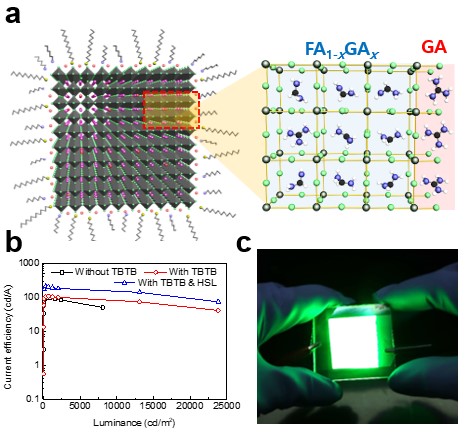
▲ a. Perovskite nanocrystal particle structure developed by the joint research team b. The light emitting efficiency of the perovskite light-emitting diode (External quantum efficiency = 23.4%), (TBTB: 1,3,5-tris(bromomethyl)-2,4,6-triethylbenzene defect removal layer, HSL: hemispherical lens) c. Large area light emitting device
2. The research paper and its authors
- Title of the research paper: Comprehensive defect suppression in perovskite nanocrystals for high-efficiency light-emitting diodes
-Authors: Professor Tae-Woo Lee (Corresponding Author, Seoul National University), Professor Andrew Rappe (Corresponding Author, University of Pennsylvania), Dr. Young-Hoon Kim (Co-first author, Seoul National University), Sungjin Kim (Co-first author, Seoul National University), Dr. Arvin Kakekhani (Co-first author, University of Pennsylvania, Jinwoo Park (Seoul National University), Jae-Hyuk Park (Seoul National University), Yong-Hee Lee (Seoul National University), Hengxing Xu (University of Tennessee), Dr Satyawan Nagane (Cambridge University), Robert Wexler (University of Pennsylvania), Dong-Hyuk Kim (Seoul National University), Seung-Hyun Cho (Seoul National University), Dr. Laura Martinez-Sarti (University of Valencia), Dr. Feng Tan (University of Pennsylvania, Harbin Institute of Technology), Dr. Aditya Sadhanala (Cambridge University, Oxford University), Professor Kyong Soo Park (Seoul National University), Professor Young-Woon Kim (Seoul National University), Professor Bin Hu (University of Tennessee), Professor Henk Bolink (University of Valencia), Professor Seunghyup Yoo (KAIST), Richard Friend(Cambridge University)
3. About the research
-Background of the study
Perovskite materials are a promising next-generation light-emitting material with excellent color purity and low material cost that is simple in its synthesis process. The researchers have continuously strived to improve the efficiency of perovskite light-emitting diodes since the first time they reported that perovskite is likely to be a light-emitting diode in 2015. In particular, they have continued their research to the improve light-emitting efficiency by synthesizing perovskite materials into nanoparticles and have developed methods to control defects in perovskite nanoparticles. During this process, Guanidinium, 1,3,5-tris (bromomethyl)-2, 4,6-triethylbenzene (TBTB) were used to revolutionize the defects of perovskite nanoparticles and a method to effectively trap the excitons inside the nanoparticles to achieve high light-efficiency (more than 90%) was developed.
-Research development process
This study proposes a comprehensive and innovative method of effectively confining excitons inside the nanoparticles while controlling all defects that are present inside and on the surface of perovskite nanoparticles. Through this method, a perovskite light-emitting diode with the world's highest efficiency (external quantum efficiency 23.4%) was developed. In addition, the composition and synthesis method for nanoparticles having high light-emitting efficiency in room temperature and atmospheric conditions were presented. This figure is the highest in the world and is outstandingly high even when compared to the green InP-based quantum dot LED. In addition to the implementation of such high efficiency, the possibility of commercializing the perovskite light-emitting devices was demonstrated through the fabrication of large-area light emitting diodes.
-What makes this achievement different from other studies
Using guanidinium, perovskite nanocrystal particles with high light-emitting efficiency were synthesized. While converting the device, additional defect control and device structure optimization through TBTB were performed, along with DFT calculation to analyze the mechanism. For the DFT calculation, the high-efficiency light-emitting mechanism of perovskite nanoparticles developed in collaboration with Professor Andrew Rappe of the University of Pennsylvania was also theoretically analyzed.
-Goals and future plans
The efficiency of perovskite light-emitting devices has reached the level of conventional organic or quantum dot light-emitting devices. However, there are still few elements that remain to be unresolved , especially the problem of drive stability of light emitting devices that remain to be greatly low. To solve this problem, we plan to develop high-intensity perovskite light-emitting devices and present strategies to commercialize perovskite materials in the future.
4. Terminology
< Nature Photonics>: Being one of the top scientific journals, it has a JCR impact factor of 31.241 (as of 2019), evaluated by Thomson Reuters, an academic journal evaluation agency.
Perovskite: A perovskite material has an ABX3 structure. It is a structure in which different cations A and B, and an anion X are combined in a 1:1:3 ratio. Physical properties vary depending on the atoms or molecules included in each of the sites A, B, and X. In the case of metal halide perovskites which are mainly used in photoelectric devices, metal cations such as organic ammonium (RNH3) or cesium (Cs) are in the A site, and metal cations such as lead (Pb) and tin (Sn) are in the B site. and halogen anions such as chlorine (Cl), bromine (Br), and iodine (I) are located at the X site. It has an excellent color purity and has the advantage of easily controlling the luminous color through the control of constituent elements.
Light-Emitting Diodes (LED): A light source that uses the luminescence phenomenon that occurs when voltage is applied to a semiconductor.
Exciton: The pair that is formed when electrons and holes are bound to each other by the electrostatic Coulomb force is called an exciton. When electrons and holes combine with excitons, light is emitted. In order to increase the light-emitting efficiency of the luminous body, it is important to implement high exciton binding energy and to prevent the excitons in the luminous body from dissociating by removing defects that exist around them.
Defect: The energy level in the bandgap that occurs due to the loss of atoms in the regular crystal structure within a material. If there is a corresponding level, the electrons cannot recombine with the holes and are trapped in the corresponding level, thereby reducing the luminous efficiency of the luminous device. Therefore, in order to have a luminous device with high light-emitting efficiency, it is necessary to prevent the formation of defects and control the formed defects.
External Quantum Efficiency (EQE): One of the representative efficiencies that indicate the performance of a light-emitting device. It is measured as the ratio of photons emitted to the number of injected electrons. The unit is %.
Current Efficiency: One of the representative efficiencies that indicate the performance of a light-emitting device. It is expressed as a device's luminance compared to its applied current density. The unit is cd/A.
2. The research paper and its authors
- Title of the research paper: Comprehensive defect suppression in perovskite nanocrystals for high-efficiency light-emitting diodes
-Authors: Professor Tae-Woo Lee (Corresponding Author, Seoul National University), Professor Andrew Rappe (Corresponding Author, University of Pennsylvania), Dr. Young-Hoon Kim (Co-first author, Seoul National University), Sungjin Kim (Co-first author, Seoul National University), Dr. Arvin Kakekhani (Co-first author, University of Pennsylvania, Jinwoo Park (Seoul National University), Jae-Hyuk Park (Seoul National University), Yong-Hee Lee (Seoul National University), Hengxing Xu (University of Tennessee), Dr Satyawan Nagane (Cambridge University), Robert Wexler (University of Pennsylvania), Dong-Hyuk Kim (Seoul National University), Seung-Hyun Cho (Seoul National University), Dr. Laura Martinez-Sarti (University of Valencia), Dr. Feng Tan (University of Pennsylvania, Harbin Institute of Technology), Dr. Aditya Sadhanala (Cambridge University, Oxford University), Professor Kyong Soo Park (Seoul National University), Professor Young-Woon Kim (Seoul National University), Professor Bin Hu (University of Tennessee), Professor Henk Bolink (University of Valencia), Professor Seunghyup Yoo (KAIST), Richard Friend(Cambridge University)
3. About the research
-Background of the study
Perovskite materials are a promising next-generation light-emitting material with excellent color purity and low material cost that is simple in its synthesis process. The researchers have continuously strived to improve the efficiency of perovskite light-emitting diodes since the first time they reported that perovskite is likely to be a light-emitting diode in 2015. In particular, they have continued their research to the improve light-emitting efficiency by synthesizing perovskite materials into nanoparticles and have developed methods to control defects in perovskite nanoparticles. During this process, Guanidinium, 1,3,5-tris (bromomethyl)-2, 4,6-triethylbenzene (TBTB) were used to revolutionize the defects of perovskite nanoparticles and a method to effectively trap the excitons inside the nanoparticles to achieve high light-efficiency (more than 90%) was developed.
-Research development process
This study proposes a comprehensive and innovative method of effectively confining excitons inside the nanoparticles while controlling all defects that are present inside and on the surface of perovskite nanoparticles. Through this method, a perovskite light-emitting diode with the world's highest efficiency (external quantum efficiency 23.4%) was developed. In addition, the composition and synthesis method for nanoparticles having high light-emitting efficiency in room temperature and atmospheric conditions were presented. This figure is the highest in the world and is outstandingly high even when compared to the green InP-based quantum dot LED. In addition to the implementation of such high efficiency, the possibility of commercializing the perovskite light-emitting devices was demonstrated through the fabrication of large-area light emitting diodes.
-What makes this achievement different from other studies
Using guanidinium, perovskite nanocrystal particles with high light-emitting efficiency were synthesized. While converting the device, additional defect control and device structure optimization through TBTB were performed, along with DFT calculation to analyze the mechanism. For the DFT calculation, the high-efficiency light-emitting mechanism of perovskite nanoparticles developed in collaboration with Professor Andrew Rappe of the University of Pennsylvania was also theoretically analyzed.
-Goals and future plans
The efficiency of perovskite light-emitting devices has reached the level of conventional organic or quantum dot light-emitting devices. However, there are still few elements that remain to be unresolved , especially the problem of drive stability of light emitting devices that remain to be greatly low. To solve this problem, we plan to develop high-intensity perovskite light-emitting devices and present strategies to commercialize perovskite materials in the future.
4. Terminology
< Nature Photonics>: Being one of the top scientific journals, it has a JCR impact factor of 31.241 (as of 2019), evaluated by Thomson Reuters, an academic journal evaluation agency.
Perovskite: A perovskite material has an ABX3 structure. It is a structure in which different cations A and B, and an anion X are combined in a 1:1:3 ratio. Physical properties vary depending on the atoms or molecules included in each of the sites A, B, and X. In the case of metal halide perovskites which are mainly used in photoelectric devices, metal cations such as organic ammonium (RNH3) or cesium (Cs) are in the A site, and metal cations such as lead (Pb) and tin (Sn) are in the B site. and halogen anions such as chlorine (Cl), bromine (Br), and iodine (I) are located at the X site. It has an excellent color purity and has the advantage of easily controlling the luminous color through the control of constituent elements.
Light-Emitting Diodes (LED): A light source that uses the luminescence phenomenon that occurs when voltage is applied to a semiconductor.
Exciton: The pair that is formed when electrons and holes are bound to each other by the electrostatic Coulomb force is called an exciton. When electrons and holes combine with excitons, light is emitted. In order to increase the light-emitting efficiency of the luminous body, it is important to implement high exciton binding energy and to prevent the excitons in the luminous body from dissociating by removing defects that exist around them.
Defect: The energy level in the bandgap that occurs due to the loss of atoms in the regular crystal structure within a material. If there is a corresponding level, the electrons cannot recombine with the holes and are trapped in the corresponding level, thereby reducing the luminous efficiency of the luminous device. Therefore, in order to have a luminous device with high light-emitting efficiency, it is necessary to prevent the formation of defects and control the formed defects.
External Quantum Efficiency (EQE): One of the representative efficiencies that indicate the performance of a light-emitting device. It is measured as the ratio of photons emitted to the number of injected electrons. The unit is %.
Current Efficiency: One of the representative efficiencies that indicate the performance of a light-emitting device. It is expressed as a device's luminance compared to its applied current density. The unit is cd/A.