loaction
SNU Professor Ho-Young Kim's Research Paper, Introduction to the Architecture of Swallows by Engineers and Biologists, Published in the International Journal
-
작성자
관리자
-
등록일
2021.02.22
-
조회수
882
SNU Professor Ho-Young Kim's Research Paper, Introduction to the Architecture of Swallows by Engineers and Biologists, Published in the International Journal <PNAS>
- Seoul National University Professor Ho-Young Kim's team publishes a research paper in the world-renowned journal <PNAS>
- Provided insight into the secret of swallow nests from an engineering point of view, providing key clues to accelerate the development of 3D printing

▲ (From left) SNU Dr. Yeonsu Jung, Sogang University Professor Wonjung Kim, SNU Professor Ho-Young Kim
- Provided insight into the secret of swallow nests from an engineering point of view, providing key clues to accelerate the development of 3D printing
▲ (From left) SNU Dr. Yeonsu Jung, Sogang University Professor Wonjung Kim, SNU Professor Ho-Young Kim
Analysis from engineering approaches revealed the secrets of a swallow's mud nests that are solid enough to withstand more than 100 times the swallow's weight.
A joint research team of Seoul National University's Department of Mechanical Engineering (Dr. Yeonsu Jung, Ph.D. student Sohyun Jung, Professor Ho-Young Kim), Sogang University's Department of Mechanical Engineering (Professor Wonjung Kim) and Daegu Gyeongbuk Institute of Science and Technology (Professor Sang-Im Lee) revealed the scientific secrets behind the swallow's nest.
Swallows, that are migratory birds of the summer, return to their mud nests under the awnings every spring. The nests stand testimony to the fact that swallows are great architects, although people often forget this. From an engineering point of view, a swallow's nest is of optimal design and is constructed with the most readily available materials – a true masterpiece. It is estimated that less than 5% of all bird species build houses such as that of swallow nests that are stably attached to vertical walls.
In order for the nest to be attached to the wall, it must overcome the pulling-down force induced by its weight and mud is originally a material that is very vulnerable to such a pulling force. The joint research team found that when the saliva of the swallow is mixed and hardened with soil grains, the polymeric substance contained in the saliva acts as an adhesive to attach the soil grains to each other, allowing the nests to bear the pulling force exceptionally well. Furthermore, it has been found that swallows build houses by putting special care into supporting the parts of the nest that carries most of the weight. Such nests withstand a load of more than 100 times the weight of the swallows.
Meanwhile, the way swallows build their nests is similar to that of 3D printing. 3D printing construction is currently in the spotlight for being the technology that quickly builds buildings in places such as disaster sites. When swallows return to their nests for breeding, they have to be able to swiftly re-build them if they are not in a reusable state. Similar to 3D printing, swallows quickly build nests by stacking materials (mud) one layer at a time. This blueprint is instinctive to the swallow. It is estimated that swallows have been nesting from about 10 million years ago and they deserve to be titled the teachers of 3D printing.
In the "Origin of Species", Darwin expressed his surprise for the swallow's instinct to build their nests by stating that "the swallow species that build houses by mixing mud and saliva may have gradually evolved into species that build houses only with saliva by natural selection." The secret of the swallow's nest, which the research team discovered, presents an answer to Darwin's surprise and inquiries from 160 years ago from an engineering point of view.
"Through 3D printing technology, mathematical modeling and their convergence with biology that closely resemble swallow's nests, we have been able to discover the scientific secrets of our familiar swallow’s nest. This research will accelerate the development of biomimicry 3D printing technology using environmentally friendly materials," said Professor Ho-Young Kim, the research director of the study.
The study was published on January 12 in the world-renowned journal Proceedings of the National Academy of Sciences of the United State of America.
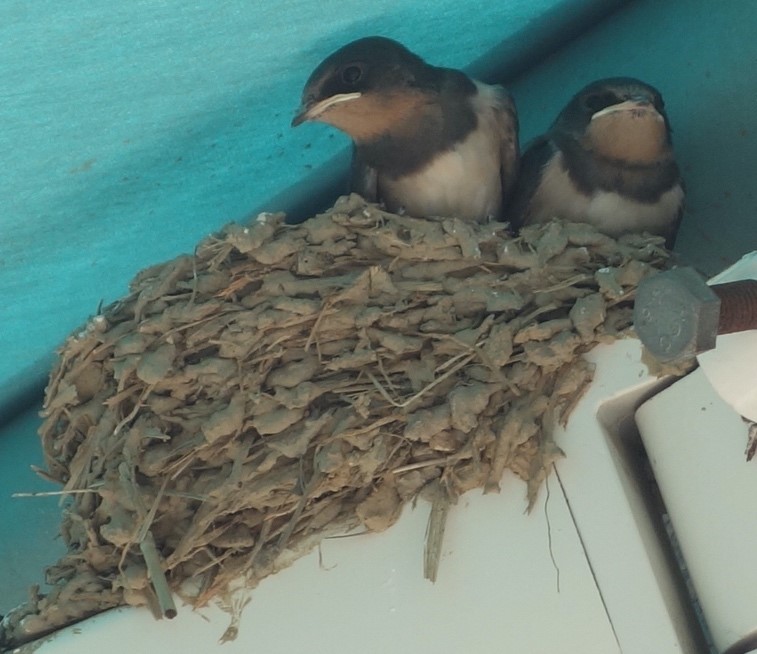
▲ A swallow nesting under an awning in Suwon, Gyeonggi-do.
The swallow's architectural skills allowing them to be capable of nesting anywhere makes it possible for them to coexist with humans.
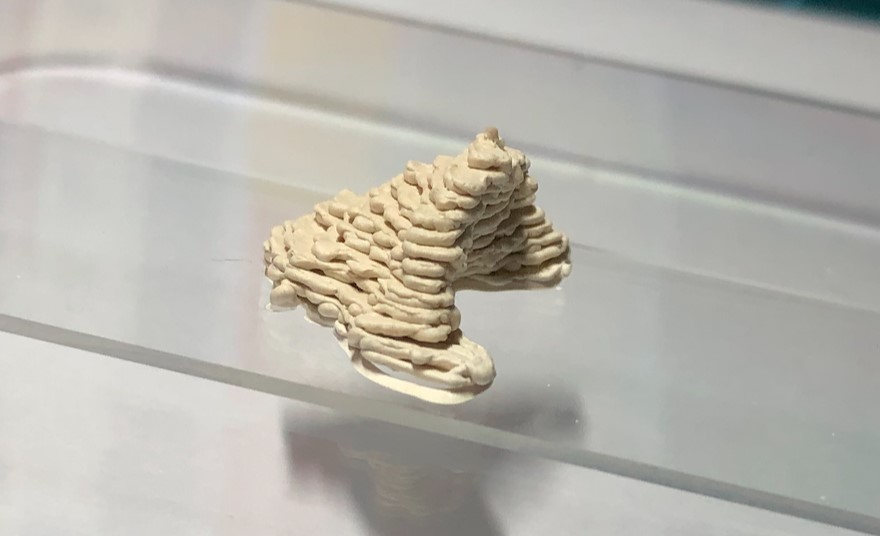
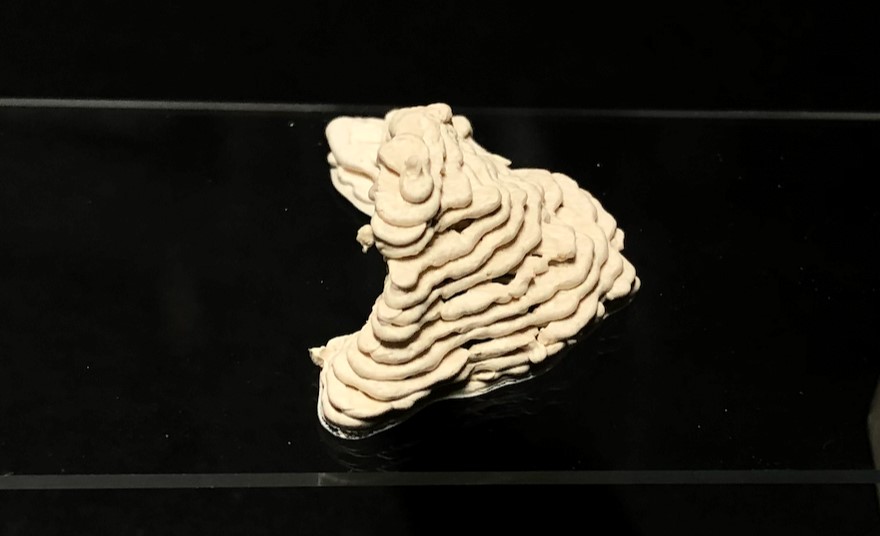
▲ 3D-printed artificial nest, made in the same proportions as the swallow's nest