loaction
With One Sensor, SNU Professor Yong-Lae Park 's Team Opens a New Era of Wearable Robot Research
-
작성자
관리자
-
등록일
2021.02.22
-
조회수
1,055
With One Sensor, SNU Professor Yong-Lae Park 's Team Opens a New Era of Wearable Robot Research
- The development of high-performance soft sensors which are then published in the international journal <Science Robotics>
- It has been made possible to achieve more delicate remote operation, suitable for the intuitive performance of robot arms, drones and AR/VRs

▲ (From left) Professor Yong-Lae Park of the SNU Department of Mechanical Engineering, Ph.D. researcher Taekyoung Kim, Polymorphic detection soft sensor
- It has been made possible to achieve more delicate remote operation, suitable for the intuitive performance of robot arms, drones and AR/VRs
▲ (From left) Professor Yong-Lae Park of the SNU Department of Mechanical Engineering, Ph.D. researcher Taekyoung Kim, Polymorphic detection soft sensor
Seoul National University's College of Engineering (Dean Kookheon Char) announced on January 8 that Professor Yong-Lae Park 's team of the Department of Mechanical Engineering has developed a soft sensor technology that can be modified in various ways and can easily detect movements. "This technology will enable the development of wearable technology that can be operated remotely and more intuitively," said Professor Yong-Lae Park.
A sensor with a thickness of 6mm and a length of 7cm can be attached to a joint such as one's wrist and remotely deliver various commands to the robot or computer with only physical movements.
Recently, with augmented reality (AR) and virtual reality (VR) technologies becoming commercialized and gaining the public's attention, the development of interfaces to enable information transfer between humans and robots (or machines) has been more actively taking place. Motion or movement is the most commonly used method for the intuitive transfer of information for robot manipulation.
In other words, it detects the movement of a individual’s every moment and enables the robot to perform the necessary tasks. Since the previously developed sensors mainly detect only single transformation movements, a large number of sensors must be used for multi-tasking, leaving the system to be greatly complicated. However, if a single sensor can easily detect various types of movements and transformations, even complex tasks can be easily understood and performed by the robot.
To solve this problem, Professor Yong-Lae Park's team developed a multifunctional soft sensor that can detect not only individual transformation modes such as stretching, contracting and bending with a single sensor, but also transformation in which two or more modes are combined at the same time.
Therefore, using this technology, it is possible to transmit many kinds of information to the robot while using a small number of sensors. In addition, since it is made of a flexible material, even if it is attached to a person's body, various transformations can be easily detected without disturbing the movement of a person, which is a great advantage for implementing a wearable interface.
The sensor developed in this study is made of a silicone rubber material that can be easily stretched or bent, and has a hollow microchannel inside a thin rod-shaped structure that is filled with a transparent ionic solution that is electrically conductive. A thin conductive fabric is attached to the outer wall of the sensor structure.
Here, it is possible to measure changes in light transmittance, electrical conductivity, and electrical resistance of conductive fabrics according to the type of transformation by stretching, bending, or pressing the sensor. Using a combination of these signals, it is possible to simultaneously detect various types of transformation. Since these three sensing mechanisms organically share a structure, it is not only structurally simple, but its manufacturing process also becomes greatly simplified.
The researchers also created a wearable interface using this sensor, demonstrating that it can be used to easily manipulate devices such as robotic arms and drones remotely. In addition, it has been shown that when this sensor is combined with a soft robot, even the movement of the robot can be accurately identified.
The results of this study were published online on December 16 in the world-renowned international journal <Science Robotics>. This research was conducted with the support of the Soft Robot Technology Leading Research Center Project and the Global Doctoral Training Project of the Ministry of Science and ICT.
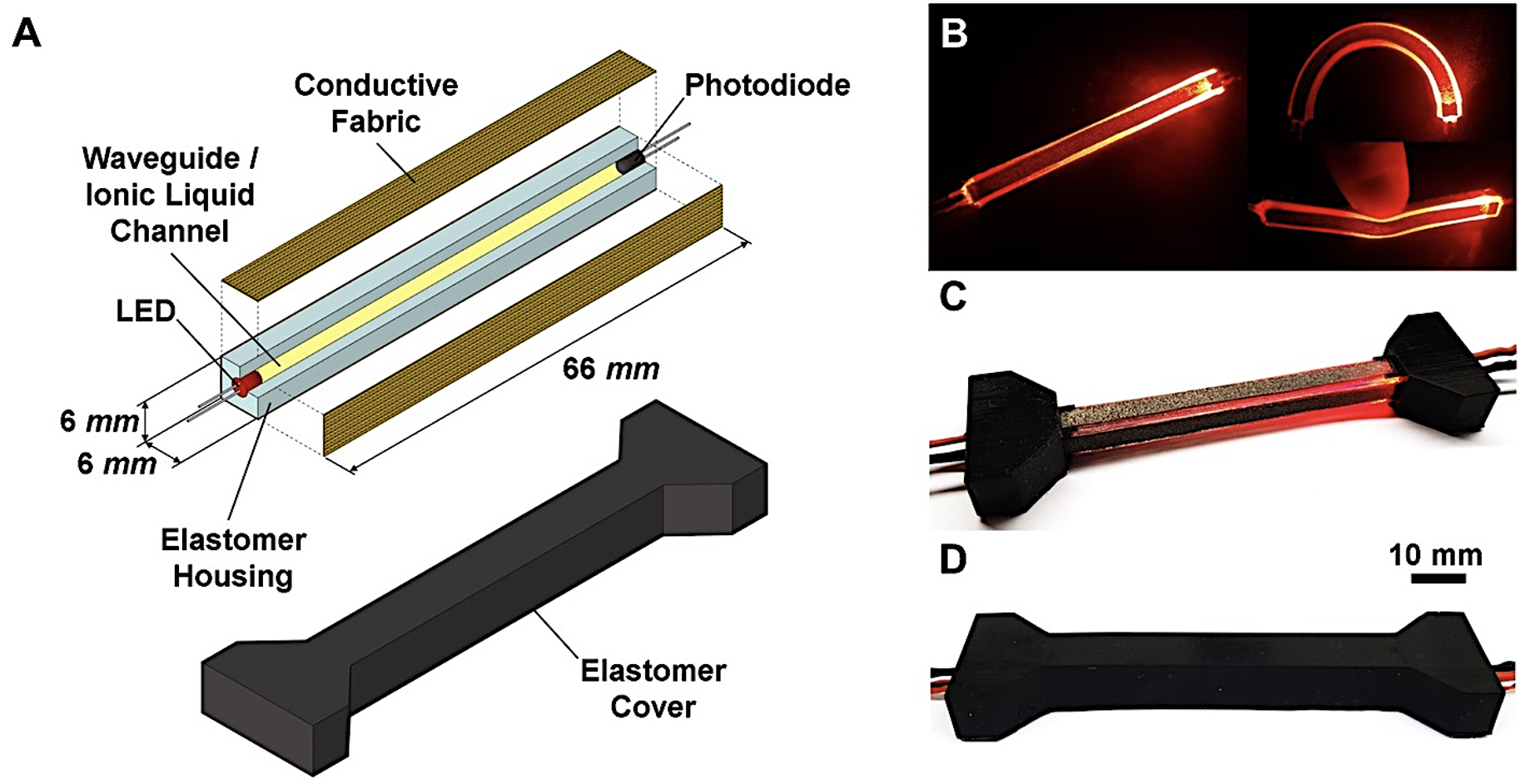
▲ A multifunctional soft sensor with three different principles (optical element, ion solution, conductive fabric) of sensor elements combined into a single sensor structure
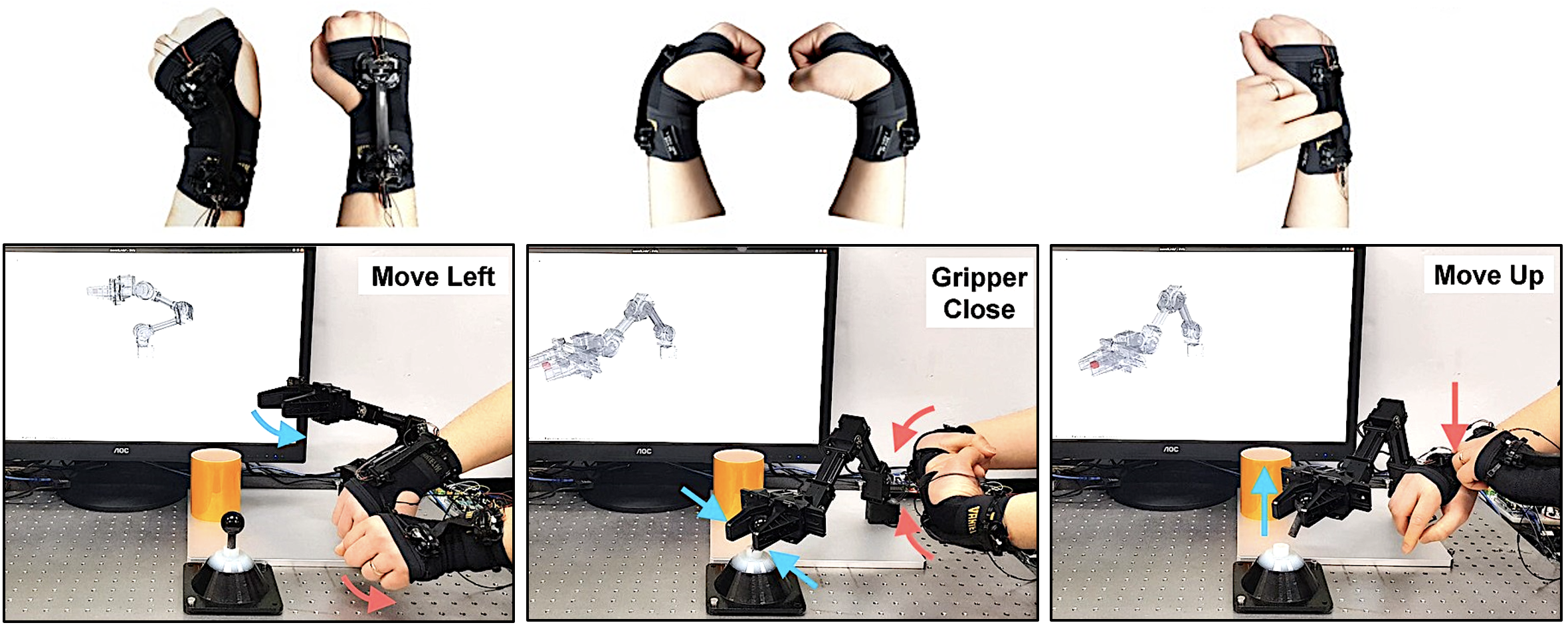
▲ Example of remote operation of a robot arm using a wearable wristband with a built-in soft sensor
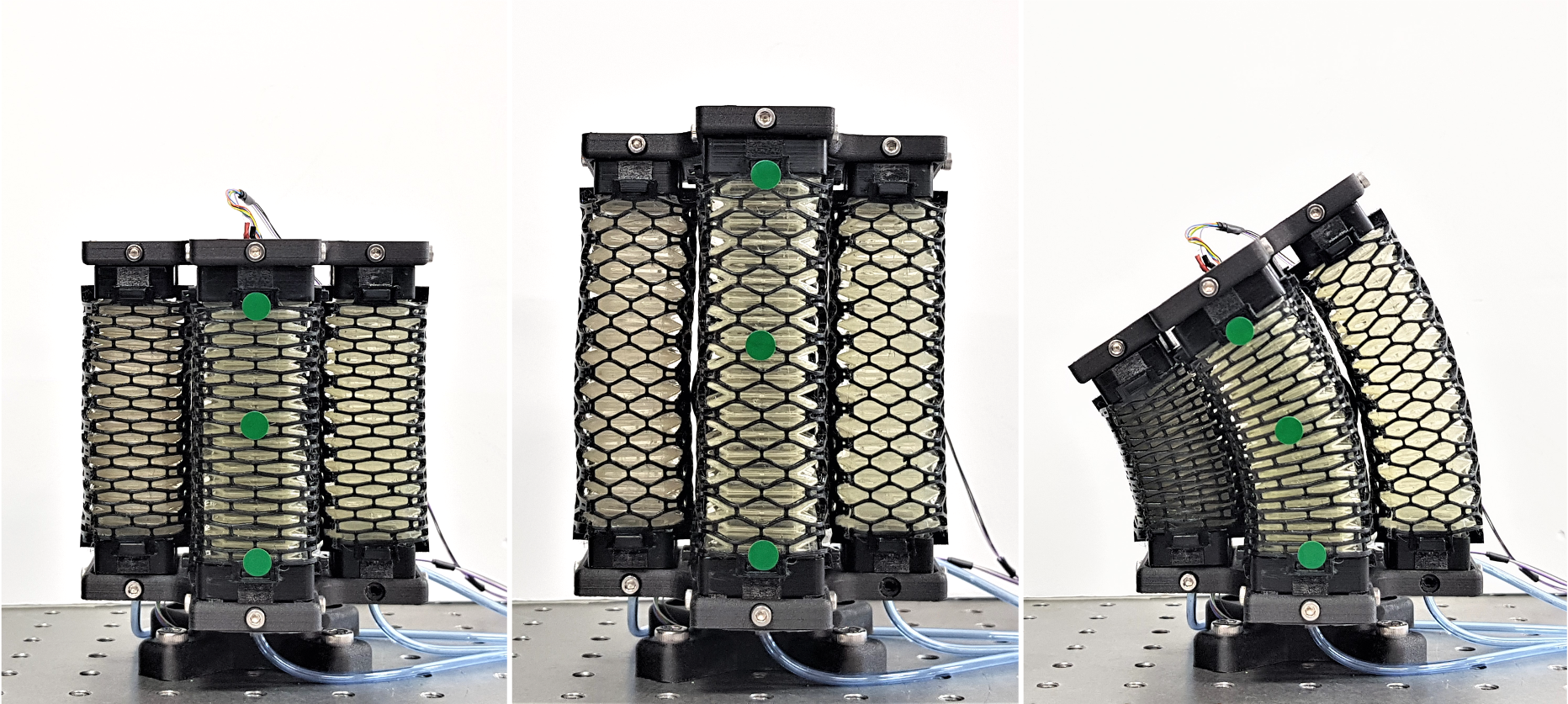
▲ A soft robot with soft sensors, capable of contraction, stretching and bending
▲ A soft robot with soft sensors, capable of contraction, stretching and bending
[Reference Materials]
Research Paper: https://robotics.sciencemag.org/content/5/49/eabc6878
T. Kim, S. Lee, T. Hong, G. Shin, T. Kim, and Y.-L. Park, “Heterogeneous Sensing in a Multifunctional Soft Sensor for Human-Robot Interfaces,” Science Robotics, vol. 5, no. 49, eabc6878, 2020.
Introduction Video: https://youtu.be/PgAEY9_7gzA