loaction
공대뉴스광장
SNU Professor Kim Dae-Hyeong Develops a Biocompatible Conductive Rubber with Maximum Stretchability of 840%
-
작성자
관리자
-
등록일
2018.09.04.
-
조회수
1236
SNU Professor Kim Dae-Hyeong Develops a Biocompatible Conductive Rubber with Maximum Stretchability of 840%
- For Wearable and Implantable Bioelectronics
- Published Online on Nature Nanotechnology

▲ SNU Professor Kim Dae-Hyeong of the Department of Chemical and Biological Engineering
SNU College of Engineering (Dean Cha Kook-Heon) announces that the joint team under Professor Kim Dae-Hyeong (Associate Director of the Center for Nanoparticle Research) and Professor Hyeon Taeghwan (Director of the Center for Nanoparticle Research) both of the Department of Chemical and Biological Engineering has succeeded in constructing a highly conductive, stretchable and biocompatible conductive rubber.
Conductive rubber is a form of elastomer that is currently receiving much attention for its high applicability in the development of wearable and implantable bioelectronics like the cardiac pacemaker. The team has focused on the research of the SBS (styrene-butadiene-styrene) polymer – a class of synthetic rubber that involves the intricate weaving of highly-conductive Ag-Au nanowires with highly-stretchable butadiene rubber. This so-called SBS, which possesses properties pertaining to both plastic and rubber, is a thermoplastic polymer made of styrene and butadiene that can easily be manipulated and is stretchable under heat and pressure.
Its limitation is that the Ag (silver) nanoparticles are toxic and is easily corroded to drop the material’s conductivity. Also, it is vulnerable to corrosion by bodily fluids, or simply externally sweat and internally blood. When additional nanowire is supplied in order to increase its conductivity, the SBS loses its rubber-like property to become rigid or brittle.
The team confronts these issues one-by-one. First, the surfaces of the Ag nanoparticles are coated with gold to prevent corrosion and toxicity. Then, using surfactants, the nanocomposite is transformed into a three-dimensional net that models the honeycomb structure. This gives the material its softness and elasticity and also, with a greater contact area with nanowire, a higher conductivity. Hence, the team’s final product can yield a maximum stretchability of 840% and maximum conductivity of 72,600 S cm-1 (Siemens per meter).
Professor Kim states, “Through our experiment that involves the conduction of heat and electric stimuli to skin or joint via conductive rubber band, we have foreseen the material’s applicability in the treatment of joint problems and into the diagnostic procedures involving ECG (electrocardiogram) or EMG (electromyogram).”
The findings of this research has been posted online on Nature Nanotechnology on 14th 0AM (KST, Korea Standard Time).
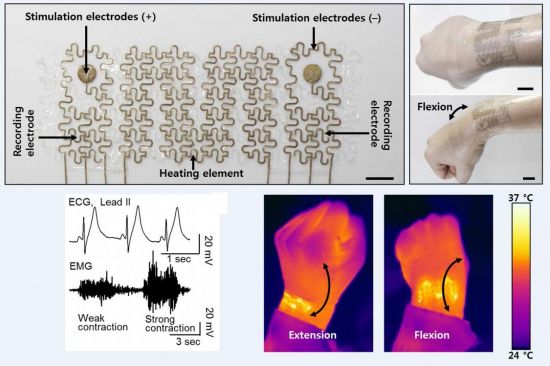
▲ Wearable Bioelectronics Made of Ag-Au Nanocomposites
담당부서대외협력실
전화번호880-9148