loaction
공대뉴스광장
Professor Tae-Woo Lee's team of SNU, develops Neuromorphic Electronic Devices-Based Artificial optic nerve that mimics a biometric optic nerve.
-
작성자
관리자
-
등록일
2020.03.20.
-
조회수
1180
Professor Tae-Woo Lee's team of SNU,
develops Neuromorphic Electronic Devices-Based
Artificial optic nerve that mimics a biometric optic nerve.
- Development of an artificial optic nerve that can selectively respond to ultraviolet radiation
- Can possibly be used in fields like healthcare systems, biomimiculate robots, and nerve prostheses.
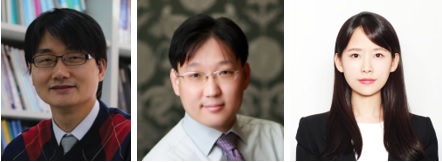
▲ From left, Professor Tae-Woo Lee of SNU, Professor Sungjin Park of Inha University,
Dr. Hye-rim Park of SNU (First Author)
SNU College of Engineering (Dean Kookheon Char) announced that a joint research team led by Professor Tae-Woo Lee of the Department of Materials Science and Engineering and Professor Sungjin Park of Inha University developed artificial visual nerves simulating biometrical visual nerves using hydrocarbon nitrogen-based two-dimensional materials. Lee's team used the visual nerves that were developed to select light signals in the ultraviolet band and processed the information to implement a smart window platform that allows the degree of ultraviolet light exposure to be adjusted in real time according to the degree of biohazard.
Neuromorphic electronic devices simulating the nerves of living bodies are widely praised in the field of artificial intelligence and Internet of Things as a technology that can fundamentally address the limitations of energy efficiency, aggregation and data processing speed that exists in Von Neumann computing-based systems. In particular, light-sensitive neuromorphic electronic devices are next-generation technologies that have high expectations to be used as diverse smart sensors by enabling detection of external visual information as well as effectively simulating the behavioral characteristics of biosynapses (connection between neurons, learning and memory effects) in the optic nerve responsible for 80% of human sensory information. However, previous related studies have only remained at a level where light sensing functions and synapses are aggregated into a single electronic device, and their practical application methods have been greatly limited.
The research team developed light-sensitive neuromorphic electronic devices that can selectively detect light in a particular wavelength band and determine external ultraviolet risk. Although ultraviolet light is very harmful to the human body, it is a waveband of light that can only be detected by certain birds and insects and technological development that can detect and process related information in real time can not only extend the human body's view that is otherwise limited to visible light areas, but is also of great importance in the healthcare industry and health care. In this study, hydrocarbon nitrogen-based two-dimensional material that can strongly absorb light in ultraviolet band was synthesized and was applied to the photo-absorbing layer of neuromorphic electronic device, which can be driven at low bio-level power and react selectively to light in the ultraviolet band. Based on this, a smart window system that can detect external ultraviolet light and adjust the level of ultraviolet exposure in real time depending on the degree of risk was implemented.
"The technology is expected to be used as a smart sensor platform in the IoT era in that it can handle various stimuli information from a short-term perspective and is also expected to be applied in the smart window and smart eyewear/glasses field that can be self-blocked according to the degree and risk of ultraviolet exposure," stated Professor Tae-Woo Lee. "In addition, in the mid- and long-term, it will be able to be applied to a wide range of fields like in diverse health care industries or in the development of nerve prosthetic devices that can be linked to electronic skin or bionic optic nerves of soft robots," he said, further explaining the significance of the research.
In recognition of its importance, the findings of the research were published on January 27 in Advanced Materials, a world-renowned international journal.
Meanwhile, the research was carried out by the support from Ministry of Science and the Research Leader Program promoted by the National Research Foundation of Korea, Midcareer Research Grant, Global Frontier Softelectronics Research Group, and the SNU Creative Research Institute.
담당부서대외협력실
전화번호880-9148