loaction
공대뉴스광장
SNU's Research Team Finds Mediator Atom to Normalize Graphene Structural Defects
-
작성자
관리자
-
등록일
2020.07.07.
-
조회수
1005
SNU's Research Team Finds Mediator Atom to
Normalize Graphene Structural Defects
Inquiries Regarding Published Article: Contact Information (Professor Gun-Do Lee: 880-5898)

▲Professor Gun-Do Lee of the SNU Research Institute of Advanced Materials (Left) Professor Euijoon Yoon of the Department of Materials Science and Engineering (Center), Professor Young-Chang Joo
Professor Gun-Do Lee of the SNU Research Institute of Advanced Materials, Professor Euijoon Yoon of the Department of Materials Science and Engineering and Professor Young-Chang Joo's team announced on June 10 that they have identified the existence as well as the role of a mediator atom, which quickly converts structural
defects existing within graphene, a representative two-dimensional substance. It is a technique to improve physical properties such as electroconductivity by forming a hexagonal shape of a complete graphene structure.
Structural defects present in two-dimensional materials are factors that degrade the performance of materials, poor electrical conductivity being a typical example. Countless studies have been conducted to overcome this, and in the case of graphene, changes in the structure have been known to be caused by the rotation of carbon
and carbon atoms. However, SNU's research team confirmed through simulations through the use of supercomputers that the transformation of structural defects can be easily made by energy that is about one-fifth smaller by the medium atom than by a conventional rotation.
In graphene, where vacancies or extra carbon atoms exist, they form incomplete bonds, and these incomplete carbon atoms move rapidly above the graphene, repeatedly breaking and connecting bonds with other carbons leading them to change into a stabilized normal structure. This can be likened to honey moving and working diligently on a hive-shaped hexagonal net structure.
This study was empirically demonstrated through world-class electron microscopy groups and joint research conducted by Dr. Alex Robertson of Oxford University of England, Professor Jamie Warner of the University of Texas in the United States and Dr. Kazu Suenaga of AIST in Japan, confirming the existence of the mediator atom.
The study is meaningful in that it has simultaneously confirmed the theoretical and experimental proof of incomplete carbon atoms moving rapidly above graphene, acting as intermediaries to transform structural defects into stable structures.
"The use of an atomic mechanism will not only allow us to produce better-performing two-dimensional materials, but also control structural defects and allow us to apply them to special-performance electronic devices," said Professor Gun-Do Lee.
The research was conducted through the mid-sized researcher support and future materials discovery projects initiated by the National Research Foundation of Korea and the Ministry of Science and ICT's initiative, along with the R&D innovation support program of the KISTI National Super Computing Center. The findings were published on June 10 (local time) in an online edition of Science Advances, a sister journal of the world-renowned journal Science, titled "Direct Observation and Catalyst Role of Mediator Atom in 2D Materials."
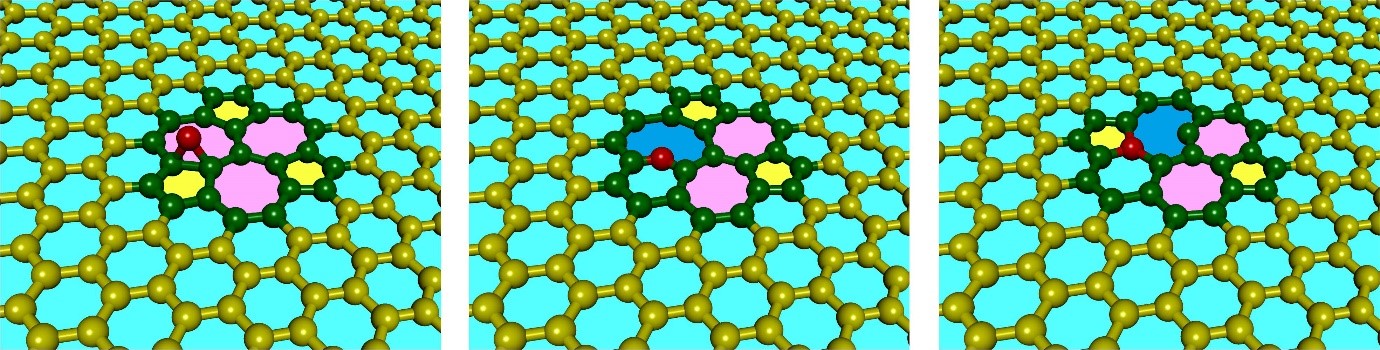
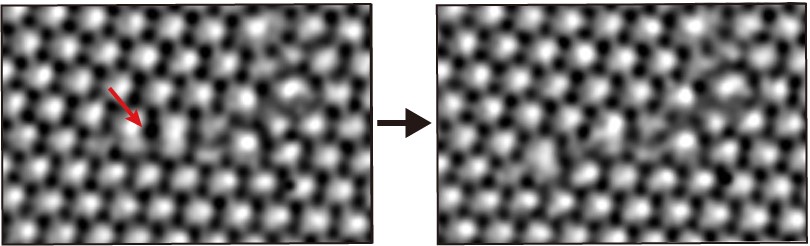
Figure: (Above) Structural transformation by a mediator atom (red) above Graphene's 555-777 structural defect, (Below) Image
of a structural transformation by a carrier (red arrow) observed in a high-resolution electron microscope
담당부서대외협력실
전화번호880-9148