loaction
공대뉴스광장
SNU Professor Jai Ick Yoh Develops Technology to Reveal Viruses in the Atmosphere in Real-Time
-
작성자
관리자
-
등록일
2020.07.07.
-
조회수
879
SNU Professor Jai Ick Yoh Develops Technology to Reveal Viruses in the Atmosphere in Real-Time
-Implementation of low-cost, high-efficiency component detection device with electric induction plasma
- Real-time analysis of substance type as well as concentration of ultrafine dust particles
-Mobile device allowing possibility of monitoring real-time information regarding pollution within the residential environment and virus situations

▲ From left SNU Professor Jai Ick Yoh Ph.D Student J un-Ho Yang M.S Student Jaehun Jung
A research team led by Professor Jai Ick Yoh of the Department of Aerospace Engineering (Ph.D Student Jun-Ho Yang, M.S Student Jaehun Jung) have developed a real-time atmospheric component analysis device that uses spark-induced plasma spectroscopy. By applying the technology used in NASA's Mars surface exploration vessel, the composition, concentration and source of the particle surface have been developed into a technology that can be checked in real time, and is expected to be a technology that can measure the real-time concentration of ultrafine particles such as viruses in the atmosphere.
This content has been selected as the Cover and Issue of the Month for the June issue of the Journal of Atomic Analytical Spectrometry (JAAS), an internationally renowned journal of chemical analysis by The Royal Society of Chemistry (Attached File: Research Paper 1. PDF).
With the start of the Post Corona era, interest in fine dust, germs and viruses that spread in the atmosphere and cause various respiratory diseases has increased greatly. In particular, COVID-19 is a new type of virus that has now killed 400,000 people and its vaccine is still yet to be developed, making it a huge threat. In addition,
ultrafine dust, including heavy metal and toxic particles from China's factory zone that visits every spring-summer to threaten the citizens' health, has become a global headache. It is the first time that a technology to detect and analyze viruses that spread through air pollution, harmful particles, and ultrafine dust in real time was developed .
The existing method required samples to be collected and analyzed in the laboratory, which took up to days to complete analysis. The method developed this time that has a unit price of less than 100,000 won can replace expensive analysis equipment worth hundreds of millions of won, which can be expected to save more than one-hundredth of the price. With future research, there is also the possibility of making a mobile device, allowing it to be carried around.
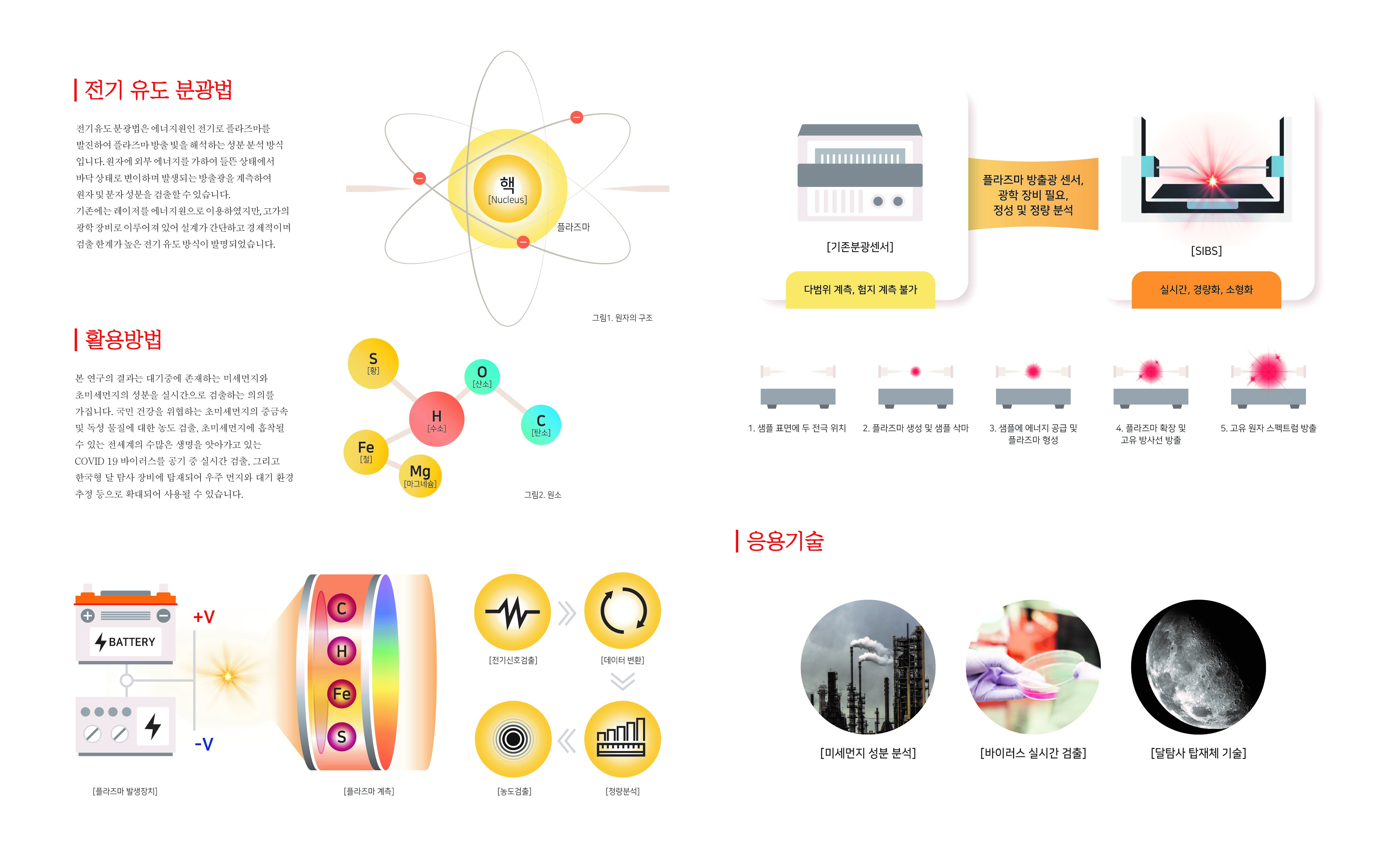
The method of detecting contaminated ultrafine particles in the atmosphere that was introduced by the research team was based on the Spark Induced Plasma Spectroscopy.
*Spark Induced Plasma Spectroscopy is a component analysis method that creates plasma on the surface of particles with its energy source of electricity and interprets the light emitted at this time. A By applying external energy to atoms and measuring the emission light generated by the process of transition from excited state resting floor state, the atomic and molecular components can be detected. Previously, expensive lasers were used as energy sources to create plasma, but the latest invention is an electric induction method that is simple in design, economical, and has excellent detection limits.

The research team developed a spectroscopic technique consisting of only a photodiode that passes specific wavelengths without using expensive spectrometers, and separately developed an algorithm for precise component analysis to provide component-specific concentration information.
The research team developed this detection device by applying ChemCam technology (chemical component analysis technology) that was carried out on NASA's Mars probe while conducting research on a Korean lunar surface probe. Prior to the development of atmospheric component analysis devices, previous research was
carried out on optimizing the Spark Induced Plasma Spectroscopy under the theme of ' Study of Optimized Planetary Exploration by Application of Spark Induced Plasma Spectroscopy'.
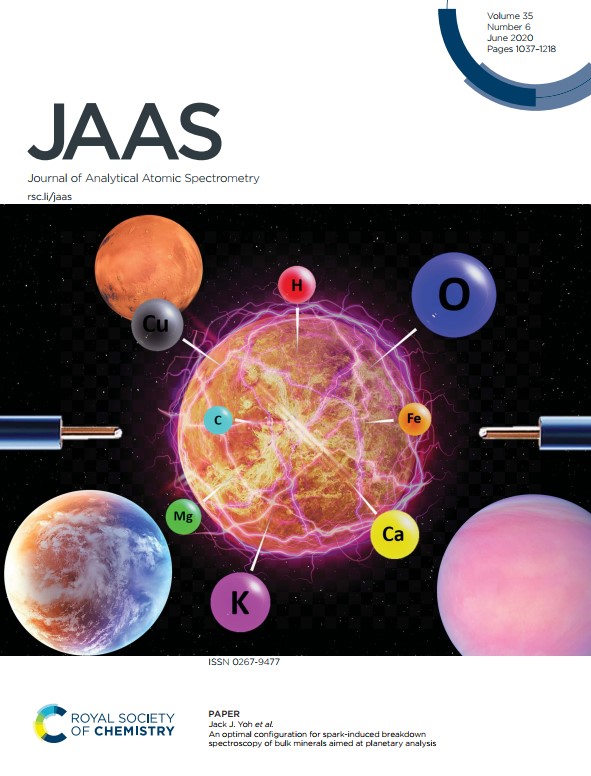
<Professor Jai Ick Yoh's team's paper was selected as the Cover and Issue of the Month of JAAS>
*This technology has been applied to the study of the composition and concentration of toxic substances in ultrafine dust, suggesting a new method for detecting harmful particles in fine dust. The findings were published online in the June issue of 'Chemosphere', a renowned chemical and meteorological journal (Attached File:
Research Paper 2.PDF).
"Unlike conventional atmospheric environment analysis detectors, there has been a way to detect 'real-time' atmospheric components at low cost," said Professor Jai Ick Yoh. "This study is expected to lead to a prelude to integrated monitoring that can guarantee citizens' healthy lives and personal hygiene after the coronavirus crisis and share real-time pollution information and virus conditions in the residential environment."
담당부서대외협력실
전화번호880-9148