loaction
연구성과
Undergraduate Student from the Department of Electrical and Computer Engineering Publishes Research Paper on the Use of Deep Learning Technology in the Most Prestigious Journal for Brain Imaging
-
작성자
관리자
-
등록일
2020.11.03.
-
조회수
970
Undergraduate Student from the Department of Electrical and Computer Engineering Publishes Research Paper on the Use of Deep Learning Technology in the Most Prestigious Journal for Brain Imaging
-Senior year student Hongjun An developed a technique to improve MRI distortion.
- Published in <NeuroImage>, the official journal of the Organization for Human Brain Mapping
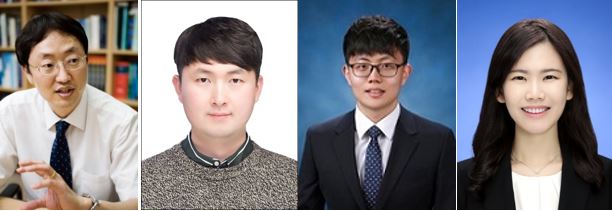
▲ Undergraduate student Hongjun An as first author and Advisor Jongho Lee as corresponding author with the overview of the research paper
SNU College of Engineering (Dean Kookheon Char) announced on October 19 that Hongjun Ahn (24 years old), an undergraduate senior in the Department of Electrical and Computer Engineering, published a paper in <NeuroImage>, the number one journal in the field of brain imaging, for his research on applying deep learning technology to brain images.
<NeuroImage> is an official journal of the Organization for Human Brain Mapping and the publishing of a paper in this journal is highly challenging as its research paper adoption rate is less than 11%. It is very unusual for an undergraduate to publish a paper as a first author in such a journal, and Hongjun An has been conducting his research as an undergraduate intern since his third year at the Laboratory for Imaging Science and Technology (Advisor Jongho Lee, list.snu.ac.kr).
This research involves the use of deep learning technology to develop a technique for improving the distortion phenomenon caused by breathing in magnetic resonance imaging (MRI) and the title of the paper is 'DeepResp: Deep learning solution for espiration-induced B0 fluctuation artifacts in multi-slice GRE’.
Using the results of the study, image distortion caused by breathing can be measured and corrected using an artificial neural network, with no need for utilizing any additional equipment. In addition, the results of the artificial neural network were implemented in an interpretable manner, overcoming difficulties in interpretation, which are generally considered to be the limits of deep learning.
The results of this study are expected to be highly utilized particularly for ultra-high magnetic resonance imaging that are 7 Tesla* or higher. Ultra-high magnetic resonance imaging is used in advanced brain science fields and diagnosing high-precision brain diseases as it can obtain high-definition brain images close to dissection. The newly developed technique dramatically improves the serious distortion of brain images that occur in ultra-high magnetic images so that high-quality images can be secured.
*A unit for indicating the magnetic field of MRI - the higher the figure, the more precise the resolution.
"I would like to express my gratitude to SNU's College of Engineering for giving me this opportunity to carry out this research study," said Hongjun An, the first author of the paper. "I want to continue to study deep learning technology and uncover the secrets of the brain that we cannot be overcome with today's conventional technology," he added.
담당부서대외협력실
전화번호880-9148