loaction
연구성과
A Drawing I Drew Becomes 3D? Professor Sunghoon Kwon's Team of SNU College of Engineering Develops 4D Printing Technology Drawn With a Pen
-
작성자
관리자
-
등록일
2021.04.06.
-
조회수
1215
A Drawing I Drew Becomes 3D?
Professor Sunghoon Kwon's Team of SNU College of Engineering Develops 4D Printing Technology
Drawn With a Pen
Professor Sunghoon Kwon's Team of SNU College of Engineering Develops 4D Printing Technology
Drawn With a Pen
-Based on the phenomenon of board marker ink floating in water, the idea developing into a technology capable of manufacturing 3D structures
-Developing a “roll-to-roll 3D processing technology” that can print in large quantities, the discovery has been spotlighted in various fields
-Developing a “roll-to-roll 3D processing technology” that can print in large quantities, the discovery has been spotlighted in various fields

▲ (from left) Dr. Seowoo Song of the Seoul National University Bio-MAX Institute, Researcher Sumin Lee of Seoul National University's Deptartment of Electrical and Computer Engineering, Professor Sunghoon Kwon, and Professor Jiyun Kim of Ulsan National Institute of Science and Technology's Department of Materials Science and Engineering
A Korean research team developed a 4D printing technology that converts a drawing drawn with a pen into a three-dimensional structure.
Seoul National University College of Engineering (Dean Kookheon Char) announced on March 25 that through the joint research by Professor Sunghoon Kwon of the Department of Electrical and Computer Engineering and Professor Jiyun Kim of UNIST, a new 4D printing technology was developed that is capable of quickly and easily producing 3D structures by merely using the commonly utilized ink pens and water.
3D printers are attracting attention as a technology that will lead the 4th industrial revolution due to its advantage of being able to create any desired 3D structures, but when compared to general 2D printers, most 3D printers that are currently commercialized still have the limitations of being slower as they use a layered lamination method while they are also highly expensive.
On the other hand, 4D printing is a technology that applies external stimuli to an initially printed object to transform it into another shape and thus has the ability to transform a simple structure that is easy to print into a more complex shape. By applying this, it is possible to quickly and easily produce 3D structures, so 4D printing technology is drawing attention for being the next-generation 3D manufacturing technology that will go beyond 3D printing. However, the 4D printing technology developed to date has to use specialized intelligent materials such as shape memory alloys and it is low in its accessibility because it still uses 3D printers.
Accordingly, the joint research team developed the world's first fast and easy 4D printing technology that can convert pictures that are freely drawn with a pen - a two-dimensional printing tool - into a three-dimensional structure. With this technology, anyone can easily create a three-dimensional structure with a just pen and a liquid solution.
In this study, in order to enhance practicality by reinforcing the three-dimensional structure that is being produced, an iron powder was added to the commonly used board marker ink and a monomer (poly(ethylene glycol) diacrylate) and initiator (potassium persulfate) capable of polymerization by the iron powder was mixed and used, although the same three-dimensional structure can be made even with purely the use of water and board marker ink.
"The 4D printing method developed in this study is a breakthrough in three-dimensional production technology that suggested a method to create a three-dimensional structure using a two-dimensional printer that is already widely used," said Dr. Seowoo Song, the first author of the research paper. "The thought of finding the phenomenon of a picture drawn with a board marker floating on water to be interesting rather than disregarding its significance made it possible to develop a three-dimensional structure manufacturing technology ," said the co-author Sumin Lee, an integrated master's and doctorate course researcher.
The contents of this study are expected to be useful in the field of STEM (Science, Technology, Engineering, Mathematics) education, which has recently become more important. Since it is possible to easily create a hydrogel-based 3D structure without special equipment, it can be used for ▲making scaffolds for 3D cell cultures, ▲making soft robots with flexible components that mimic those of living organisms. Anyone can carry out 3D prototyping regardless of whether they are part of a a specialized field of study, making it possible to increase the accessibility of the production of 3D structures to the general public.
The research team also developed a 'roll-to-roll 3D processing technology' that combines the 4D printing method developed with the roll-to-roll process, which is a two-dimensional printing technology used for continuous mass printing. "We presented a new possibility of mass production in 3D by combining the 2D printing technology with 3D printing, which had been difficult to mass-produce," explained Professor Jiyun Kim who conducted the joint research.
A commercially available 3D printer took about 1 hour to produce one 3D structure, but the results of manufacturing and testing similar structures in this study showed that it was able to produce 60 structures in 30 minutes. By further developing the system, the scale for production is expected to be further expandable.
This research paper was published on March 24 (local time) in the world-renowned international journal 'Science Advances' under the title <Direct 2D-to-3D transformation of pen drawings>. The research was conducted with the support of the National Research Foundation of Korea (NRF) and the Korea Evaluation Institute Of Industrial Technology.
[Photos and Videos]
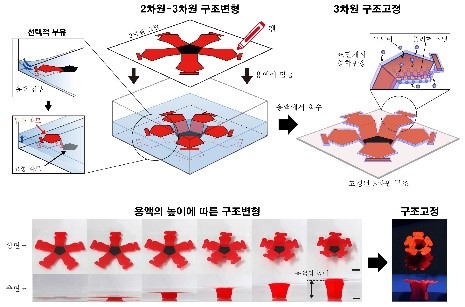
▲ Picture 1. The principle behind how a two-dimensional pen drawing is
converted into a three-dimensional structure
converted into a three-dimensional structure
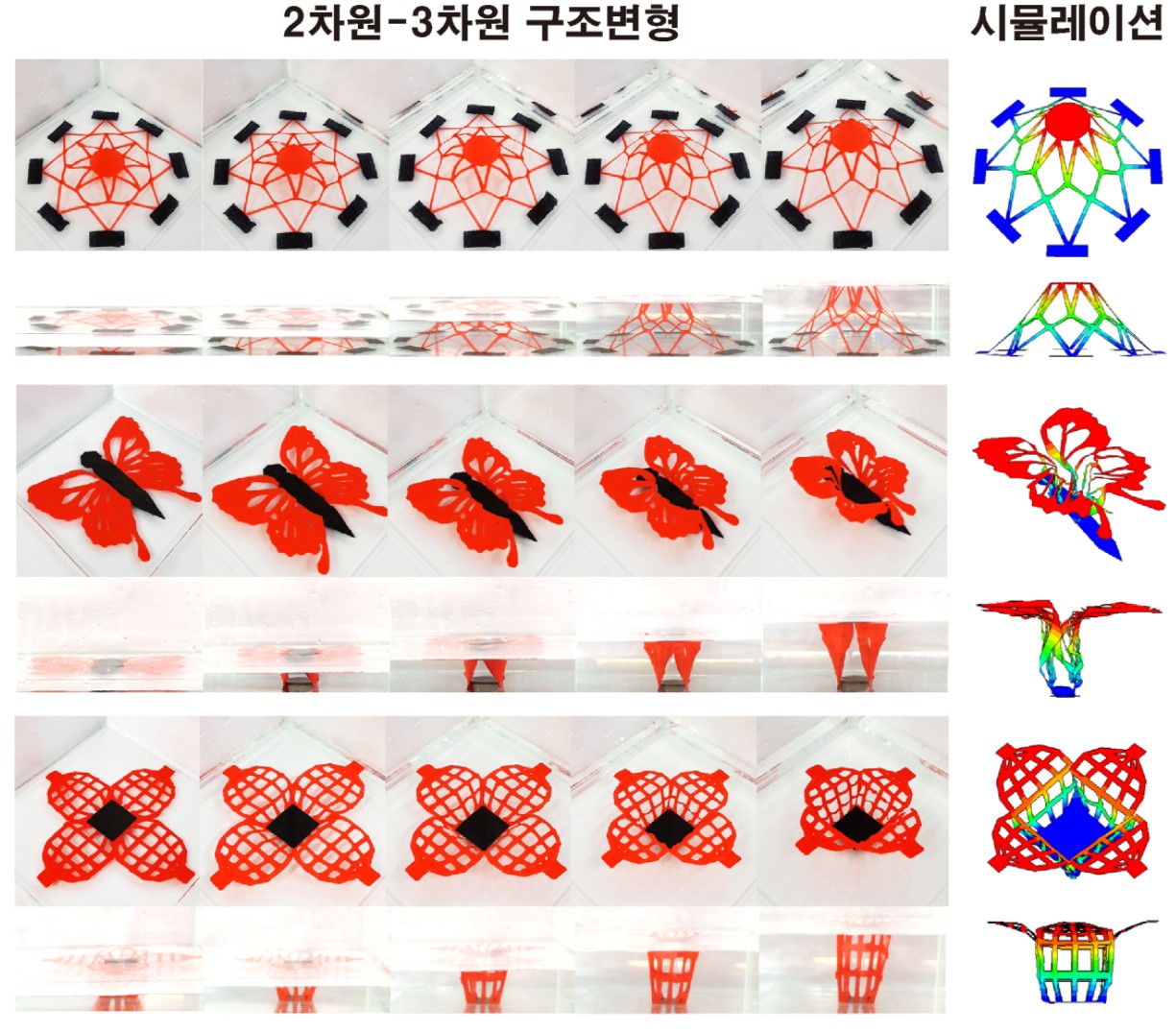
▲ Picture 2. Structural prediction through 2D-3D structural transformation process and simulation
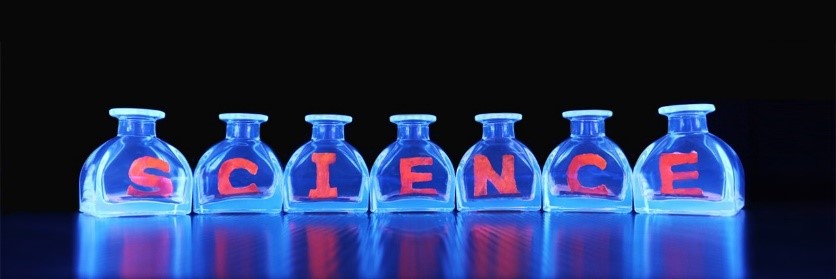
▲ Picture 3. Three-dimensional structural transformation in a narrow space
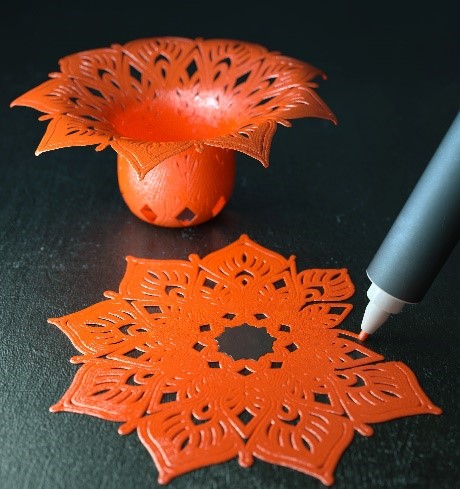
▲ Picture 4. Imagination of a 2-dimensional-3-dimensional structural transformation
담당부서대외협력실
전화번호880-9148