loaction
연구성과
Developed by Professor Byoungho Lee's Team of theSNU College of Engineering, VR display Becomes As Thin As Sunglasses
-
작성자
관리자
-
등록일
2021.04.06.
-
조회수
1158
Developed by Professor Byoungho Lee's Team of
theSNU College of Engineering, VR display Becomes
As Thin As Sunglasses
-Using a lens array, its volume reduced to below 1/6 as when compared to existing VR headsets
-Innovative technology that opens a new chapter for VR devices by improving the fit/wear and environment of use
-Innovative technology that opens a new chapter for VR devices by improving the fit/wear and environment of use

▲(From left) Professor Byoungho Lee of the Seoul National University Department of Electrical and Computer Engineering, Ph.D. Researcher Kiseung Bang
Seoul National University College of Engineering (Dean Kookheon Char) announced on March 25 that Professor Byoungho Lee's team of the Department of Electrical and Computer Engineering has developed a new VR display technology that can drastically reduce the size of a VR (Virtual Reality) device that is in the form of a large headset. This study is expected to solve the problem of the cumbersome and uncomfortable fit when worn, which was the biggest obstacle for the spread of VR to the general public.
The reason for the volume of existing VR displays being so large is due to the space that exists inside. In order to reduce the thickness of this space, the focal length of the VR optical system lens must be reduced, but for the minimum distance that must be secured between the eye and the lens (eye relief), there is the limit of being unable to use a lens with a focal length that is too short. The research team set out to design a new VR optical system that can overcome these limitations.
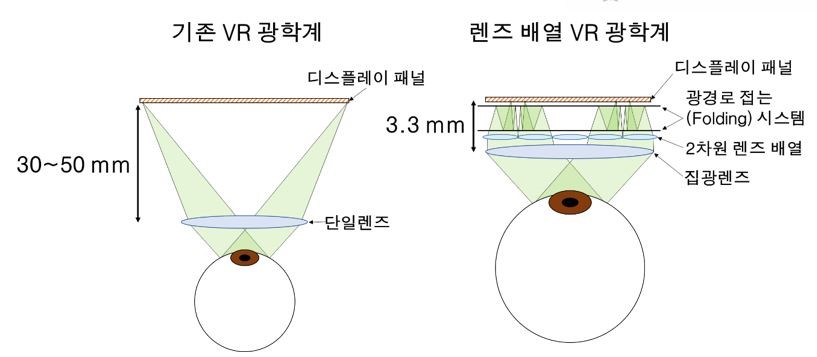
▲ Comparison between the existing VR optical system (left) and the lens array VR optical system proposed in this study (right). By using a two-dimensional lens array and a system that folds the optical path, the volume of space required inside the VR device has been drastically reduced
The lens array VR display proposed by the research team is a structure in which an additional two-dimensional lens arrangement is inserted in addition to the existing lens. A two-dimensional lens arrangement is an optical device with small lenses arranged in a parallel form. In this optical system structure, the actual focal distance of the lens can be reduced while still securing the eye relief distance, reducing the required space by less than half compared to the existing one.
In addition, the team applied the 'folding' technique to control the polarization of light so that light travels back and forth within the space of the optical system. Through this, the same effect as securing a sufficient optical path with only a short physical distance can be obtained, reducing the required space by an additional third. Accordingly, the volume is reduced to less than a sixth in total. As a result, in theory, the research team succeeded in developing a VR optical system design that requires only a space of 3.3mm thickness.
At the core of this technology is light field analysis, which compensates for the inherent shortcomings of lens arrangement and optimizes it to have VR-appropriate performance. The display optics developed by the research team is equipped with excellent optical VR display performance where it is not only thin but has other benefits like having a wide viewing angles of 102 degrees by 102 degrees, a 8.8mm wide eye center position area (eye box, eye-box) and a 20mm eye relief distance.
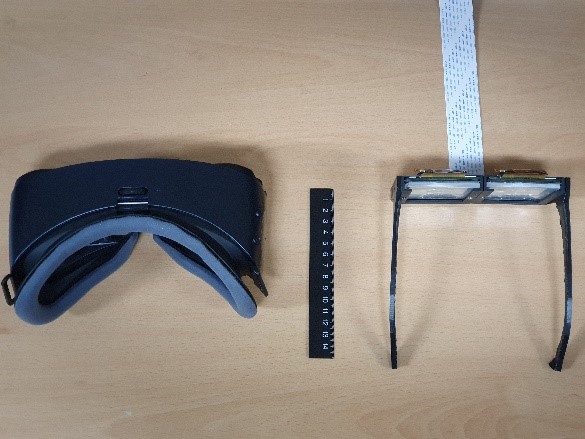
▲Comparison of the size of the VR display. The existing VR headset (left), glass-type VR display prototype developed by Professor Byoungho Lee's team (right)
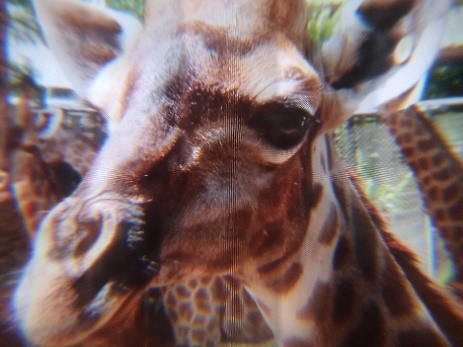
▲ The result of taking a VR video played as a prototype. The horizontal viewing angle of the video is 102 degrees.
The research team revealed a glass-type prototype made using a liquid crystal display (LCD) panel and Fresnel lens. This spectacle-type device is only 8.8mm thick, even when including all the thickness of necessary elements such as the interior space, LCD panel and the Fresnel lens.
"The glass-type VR display that has been designed will solve issues such as that of having an uncomfortable fit and the limitations in its environment of use that have not been solved for the past 10 years," said researcher Kiseung Bang, the first author of the research paper. "By developing its performance such as that regarding its resolution, I wish to implement a virtual reality and augmented reality hardware that can be worn throughout our daily life," he added. "This is an innovative technology that opens a new chapter for VR devices," said Professor Byoungho Lee. This technology has applied for an international patent and can be commercialized within one to two years if there is a company that starts producing the products.
The results of this research will be announced on March 29 at IEEE VR, a world-class academic conference in the field of virtual reality, and was published on March 25 in the prestigious academic journal 'IEEE Transactions on Visualization and Computer Graphics'. The research was supported by the digital content source technology development project of the Ministry of Science and ICT and the
Institute of Information & Communications Technology Planning & Evaluation (IITP).
[Presentation Video]
30 second video
https://youtu.be/W-0q5nisU2s
7 minute presentation
https://youtu.be/8tw8mSYuqX8
[Title of the Research Paper]
K. Bang, Y. Jo, M. Chae, and B. Lee, “Lenslet VR: Thin, flat and wide-FOV virtual reality display using Fresnel lens and lenslet array,” IEEE VR 2021 (2021).
[Link for the Research Paper Presentation]
https://ieeexplore.ieee.org/stamp/stamp.jsp?tp=&arnumber=9384477
담당부서대외협력실
전화번호880-9148