loaction
연구성과
Birth of Unprecedented Transformer Wheel Developed by the Joint Research Team of SNU Professor Kyu-Jin Cho-Hankook Tire
-
작성자
관리자
-
등록일
2021.04.26.
-
조회수
1025
Birth of Unprecedented Transformer Wheel
Developed by the Joint Research Team of SNU Professor Kyu-Jin Cho-Hankook Tire
Developed by the Joint Research Team of SNU Professor Kyu-Jin Cho-Hankook Tire
-Shape-transforming wheels capable of supporting heavy load, expected to be applied
for use as space exploration rovers, etc.
-Inspired by origami, selected as the cover of 'Science Robotics', a prestigious journal
in the field of robotics
for use as space exploration rovers, etc.
-Inspired by origami, selected as the cover of 'Science Robotics', a prestigious journal
in the field of robotics

▲(from left) Dae-Young Lee - post-doctoral researcher at Harvard University, Jae-Kyeong Kim - Ph.D student at Seoul National University, Chang-Young Sohn - Head of Hankook Tire, Jeong Mu Heo of Hankook Tire and Professor Kyu-Jin Cho of Seoul National University.
With a design technology borrowed from origami, the world's first transformer wheel that changes in shape as needed and is capable of withstanding loads as heavy as 1 ton was developed.
Seoul National University College of Engineering (Dean Kookheon Char) announced on April 8 that the joint research team of Professor Kyu-Jin Cho's (Director of the Human-Centered Soft robotic Future Technology Center) research team of the Department of Mechanical Engineering and the Hankook Tire and Technology team developed a transformer wheel applicable to a vehicle of up to 1-ton in weight.
Through the collaboration between the design technology from the SNU research team's side and the material/manufacturing technology of the Hankook Tire research team, this achievement was recognized as research that suggested a new possibility for variable structures and was therefore published on April 8 in 'Science Robotics', a internationally renowned journal and was selected as the cover paper of its April issue.
The transformer wheel that was developed is designed to ensure high maneuverability by changing to a smaller shaped wheel when on paved roads to enable stable and agile driving while on unpaved, rough roads, it transforms into a wheel that is larger in diameter and has projections. The wheels can withstand a load of more than 1 ton and can vary in diameter from 450mm to 800mm. This technology is expected to be used in fields requiring high mobility in unpredictable environments, such as that of indoor service robots, delivery robots, and space exploration rovers.
The simple yet unique method of changing an object's shape through the act of folding has drawn significant attention not just in our daily lives or during our hobbies but also in various fields such as that of art, education and mathematics. Furthermore, it is gradually expanding its application range to various high-tech fields ranging from micro robots to space structures. In particular, the method used in this study, which implements origami structures by attaching a piece of hard plate to a fabric or thin film type material, has great potential as it is much easier to manufacture than the traditional design method using mechanical elements, but its applicability has been greatly restricted due to limitations in its load-bearing capacity.
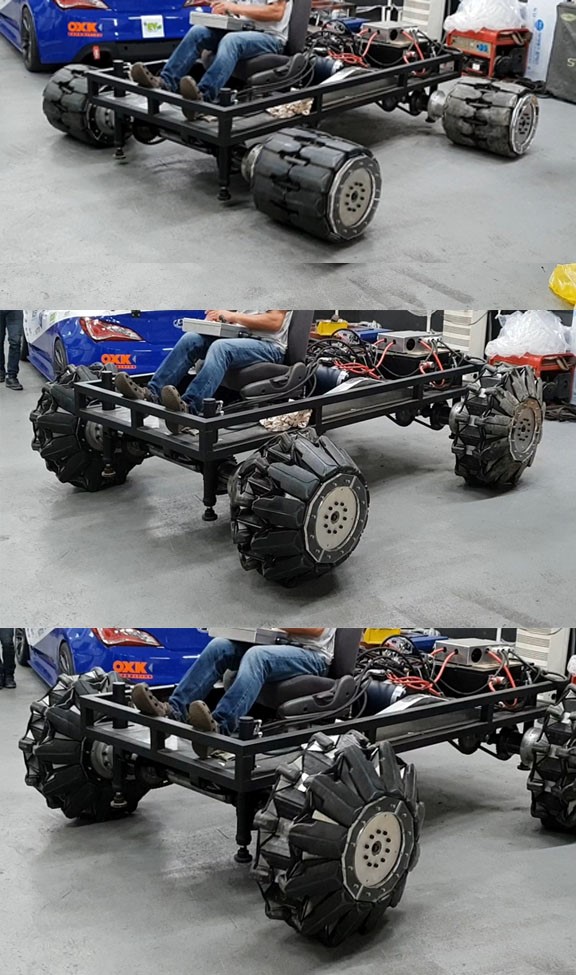
▲ Transformer wheel in the process of changing in shape
In this paper, the researchers proposed a design/manufacturing method that enables origami structures to support heavy loads. The non-folding facet of the origami structure is made of the aluminum 60 series, which is used as an aircraft material, allowing it to be light, thin and of high rigidity. At the foldlines, fabrics manufactured using special treatment were utilized so that the nylon and PET materials used for the carcass (textile cord) that make up the skeleton of the tire can be prevented from unwinding or being damaged while making sure that the entire structure remains strongly connected even under heavy loads.
Even if a material with high rigidity is used, it is necessary that the thickness of the material also increases to secure a high load-bearing capacity. However, most of the existing origami design methods assume an ideal situation (ignoring the thickness and elasticity of the material), so the existing methods could not be applied as they were. Therefore, in this study, a new origami design rule that takes into consideration the thickness and elasticity of the material was proposed and the target shape change was achieved through this.
The proposed origami structure not only has a great advantage in manufacturing and assemblage compared to the traditional mechanical joint method, but the implementation of a flexible joint made of fabric also achieved high resistance to external shock and vibration. In addition, despite the inclusion of complex mechanical mechanisms, the weight is comparable to that of a conventional car wheel. Another advantage of the origami method is that it is resistant to friction and dust contamination. There is no friction between sections because the fabric itself moves when being folded rather than having the different sections moving relative to each other and there is also freedom from the problem of structures being damaged due to contaminants such as dust accumulating between parts which can be fatal to the wheel.
“This project is an example of excellent synergistic collaboration between new ideas of universities with the technological prowess of companies. It was an attempt to break the stereotype that tires must always be of a constant shape and was an attempt to show willingness and eagerness for change. The developed technology is expected to be highly utilized not only in the tire field but also in the field of mobility service. Hankook Tire & Technology will stop not just at the field of tires but will continue to challenge itself for further change,” said Bon-Hee Ku, the Senior Managing Director at Hankook Tire & Technology Co Ltd., revealing the significance of this project.
“The research that started with a small wheel made by folding paper in 2013 met a company with tire manufacturing technology which allowed it to take such a great leap forward. This study proves the possibility of variable wheel technology and further research and development is required for it to be applied to general mobility in the future. A small seed, after its extensive periods technical accumulation, has met a great opportunity and has finally sprouted. It will take more time for it to bear fruit but without any seeds, there cannot be any fruit. We hope that this achievement will be valued not by the performance of the wheels that we see right now, but for its process that has shown how innovation is made,” said Professor Kyu-Jin Cho of Seoul National University.
This study, through various technical and theoretical amendments, was completed after the concept of this research was unveiled in the 4th project of Hankook Tire TNDL (The Next Driving Lab) in 2019 and the design and production of vehicles for the transformer wheels were conducted by the KAIST Professor Naehyuck Chang of EMVcon and CEO Heung-seop Kim of OXK.
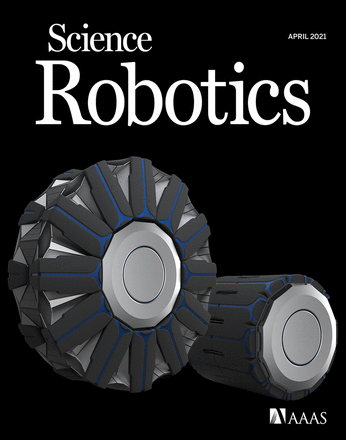
▲ Selected to be the cover paper for the April issue of 'Science Robotics'
담당부서대외협력실
전화번호880-9148