loaction
- About
-
Academics
-
Undergraduate Programs
- Civil, Urban and Environmental Engineering
- Architecture and Architectural Engineering
- Mechanical Engineering
- Industrial Engineering
- Energy Resources Engineering
- Nuclear Engineering
- Materials Science and Engineering
- Electrical and Computer Engineering
- Naval Architecture and Ocean Engineering
- Computer Science and Engineering
- Aerospace Engineering
- Chemical and Biological Engineering
-
Graduate Programs
- Civil, Urban and Environmental Engineering
- Architecture and Architectural Engineering
- Mechanical Engineering
- Industrial Engineering
- Energy Systems Engineering
- Materials Science and Engineering
- Electrical and Computer Engineering
- Naval Architecture and Ocean Engineering
- Computer Science and Engineering
- Aerospace Engineering
- Chemical and Biological Engineering
- Interdisciplinary Program in Technology, Management, Economics and Policy
- Interdisciplinary Program in Urban Design
- Interdisciplinary Program in Bioengineering
- Interdisciplinary Program in Artificial Intelligence
- Interdisciplinary Program in Intelligent Space and Aerospace Systems
- Chemical Convergence for Energy and Environment Major
- Multiscale Mechanics Design Major
- Hybrid Materials Major
- Double Major Program
- Open Programs
-
Undergraduate Programs
- Research
- Prospective Students
- Campus Life
- International Office
- Communication
Industrial Engineering
-
 ChairPark, Woojin
 -
 Tel02-880-7105
 -

-

Introduction

The conductor leading the orchestra of engineers
Industrial engineering is a discipline to coordinate the various fields of industrial systems. It covers scientific theory and practical methodologies to plan and operate a firm’s management strategy based on the engineering technologies and management.
The leader guiding the new fields
Industrial engineers are leading not only the traditional areas in production but also new areas such as transportation, network, logistics, healthcare and service industries. Marketing, finance and human resource management are also the fields in which industrial engineers starts to play their role.
The engineer who sees the wood and the trees
The purpose of industrial engineering education is to nurture engineers who sees the woods by making decisions on the whole system and sees the trees by having knowledge in each component of that complex system.
Research Areas in Detail
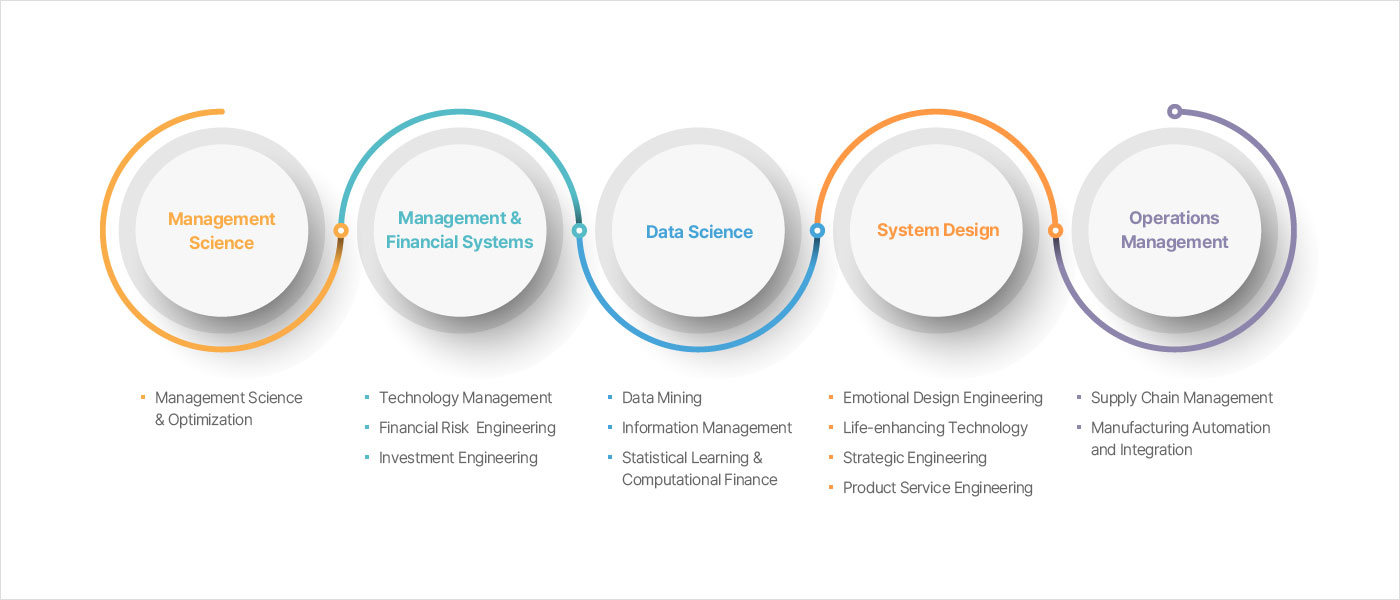
The curriculum and research organization of the Department of Industrial Engineering are divided into three main stages to ensure the ability to analyze and solve extensive and complex problems
In the first stage, students learn theoretical and quantitative methodologies based on subjects such as mathematics, statistics, management science, computer engineering, and economics.
In the second stage, students acquire experiential and practical engineering skills through experimentation, practical training, design, and fabrication.
In the final stage, students enhance their expertise in analyzing problems and deriving practical alternatives by focusing on real-life cases.
To achieve this process, the department operates a number of research labs that pursue expertise and efficiency.