loaction
- About
-
Academics
-
Undergraduate Programs
- Civil, Urban and Environmental Engineering
- Architecture and Architectural Engineering
- Mechanical Engineering
- Industrial Engineering
- Energy Resources Engineering
- Nuclear Engineering
- Materials Science and Engineering
- Electrical and Computer Engineering
- Naval Architecture and Ocean Engineering
- Computer Science and Engineering
- Aerospace Engineering
- Chemical and Biological Engineering
-
Graduate Programs
- Civil, Urban and Environmental Engineering
- Architecture and Architectural Engineering
- Mechanical Engineering
- Industrial Engineering
- Energy Systems Engineering
- Materials Science and Engineering
- Electrical and Computer Engineering
- Naval Architecture and Ocean Engineering
- Computer Science and Engineering
- Aerospace Engineering
- Chemical and Biological Engineering
- Interdisciplinary Program in Technology, Management, Economics and Policy
- Interdisciplinary Program in Urban Design
- Interdisciplinary Program in Bioengineering
- Interdisciplinary Program in Artificial Intelligence
- Interdisciplinary Program in Intelligent Space and Aerospace Systems
- Chemical Convergence for Energy and Environment Major
- Multiscale Mechanics Design Major
- Hybrid Materials Major
- Double Major Program
- Open Programs
-
Undergraduate Programs
- Research
- Prospective Students
- Campus Life
- International Office
- Communication
News
SNU Engineering Ph.D. Student Young-Seok Lee Becomes First Korean to Win Best Student Paper Award at World’s Largest Wireless Power Transfer Conference
-
Uploaded by
대외협력실
-
Upload Date
Aug 19, 2026
-
Views
28
SNU Engineering Ph.D. Student Young-Seok Lee Becomes First Korean to Win Best Student Paper Award at World’s Largest Wireless Power Transfer Conference
- Sole winner selected from 145 papers submitted by researchers from 26 countries, marking the first top Best Student Paper Award for a researcher affiliated with a Korean institution
- World’s first end-to-end (DC-to-DC) efficiency optimization design method achieves 97% of the theoretical maximum efficiency
Expected to advance next-generation wireless power transfer technologies for long-range wireless charging, 6G, space-based solar power, and more
Expanded study accepted for publication in IEEE Transactions on Microwave Theory and Techniques (IEEE TMTT), a leading journal in the microwave field
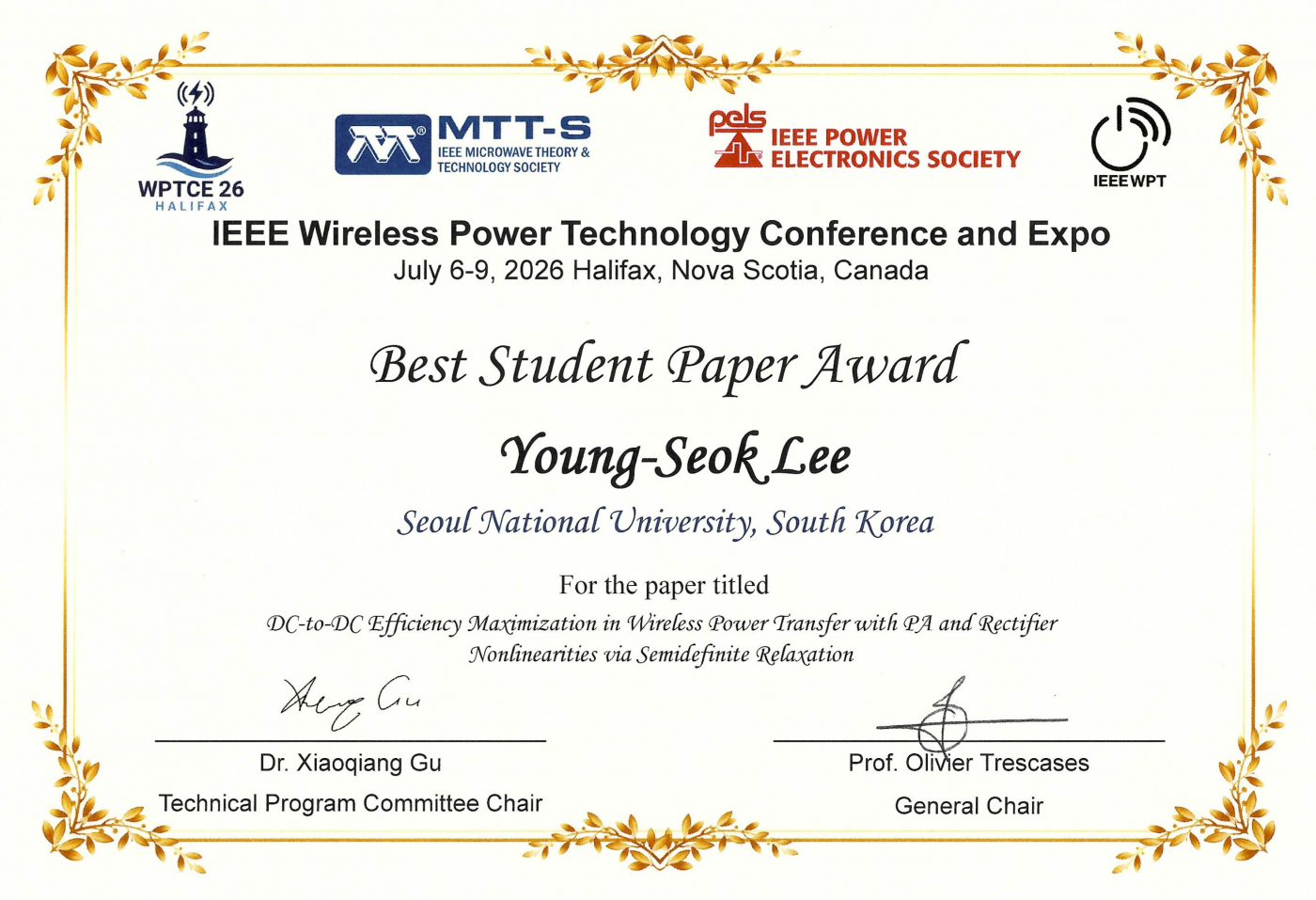
▲ Certificate for the IEEE WPTCE Best Student Paper Award
Young-Seok Lee, a Ph.D. student in the research group of Professor Jungsuek Oh in the Department of Electrical and Computer Engineering at Seoul National University College of Engineering, has received the Best Student Paper Award at the IEEE Wireless Power Technology Conference and Expo 2026 (IEEE WPTCE 2026), the world’s largest international conference on wireless power transfer (WPT). This marks the first time that a researcher affiliated with a Korean institution has won first place in the Best Student Paper Award since WPTC and WoW were merged into WPTCE in 2023.
Seoul National University College of Engineering announced that Lee’s paper was selected as the sole winner following a review by the Technical Program Committee (TPC) from among 145 papers submitted from 26 countries. The award-winning paper presents an end-to-end, or DC-to-DC, design method that optimizes actual power efficiency across the entire wireless power transfer system, from transmitter to receiver.
Wireless power transfer is a technology that transmits electrical power without wires and is currently used primarily over short distances, as in smartphone wireless charging. When radio-frequency (RF) electromagnetic waves are used, power can be delivered to devices several meters away. In principle, the technology could even be used to transmit power generated by space-based solar power systems back to Earth, making it a promising technology for future applications.
Until now, the performance of wireless power transfer systems has largely been evaluated in terms of how effectively radio waves emitted by a transmitting antenna reach a receiving antenna. In practical use, however, what matters to users and industry is how much of the electricity drawn from the outlet actually ends up stored in the battery. Using a water-supply analogy, previous approaches have focused mainly on how much water leaks from the pipes along the way, whereas the more important question is how much water ultimately reaches the storage tank relative to the electricity consumed by the pump.
Lee developed the first design framework to jointly optimize, as a single problem, the entire energy conversion process in a multiple-input multiple-output (MIMO) antenna system, from the DC power consumed by the transmitter’s power amplifiers (PAs) to the DC power produced by the receiver’s rectifiers.
In wireless power transfer, the greatest power losses occur not in the propagation of radio waves through the air, but in the transmitter’s power amplifiers, which convert electrical power into RF signals, and the receiver’s rectifiers, which convert RF signals back into electricity. Even state-of-the-art devices currently achieve maximum efficiencies of only around 70% for each conversion stage, making system design that considers both components together a key challenge in improving overall performance.
Power amplifiers and rectifiers are also nonlinear devices, meaning that their outputs do not change proportionally with their inputs. Because transmitter signal settings simultaneously alter the operating points of the power amplifiers and the distribution of received power, optimizing each stage independently makes it difficult to achieve the highest possible efficiency for the system as a whole. Previous studies have gradually expanded their design scope from the wireless link to include rectifiers and the full set of transmitting and receiving components. However, they have either remained limited to simple single-antenna configurations or relied on mathematically approximated device models, with no validation using actual hardware.
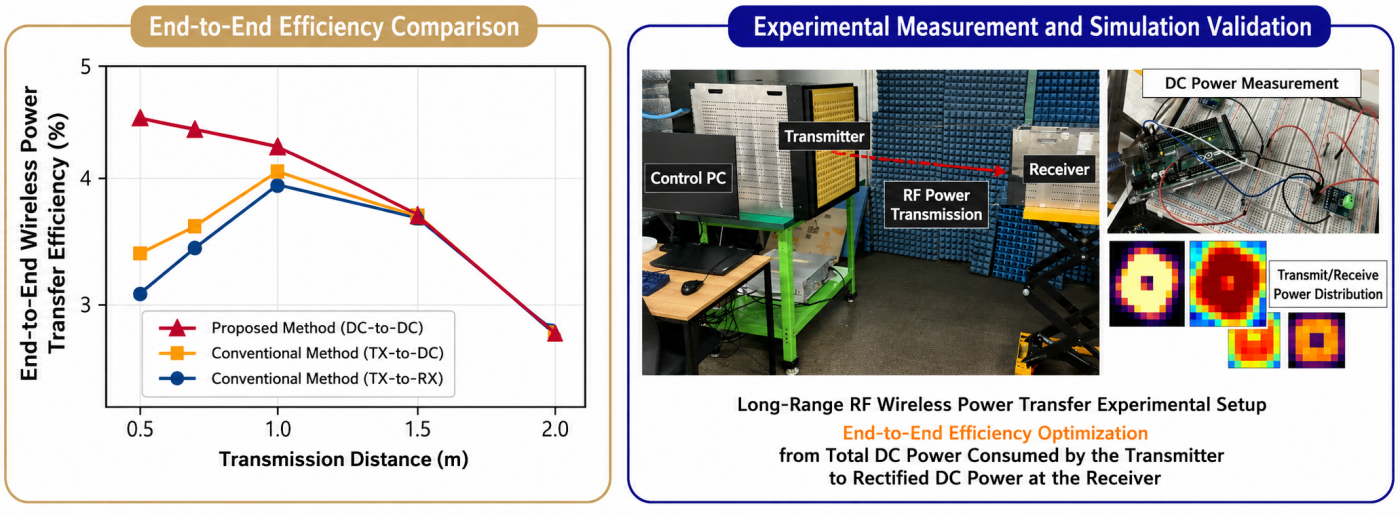
▲ (Left) Comparison of end-to-end efficiency between the conventional method and the proposed method.
Although the absolute efficiency of the experimental setup is relatively low because it uses commercially available chips, simulations show that applying the proposed method directly to current state-of-the-art (SOTA) devices would achieve an end-to-end efficiency of 32.95%.
(Right) Experimental setup for long-range RF-based wireless power transfer.
The simulation results were validated through measurements obtained using the proposed method.
The research team directly incorporated experimentally measured characteristics of the power amplifiers and rectifiers into the optimization model. The researchers then used semidefinite relaxation to simultaneously optimize the signal amplitudes and phases of hundreds of antennas. A key feature of this approach is that it does more than identify a highly efficient solution: it also provides a theoretical upper bound on the maximum efficiency achievable under the given hardware conditions. This allows designers to quantitatively assess how closely their systems approach the theoretical limit. The design method proposed by the team achieved more than 97% of the theoretical maximum efficiency.
In performance comparisons, the proposed method achieved 48% higher end-to-end efficiency than conventional wireless-link optimization methods. Experiments conducted at 5.64 GHz using a custom-built 16×16 transmitting antenna array and 5×5 rectenna array also showed that the discrepancy between predicted and experimentally measured values remained within 5%. The researchers explained that the proposed method is not tied to specific components and can therefore be applied directly to a wide range of wireless power transfer systems simply by substituting the relevant device-characteristic data.
The study is expected to help shift the benchmark for wireless power transfer system design from “radio-wave transfer efficiency” to “actual power efficiency.” Potential applications include long-range wireless charging that powers multiple devices in offices or homes without cables; 6G integrated sensing and communication (ISAC) systems that simultaneously perform communications, sensing, and power transfer; drones and unmanned aerial vehicles that can be recharged in flight; and terrestrial power transmission for space-based solar power systems (SSPS).

▲ From left: Young-Seok Lee, Ph.D. student; Taeyeong Yoon, Ph.D. student; Professor Emeritus Sangwook Nam; and Professor Jungsuek Oh, Department of Electrical and Computer Engineering, Seoul National University. Professors Nam and Oh jointly supervised the research.
Professor Jungsuek Oh said, “This research is particularly significant because it addresses, in an integrated manner, the nonlinear characteristics of transmitting and receiving components that have long been overlooked in discussions of wireless power transfer efficiency, while also establishing a theoretical upper bound.”
He added, “We plan to extend this work by developing algorithms that can operate in real time while still approaching the optimized efficiency demonstrated in this study, bringing the technology one step closer to practical implementation.”
Professor Emeritus Sangwook Nam, who jointly supervised the research, said, “I am pleased that our research achievements have received international recognition. Low efficiency has long been one of the major obstacles to the commercialization of long-range wireless charging, and I hope the optimization method presented in this study will help lower that barrier.”
Young-Seok Lee, the first author of the study, is currently pursuing his Ph.D. in the Department of Electrical and Computer Engineering at Seoul National University, where he conducts research on wireless power transfer system design and optimization. After completing his Ph.D., he plans to continue research in wireless power transfer and phased-array antennas, with the long-term goal of expanding his work to power transmission systems for space-based solar power (SSPS).
Lee was also selected as a recipient of the IEEE MTT-S Student Travel Grant ahead of the conference and received US$1,000 in support. In addition, an expanded version of this research, titled “An End-to-End DC-to-DC Efficiency Optimization and Design Analysis for MIMO Wireless Power Transfer Systems,” was accepted for publication in June in IEEE Transactions on Microwave Theory and Techniques (IEEE TMTT), one of the most prestigious journals in the microwave field.
Lee previously won the Grand Prize (first place) in the Outstanding Student Paper Award at the 2025 Winter Annual Conference of the Korean Institute of Electromagnetic Engineering and Science. He also received the Best Paper Award (second place) at the 2024 International Symposium on Antennas and Propagation (ISAP), a leading international conference representing the Asia-Pacific region in the fields of antennas and radio-wave propagation.
This research was supported by the Institute of Information & Communications Technology Planning & Evaluation (IITP) under a grant funded by the Ministry of Science and ICT (No. 2019-0-00098, Development of Advanced and Integrated Software for Electromagnetic Analysis).
[Reference Materials]
Title / Journal: An End-to-End DC-to-DC Efficiency Optimization and Design Analysis for MIMO Wireless Power Transfer Systems, IEEE Transactions on Microwave Theory and Techniques (TMTT)
DOI: https://doi.org/10.1109/TMTT.2026.3714844
[Contact Information]
Young-Seok Lee, Ph.D. Student, Department of Electrical and Computer Engineering
Seoul National University / ryanlee@snu.ac.kr