loaction
- About
-
Academics
-
Undergraduate Programs
- Civil, Urban and Environmental Engineering
- Architecture and Architectural Engineering
- Mechanical Engineering
- Industrial Engineering
- Energy Resources Engineering
- Nuclear Engineering
- Materials Science and Engineering
- Electrical and Computer Engineering
- Naval Architecture and Ocean Engineering
- Computer Science and Engineering
- Aerospace Engineering
- Chemical and Biological Engineering
-
Graduate Programs
- Civil, Urban and Environmental Engineering
- Architecture and Architectural Engineering
- Mechanical Engineering
- Industrial Engineering
- Energy Systems Engineering
- Materials Science and Engineering
- Electrical and Computer Engineering
- Naval Architecture and Ocean Engineering
- Computer Science and Engineering
- Aerospace Engineering
- Chemical and Biological Engineering
- Interdisciplinary Program in Technology, Management, Economics and Policy
- Interdisciplinary Program in Urban Design
- Interdisciplinary Program in Bioengineering
- Interdisciplinary Program in Artificial Intelligence
- Interdisciplinary Program in Intelligent Space and Aerospace Systems
- Chemical Convergence for Energy and Environment Major
- Multiscale Mechanics Design Major
- Hybrid Materials Major
- Double Major Program
- Open Programs
-
Undergraduate Programs
- Research
- Prospective Students
- Campus Life
- International Office
- Communication
News
SNU Professor Sang Woo Seo’s Team Boosts Cell Factory Productivity by Turning Easily Degraded mRNA into ‘Rings’
-
Uploaded by
대외협력실
-
Upload Date
Sep 15, 2026
-
Views
77
SNU Professor Sang Woo Seo’s Team Boosts Cell Factory Productivity by Turning Easily Degraded mRNA into ‘Rings’
- CRESEnT technology circularizes linear mRNA, simultaneously improving stability and protein expression efficiency
- Validated in Escherichia coli, Bacillus subtilis, and Corynebacterium glutamicum, increasing production of valuable compounds by up to 2.74-fold
- Study published in the international journal Nucleic Acids Research
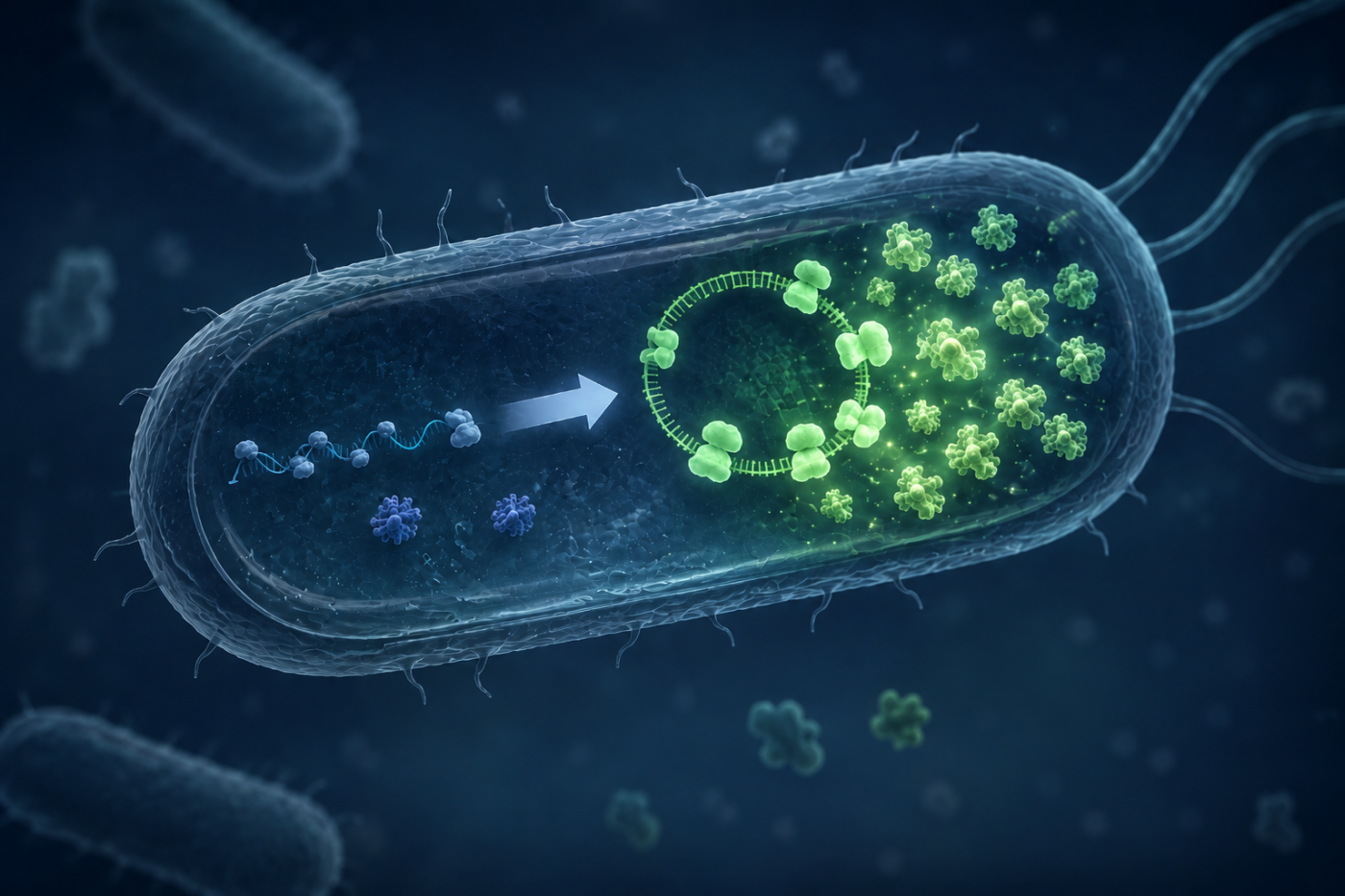
▲ Conceptual image illustrating CRESEnT technology, which circularizes linear mRNA inside microbial cells to increase protein production
A synthetic biology technology has been developed that converts easily degraded messenger RNA (mRNA) into a ring-shaped form inside microbial cells, increasing protein production.
A research team led by Professor Sang Woo Seo of the Department of Chemical and Biological Engineering at Seoul National University College of Engineering has developed a synthetic biology technology that converts linear mRNA into a circular form inside microbial cells, simultaneously increasing mRNA stability and protein production efficiency. The team named the technology CRESEnT (Circular RNA Expression for Stable and Enhanced Translation).
Compared with a control in which circularization did not occur, CRESEnT increased fluorescent protein production by up to 5.95-fold and intracellular mRNA levels by 3.95-fold. The amount of protein produced per mRNA molecule also increased by 1.51-fold. The researchers confirmed the technology’s effectiveness not only in Escherichia coli but also in Bacillus subtilis and Corynebacterium glutamicum, and applied it to the production of valuable compounds including flaviolin, itaconic acid, lycopene, and violacein.
The findings were published in the international life sciences journal Nucleic Acids Research.
Microorganisms are widely used as “cell factories” to produce biofuels, environmentally friendly chemicals, pharmaceutical ingredients, and other products. Amino acids used in food seasonings and livestock feed are also produced through microbial fermentation on a scale of millions of tons annually. The productivity of these cell factories depends on whether the enzymes needed to produce the target compounds can be generated in sufficient quantities inside the cells.
Until now, efforts to increase gene expression have focused primarily on controlling elements involved in the initial stages of reading genetic information, such as promoters and ribosome-binding sites (RBSs). However, mRNA itself—the blueprint for protein production—is highly unstable. Unlike mRNA in eukaryotic cells, bacterial mRNA lacks protective structures at its ends, such as a cap or poly(A) tail, leaving it readily exposed to intracellular RNA-degrading enzymes, or RNases. As a result, bacterial mRNA is rapidly degraded, with a lifespan of only a few minutes.
This rapid degradation of mRNA is advantageous for microorganisms in nature, where they must adapt quickly to environmental changes. In cell factories, however, where a specific substance must be produced continuously under controlled conditions, the rapid disappearance of mRNA—the production blueprint—can reduce production efficiency. Consequently, extending the length of time that mRNA remains intact has emerged as an important factor in improving productivity.
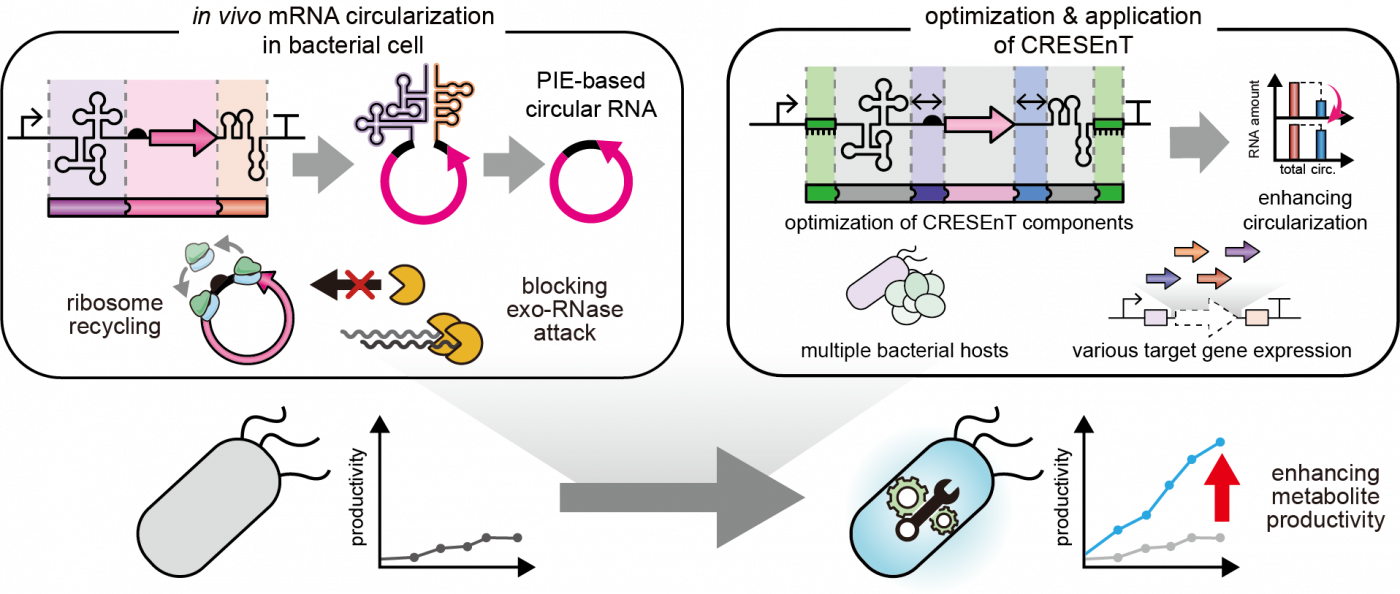
▲ Schematic illustration of the CRESEnT mRNA circularization system inside microbial cells
Rather than increasing the amount of mRNA, the research team addressed this problem by changing its “shape.” Linear mRNA, which resembles a thread with two open ends, can be targeted by enzymes that degrade RNA from its ends. Connecting those ends to form a ring, however, can reduce its exposure to these degradation pathways.
In nature, there are RNA segments known as introns that possess a “self-splicing” ability, allowing them to cut out part of themselves and then reconnect the remaining segments. The researchers rearranged the front and back portions of an intron in reverse order, designing the target gene’s mRNA so that its two ends would join together inside the cell to form a circular structure. This enabled mRNA to be circularized directly inside living E. coli cells without adding separate enzymes or performing additional processing in a test tube.
The team also identified two design principles for improving CRESEnT efficiency. The first concerns the length of the untranslated regions (UTRs). UTRs do not encode protein information but serve as flanking regions that influence mRNA stability. If a UTR is too long, a larger region is exposed to RNA-degrading enzymes; if it is too short, the intron may not fold properly, reducing circularization efficiency. Through experiments, the researchers identified the optimal lengths at both ends. The second principle involves a mechanism that helps the two separated intron fragments bind precisely to one another. When the researchers added short sequences designed to interlock like the teeth of a zipper, the two fragments bound more efficiently, increasing circularization efficiency.
When the optimized CRESEnT system was applied, protein production increased by up to 5.95-fold and intracellular mRNA levels by 3.95-fold compared with a control in which circularization did not occur. In experiments that tracked changes in mRNA after transcription was artificially halted, linear mRNA declined rapidly, whereas circular mRNA showed almost no decrease. These results confirmed that the increase in protein expression was associated with improved RNA stability. Moreover, protein production per mRNA molecule increased by 1.51-fold, demonstrating that the circular structure also contributed to improved protein production efficiency.
A key strength of CRESEnT is its versatility. The researchers showed that the increase in protein production remained consistent under a range of expression conditions combining promoters and ribosome-binding sites of different strengths, demonstrating that CRESEnT can be used alongside existing gene-expression control technologies. The system was also applied to several types of fluorescent proteins and to a large gene of approximately 3.5 kb. In addition to multiple strains of E. coli, the same effect was confirmed in Bacillus subtilis and Corynebacterium glutamicum. These results demonstrate that CRESEnT is a platform technology that is not limited to a particular microorganism and can be broadly applied to a variety of industrial microorganisms.
The research team also applied CRESEnT to the production of useful compounds. When genes encoding enzymes involved in metabolic pathways were expressed using CRESEnT, production of the natural pigment flaviolin increased by 2.74-fold, while itaconic acid, a feedstock for bioplastics, increased by 1.52-fold; the antioxidant compound lycopene increased by 1.60-fold; and violacein, which has antimicrobial and anticancer activity, increased by 1.62-fold. In other words, the same effect was observed in the production of industrially useful compounds.
CRESEnT can be applied to the production of a variety of proteins and metabolites simply by replacing the gene inside the system while retaining the circularization machinery. The researchers expect that the technology could eventually be used in cell factories that produce high-value products, including pharmaceuticals and environmentally friendly biomaterials.

▲ From left: Professor Sang Woo Seo, Seongjun Park, and Dr. Giho Kim, postdoctoral researcher, Department of Chemical and Biological Engineering, Seoul National University
Professor Sang Woo Seo said, “This study moves beyond the conventional perspective of focusing only on the transcription and translation stages when regulating gene expression and introduces a new dimension of ‘RNA topology engineering,’ in which the structure of RNA itself is altered.” He added, “Because it can be layered together with existing synthetic biology tools, the technology could be extended not only to improving the productivity of microbial cell factories but also to areas such as the development of therapeutics using living microorganisms.”
Co-first authors Seongjun Park and Dr. Giho Kim conduct research on synthetic biology-based gene expression control technologies and the development of microbial cell factories. The two researchers plan to continue follow-up studies in the field of RNA engineering-based biomanufacturing platforms.
This research was supported by the C1 Gas Refinery Value-Up Program, the Core Technology Development Program for Synthetic Biology, and the Biofoundry Infrastructure Technology Development Program of the National Research Foundation of Korea, among other programs.
[Reference Materials]
Title / Journal: Programmable in vivo mRNA circularization for enhanced gene expression in bacteria, Nucleic Acids Research (2026)
DOI: 10.1093/nar/gkag854
[Contact Information]
Professor Sang Woo Seo, Department of Chemical and Biological Engineering
Seoul National University / +82-2-880-2274 / swseo@snu.ac.kr / @SangWooSeo_SNU