loaction
- About
-
Academics
-
Undergraduate Programs
- Civil, Urban and Environmental Engineering
- Architecture and Architectural Engineering
- Mechanical Engineering
- Industrial Engineering
- Energy Resources Engineering
- Nuclear Engineering
- Materials Science and Engineering
- Electrical and Computer Engineering
- Naval Architecture and Ocean Engineering
- Computer Science and Engineering
- Aerospace Engineering
- Chemical and Biological Engineering
-
Graduate Programs
- Civil, Urban and Environmental Engineering
- Architecture and Architectural Engineering
- Mechanical Engineering
- Industrial Engineering
- Energy Systems Engineering
- Materials Science and Engineering
- Electrical and Computer Engineering
- Naval Architecture and Ocean Engineering
- Computer Science and Engineering
- Aerospace Engineering
- Chemical and Biological Engineering
- Interdisciplinary Program in Technology, Management, Economics and Policy
- Interdisciplinary Program in Urban Design
- Interdisciplinary Program in Bioengineering
- Interdisciplinary Program in Artificial Intelligence
- Interdisciplinary Program in Intelligent Space and Aerospace Systems
- Chemical Convergence for Energy and Environment Major
- Multiscale Mechanics Design Major
- Hybrid Materials Major
- Double Major Program
- Open Programs
-
Undergraduate Programs
- Research
- Prospective Students
- Campus Life
- International Office
- Communication
News
SNU Professor Emeritus Mooyoung Han Receives IWA Award for ‘Outstanding Contribution to Water Management & Science’
-
Uploaded by
대외협력실
-
Upload Date
Oct 06, 2026
-
Views
63
SNU Professor Emeritus Mooyoung Han Receives IWA Award for ‘Outstanding Contribution to Water Management & Science’
- Internationally recognized for more than 30 years of research and practical work on rainwater management
- Shifts the perspective on rainwater from something to be “drained away” to a valuable resource through decentralized water management
- Expands school and community participation through the “Rain School Initiative,” registered with the UN Water Action Agenda
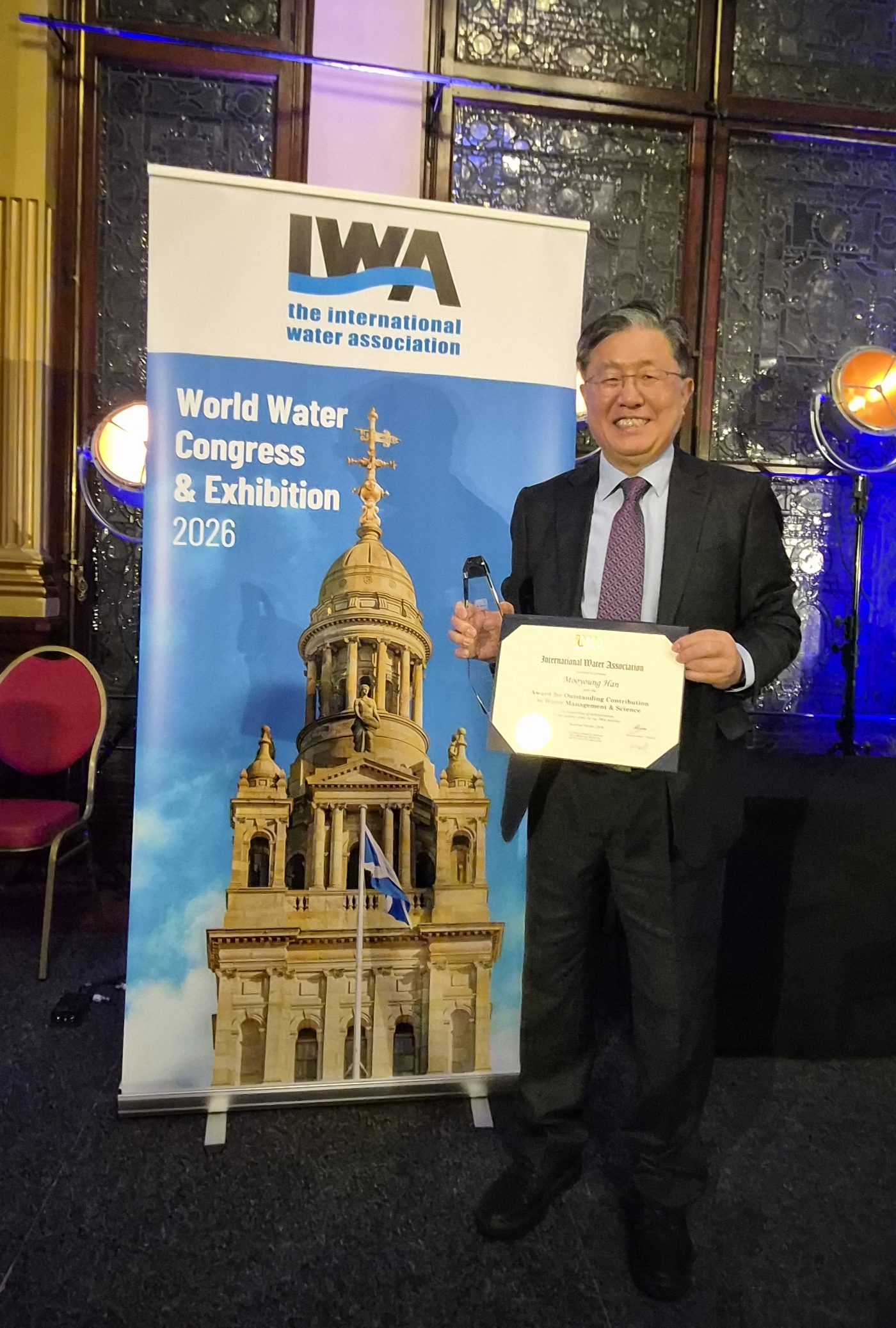
▲ Professor Emeritus Mooyoung Han of Seoul National University poses with his certificate and award after receiving the IWA honor in Glasgow, United Kingdom, on October 3.
Professor Emeritus Mooyoung Han of the Department of Civil and Environmental Engineering at Seoul National University College of Engineering has received the International Water Association (IWA) Award for Outstanding Contribution to Water Management & Science.
The award recognizes Professor Han’s contributions over more than 30 years in connecting rainwater research and scientific achievements with practical water management, education, and community initiatives, and in expanding these efforts internationally.
The award ceremony took place on October 3 at the IWA Presidents’ Dinner at Glasgow City Chambers in the United Kingdom. The event was held ahead of the IWA World Water Congress & Exhibition, which takes place in Glasgow from October 4 to 8.
The IWA is an international network bringing together water researchers and professionals, public agencies, and related organizations from around the world. The award is one of the major honors under the IWA Member Honours program and is presented to members who have made outstanding achievements in research, science, and water management.
From ‘Rainwater to Be Drained Away’ to a ‘Valuable Water Resource’
For more than 30 years, Professor Emeritus Han has pursued research and practical initiatives based on the view that rainwater is not simply water that should be drained away as quickly as possible, but a valuable water resource that should be collected, stored, used, and returned to nature.
While conventional urban water management has focused on supplying water through large-scale centralized infrastructure such as dams, water supply systems, and sewer systems, as well as rapidly draining rainwater, Han has consistently emphasized the need for decentralized water management, in which rainwater is collected, stored, and used close to where it falls. During his tenure at Seoul National University, he conducted research on rainwater storage and utilization, urban water cycles, and decentralized water management, while working to apply these findings in cities and local communities.
A Shift in the Water Management Paradigm in the Era of Climate Crisis
As climate change intensifies droughts, floods, extreme heat, and water shortages around the world, perceptions of rainwater are also changing. Collecting and storing rainwater close to where it falls and using it when needed can help communities prepare for water shortages while reducing the volume of runoff released all at once during heavy rainfall and contributing to the restoration of local water cycles.
This represents a shift in perspective from viewing rainwater as “water that must be treated or drained away” to seeing it as “a resource that should be managed and utilized.” Such decentralized rainwater management is drawing attention as an approach that can strengthen community water resilience in the era of climate crisis.
This is precisely the shift Han has long advocated. Rather than attempting to solve every water-related problem through large-scale infrastructure alone, he has called for citizens, schools, and local communities to become active participants in water management and to complement existing water management systems by making greater use of rainwater available within their own communities.
Expanding Rainwater Research into Action in Schools and Communities
Han’s rainwater research has recently evolved into the school- and community-centered Rain School Initiative. Registered with the UN Water Action Agenda, this water action initiative is a school-based decentralized water management model in which rainwater falling on school roofs is collected, stored, and treated for safe use, while students, teachers, and parents participate directly in the water management process.
Rain School is not simply a project to install rainwater tanks at schools. Its goal is to use schools as hubs for simultaneously advancing safe water supply, climate change adaptation, water education, community participation, and strengthened water management capacity. The model is currently being implemented at schools in Cambodia and other parts of the Mekong region. Students learn how to collect and use rainwater falling on their school roofs and participate directly in water management by checking and recording water quality and usage themselves.
This demonstrates how Han’s long-standing rainwater research has expanded beyond scientific and technological research into practical water management, education, and community participation.
“Making Invisible Rainwater Visible”
Through his work with the IWA specialist group on rainwater management, Han has shared research findings and field experience with experts from around the world. He has also pursued international cooperation that connects rainwater management with water security, climate change adaptation, safe water supply, education, and community participation.
Young-oh Kim, Dean of Seoul National University College of Engineering, said, “Professor Emeritus Mooyoung Han’s award is a meaningful achievement that demonstrates how engineering research can move beyond academia and lead to practical solutions to the shared challenges facing humanity, including the climate crisis and water-related problems.” He added, “Together with the entire SNU College of Engineering community, I sincerely congratulate him on seeing his many years of research and perseverance receive international recognition.”
Reflecting on the award, Han said, “Rather than viewing this award as an evaluation of me as an individual, I would like to see it as recognition that rainwater management, which for many years remained on the periphery of water management, is now being acknowledged as an important field of water management in the era of climate crisis.”
He continued, “Rainwater is the beginning of all water. If I were to describe in one phrase what I have done over the past 30 years, it would be ‘Making invisible rainwater visible.’” He added, “Going forward, I hope that more children will have the opportunity at their own schools to learn about rainwater firsthand, drink it, measure it, and manage it, thereby experiencing the value and importance of water for themselves.”
Han served as a professor in the Department of Civil and Environmental Engineering at Seoul National University College of Engineering, where he conducted research and education in rainwater management and sustainable water management. Even after his retirement, he has continued working to expand rainwater management internationally by connecting international academic organizations and institutions with field projects in developing countries.
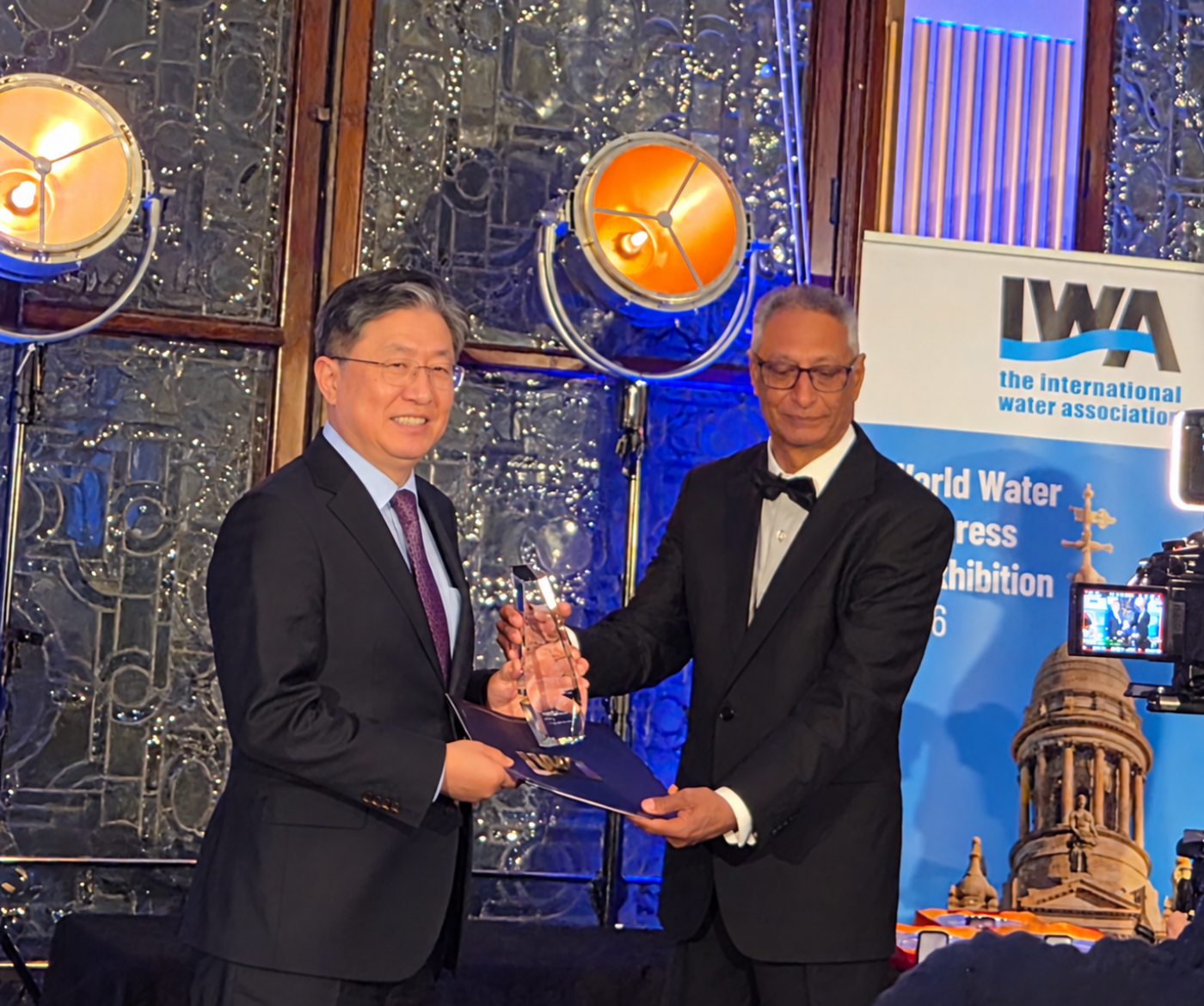
▲ Professor Emeritus Mooyoung Han of Seoul National University (left) receives the “Award for Outstanding Contribution to Water Management & Science” from IWA President Hamanth Kasan at the International Water Association (IWA) Presidents’ Dinner.
[Contact Information]
Professor Emeritus Mooyoung Han, Department of Civil and Environmental Engineering
Seoul National University / myhan@snu.ac.kr