loaction
- About
-
Academics
-
Undergraduate Programs
- Civil, Urban and Environmental Engineering
- Architecture and Architectural Engineering
- Mechanical Engineering
- Industrial Engineering
- Energy Resources Engineering
- Nuclear Engineering
- Materials Science and Engineering
- Electrical and Computer Engineering
- Naval Architecture and Ocean Engineering
- Computer Science and Engineering
- Aerospace Engineering
- Chemical and Biological Engineering
-
Graduate Programs
- Civil, Urban and Environmental Engineering
- Architecture and Architectural Engineering
- Mechanical Engineering
- Industrial Engineering
- Energy Systems Engineering
- Materials Science and Engineering
- Electrical and Computer Engineering
- Naval Architecture and Ocean Engineering
- Computer Science and Engineering
- Aerospace Engineering
- Chemical and Biological Engineering
- Interdisciplinary Program in Technology, Management, Economics and Policy
- Interdisciplinary Program in Urban Design
- Interdisciplinary Program in Bioengineering
- Interdisciplinary Program in Artificial Intelligence
- Interdisciplinary Program in Intelligent Space and Aerospace Systems
- Chemical Convergence for Energy and Environment Major
- Multiscale Mechanics Design Major
- Hybrid Materials Major
- Double Major Program
- Open Programs
-
Undergraduate Programs
- Research
- Prospective Students
- Campus Life
- International Office
- Communication
Research Achievements
SNU College of Engineering Hosts 2025 “Issue & Voice” Forum
-
Uploaded by
대외협력실
-
Upload Date
Jun 17, 2025
-
Views
2381
SNU College of Engineering Hosts 2025 “Issue & Voice” Forum
Exploring policies to foster engineering talent that changes the world and defining the role of research-oriented universities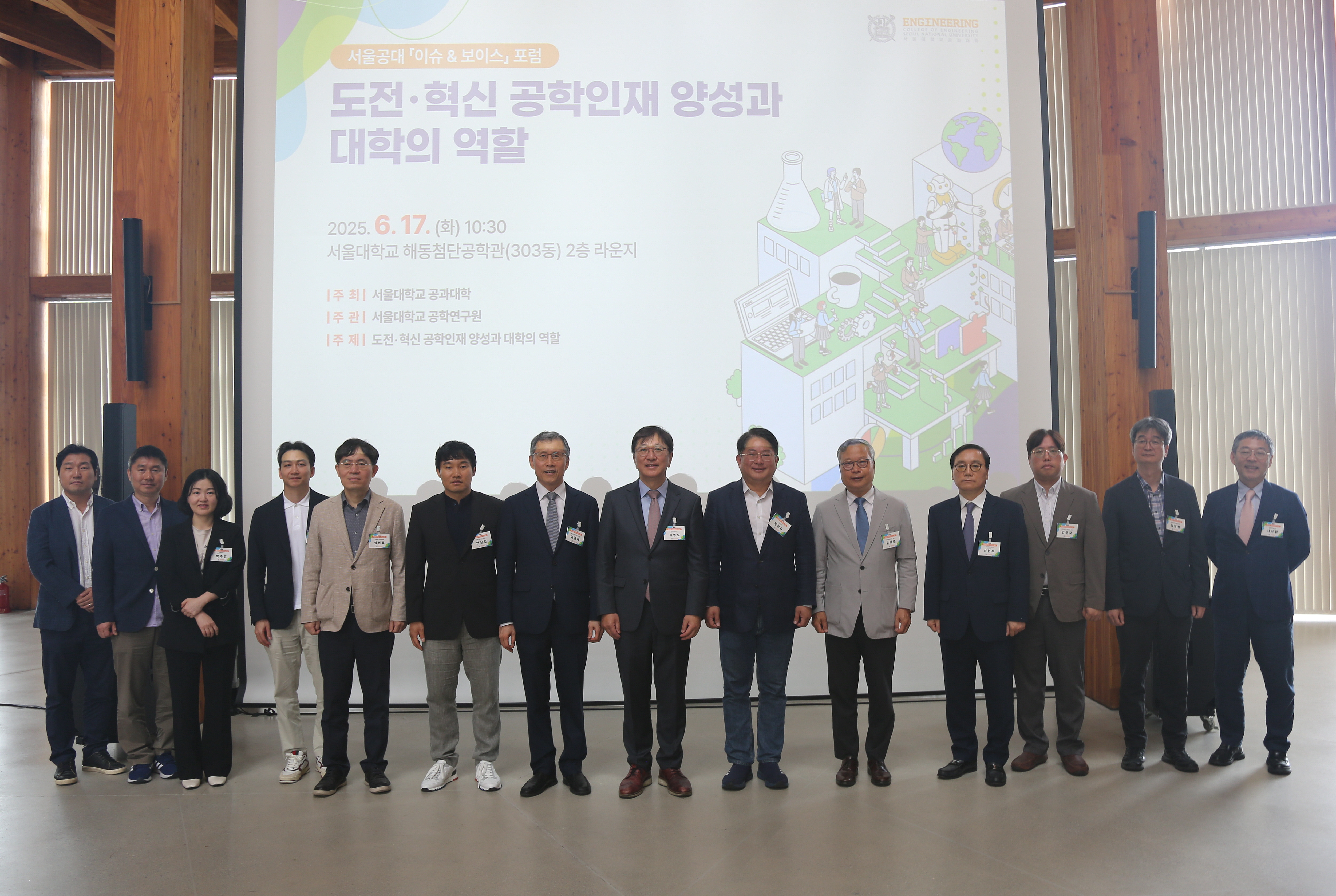
▲ Group photo from the 2025 “Issue & Voice” Forum held at SNU College of Engineering
Seoul National University College of Engineering announced that it held the first “Issue & Voice” forum of 2025 on June 17 at the Haedong Advanced Engineering Center (Building 303) on its Gwanak campus.
The forum, held under the theme “Fostering Challenging and Innovative Engineering Talent and the Role of Universities,” aimed to propose policies for nurturing engineering leaders and to discuss the role of SNU College of Engineering as a research-driven institution in light of the new government administration.
The forum began with a keynote presentation by Dean Young-oh Kim of the College of Engineering, followed by a panel discussion moderated by Emeritus Professor Kwang Bok Lee from the Department of Electrical and Computer Engineering and former Chairman of the National Research Foundation of Korea. Panelists included Professor Joo Young Park (Department of Civil and Environmental Engineering, SNU), Jaejoon Song (GCIO of Com2uS and CEO of Crit Ventures), Hyun Woo Shin (Visiting Professor at the Department of Aerospace Engineering, SNU; former CEO of Hanwha Aerospace), Sangil Ahn (Partner at Altos Ventures), and Joonmo Ahn (Professor in the Department of Public Administration at Korea University and incoming President of the Korea Society for Innovation Management & Economics), who each offered their insights from diverse perspectives.
Dean Young-oh Kim opened his presentation by diagnosing the current crises in Korea’s industry and STEM higher education. He proposed key initiatives to nurture outstanding students who embody the College of Engineering’s Ideal Talent model—Excellence Beyond Technology, Self-Directed Convergence, and Creativity Beyond Limits—including the EXCEL (Education for X-Caliber Engineering Leaders) Project, the introduction of a majorless graduate program, and the establishment of the Industrial AI Center.
He explained, “Through the EXCEL Project, we will select 40 exceptional undergraduate students each year and support them over three years with 20 million KRW in scholarships and 10 million KRW in research funding annually, along with intensive guidance from faculty advisors.” He emphasized that these students would “pose unprecedented questions and explore new technological frontiers from their early twenties.”
Kim also announced the launch of a student-designed major system at the SNU Graduate School of Engineering Practice, which admits students with at least three years of corporate experience. “We aim to encourage students with domain knowledge to design interdisciplinary programs that match their career trajectories,” he said. For example, a student with a bachelor's degree in mechanical engineering and three years of automotive industry experience could pursue a custom-designed ‘AI Autonomous Driving Major’ and earn a specialized master’s degree in engineering.
He further stressed that Korea—where manufacturing constitutes the highest proportion of total industry globally—must pursue a “first mover” strategy in the AI-driven industrial transformation. To support the government's goal of raising AI utilization in companies from under 30% to 70% within five years, Kim announced that SNU Engineering is establishing the Industrial AI Center. “Vertical AI requires domain-specific, customized approaches and faces data scarcity,” he noted. “Paradoxically, this challenge presents Korea with a competitive advantage.”
Kim concluded by proposing two key initiatives to the new government: the establishment of a national “AI Innovation Institute” offering annual salaries over 500 million KRW and housing to 200 newly-minted PhDs, and the “Korean Thousand Talents Program,” which would annually select and support 1,000 of the top 1% STEM freshmen. He stated, “SNU Engineering is committed to ensuring that the new administration’s initiative to establish ‘Ten Seoul Nationals’ evolves into a plan for creating ten world-class universities like Stanford.”
During the panel discussion, moderator Kwang Bok Lee emphasized that in an era of winner-takes-all global competition in science and technology, the government’s “Ten Seoul Nationals” initiative should be complemented by a plan to foster ten world-class research-oriented universities through specialization. He asserted that realizing this vision would require not only innovation in faculty hiring, student admissions, and educational methodologies, but also bold and substantial financial investment. He further noted that promoting excellence and providing broad-based support are not mutually exclusive, but rather complementary goals, and called for policy frameworks that achieve a balance between excellence and inclusiveness.
Professor Joo Young Park of the Department of Civil and Environmental Engineering pointed out that Korea’s demographic cliff and economic constraints necessitate the focused development of elite talent. He emphasized the importance of carefully defining talent development goals, target competencies, and strategies. “We need to determine what foundational science education and skills, beyond AI core capabilities, are essential to train talent capable of applying AI to real-world industrial problems,” he said. He also highlighted the need for data, infrastructure, and industry-academia collaboration, as well as both short-term incentives to keep top talent in Korea and long-term visions for a sustainable research ecosystem.
Jaejoon Song, GCIO of Com2uS and CEO of Crit Ventures, stressed that encouraging top-tier students to enter STEM fields requires robust support for tech-based entrepreneurship. He noted the current shortage of engineering talent in the startup ecosystem compared to the early 2000s boom in internet, gaming, and IT startups. He proposed significantly expanding military service exemptions for startup founders to attract top engineering talent. He also advocated for reforms that provide social and tax incentives for successful entrepreneurs to donate to engineering schools, given the substantial funding required for deep tech development in universities.
Hyun Woo Shin, Visiting Professor of Aerospace Engineering at SNU and former CEO of Hanwha Aerospace, expressed strong support for the SNU College of Engineering’s mission of nurturing “engineering innovators who change the world.” He proposed national-level solutions, such as resolving the overwhelming preference for medical school, offering bold support from universities for engineering talent, and sustained government incentives. He stressed the importance of promoting successful engineering alumni and their contributions to industry as a way to build national consensus around the value of engineering. He also emphasized that to produce engineering graduates with the expertise demanded by industry—those who deeply understand a company’s vision, strategy, business, R&D, and production technologies—engineering schools must actively promote industry-academia collaboration projects, graduate-level retraining programs for professionals with industry experience, and initiatives such as lectures and roundtables with corporate executives. He also introduced the talent profile sought by Hanwha Group as an example.
Sangil Ahn, Partner at Altos Ventures and a former member of SNU’s student startup club, proposed strategies to invigorate entrepreneurship among engineering students. He pointed out the lack of university-provided spaces to support team formation and idea generation during the early stages of startups, and suggested that instead of remodeling aging campus buildings, universities should repurpose them as open “startup playgrounds” freely accessible to students. Ahn emphasized, “A true startup ecosystem can only emerge when students are able to interact naturally and generate creative ideas in unrestricted spaces.” He explained that these playgrounds are especially effective for fostering entrepreneurship in the early stages because they require minimal funding and can be run independently by students. He also noted that such open spaces are rare across the country and added that SNU could take the lead in establishing a unique and exemplary startup culture model.
Joonmo Ahn, Professor of Public Administration at Korea University and incoming President of the Korea Society for Innovation Management & Economics, emphasized the urgent need for industrial transformation in Korea, citing how the U.S. has rapidly evolved its industrial structure over the past decade while Korea’s remains stagnant. He shared his experience in Shenzhen, China’s Silicon Valley, where even law majors were thriving as startup CEOs, as evidence of a dynamic innovation ecosystem. He called for bold implementation of university strategies and regulatory reform to enable similar startup activity in Korea. Ahn pointed out that regulations specific to metropolitan and national universities hinder talent attraction. He concluded by emphasizing the need for SNU’s global expansion, increased recruitment of international undergraduate students, and the importance of raising the overall quality of higher education to achieve the vision of creating “Ten Seoul National Universities.”
[Contact Information]
Jangyoon Bae, Office of Public Affairs, SNU College of Engineering / +82-2-880-9147 / jybae311@snu.ac.kr