loaction
- About
-
Academics
-
Undergraduate Programs
- Civil, Urban and Environmental Engineering
- Architecture and Architectural Engineering
- Mechanical Engineering
- Industrial Engineering
- Energy Resources Engineering
- Nuclear Engineering
- Materials Science and Engineering
- Electrical and Computer Engineering
- Naval Architecture and Ocean Engineering
- Computer Science and Engineering
- Aerospace Engineering
- Chemical and Biological Engineering
-
Graduate Programs
- Civil, Urban and Environmental Engineering
- Architecture and Architectural Engineering
- Mechanical Engineering
- Industrial Engineering
- Energy Systems Engineering
- Materials Science and Engineering
- Electrical and Computer Engineering
- Naval Architecture and Ocean Engineering
- Computer Science and Engineering
- Aerospace Engineering
- Chemical and Biological Engineering
- Interdisciplinary Program in Technology, Management, Economics and Policy
- Interdisciplinary Program in Urban Design
- Interdisciplinary Program in Bioengineering
- Interdisciplinary Program in Artificial Intelligence
- Interdisciplinary Program in Intelligent Space and Aerospace Systems
- Chemical Convergence for Energy and Environment Major
- Multiscale Mechanics Design Major
- Hybrid Materials Major
- Double Major Program
- Open Programs
-
Undergraduate Programs
- Research
- Prospective Students
- Campus Life
- International Office
- Communication
Research Achievements
Quantifying the “Ability to See Risk” to Prevent Industrial Accidents: SNU Researchers Develop Behavioral Safety Assessment System for Construction Workers
-
Uploaded by
대외협력실
-
Upload Date
Mar 17, 2026
-
Views
932
Quantifying the “Ability to See Risk” to Prevent Industrial Accidents:
SNU Researchers Develop Behavioral Safety Assessment System for Construction Workers
- Cognitive psychology–based safety assessment tool developed in collaboration with KAIST
- 55% of workers showed improved safety behavior, demonstrating accident prevention effectiveness- Analysis of gaze and response speed enables fair evaluation regardless of nationality, experience, or age
▲ (From left) Jeongmi Lee, Professor, Graduate School of Culture Technology, KAIST (Co-corresponding author); Eugene Hwang, Postdoctoral Researcher, KAIST (currently Research Professor, Yonsei University Barun ICT Research Center / Co-first author); Myeongjun Kim, Ph.D. Candidate, Department of Architecture and Architectural Engineering, Seoul National University (Co-first author); Changbum R. Ahn, Professor, Department of Architecture and Architectural Engineering, Seoul National University (Co-corresponding author)
Seoul National University College of Engineering announced that a research team led by Prof. Changbum R. Ahn of the Department of Architecture and Architectural Engineering has developed a behavior-based safety assessment system capable of measuring construction workers’ ability to perceive risks and respond appropriately to them, in collaboration with Prof. Jeongmi Lee’s team at the Graduate School of Culture Technology at KAIST.
This system utilizes three tests grounded in cognitive psychology and, unlike conventional safety knowledge assessments that rely on quizzes or image interpretation, evaluates workers’ actual, real-world behavioral characteristics—including attention, speed of risk recognition, and inhibitory control. The system has attracted attention from both academia and industry and is expected to contribute to accident prevention at construction sites and to the development of customized safety training tailored to individual cognitive traits.
The research findings were recently published in the international journal, Journal of Safety Research, in the fields of safety engineering and safety science.
The construction industry is one of the most hazardous sectors, recording the highest number of fatal workplace accidents. According to industrial accident statistics released by the Ministry of Employment and Labor in 2024, 328 fatalities—accounting for 39.7% of all industrial accident deaths—occurred at construction sites.
Most of these accidents occur because workers fail to immediately recognize hazards or are unable to respond appropriately even after recognizing them. As a result, many construction sites currently implement safety competency assessments to measure workers’ ability to perceive risks in order to prevent accidents.
However, existing evaluation methods have largely been limited to selecting correct answers related to safety knowledge, raising concerns that they fail to adequately reflect the complex, non-routine, and context-dependent risk response abilities exhibited by workers in real-world situations. This limitation has made it difficult to objectively measure workers’ immediate perception and response to diverse hazards in the field.
Furthermore, conventional knowledge-based assessment methods, which rely on scores, have limitations in inducing actual safe behavior among workers, and therefore have not been effective in preventing accidents in practice.
To overcome these limitations, the joint research team developed a system based on cognitive psychology that evaluates workers’ latent risk perception abilities and successfully verified its effectiveness. By analyzing behavioral characteristics such as individual gaze patterns and response speed to hazards, the system quantifies a worker’s “ability to see risk.”
The successful development of the system is attributed to the synergy between SNU’s Construction Engineering & Management Lab, which possesses expertise in construction risk management and hazard perception, and KAIST’s Visual Cognition Lab, which designed the behavioral experiments based on cognitive psychology.
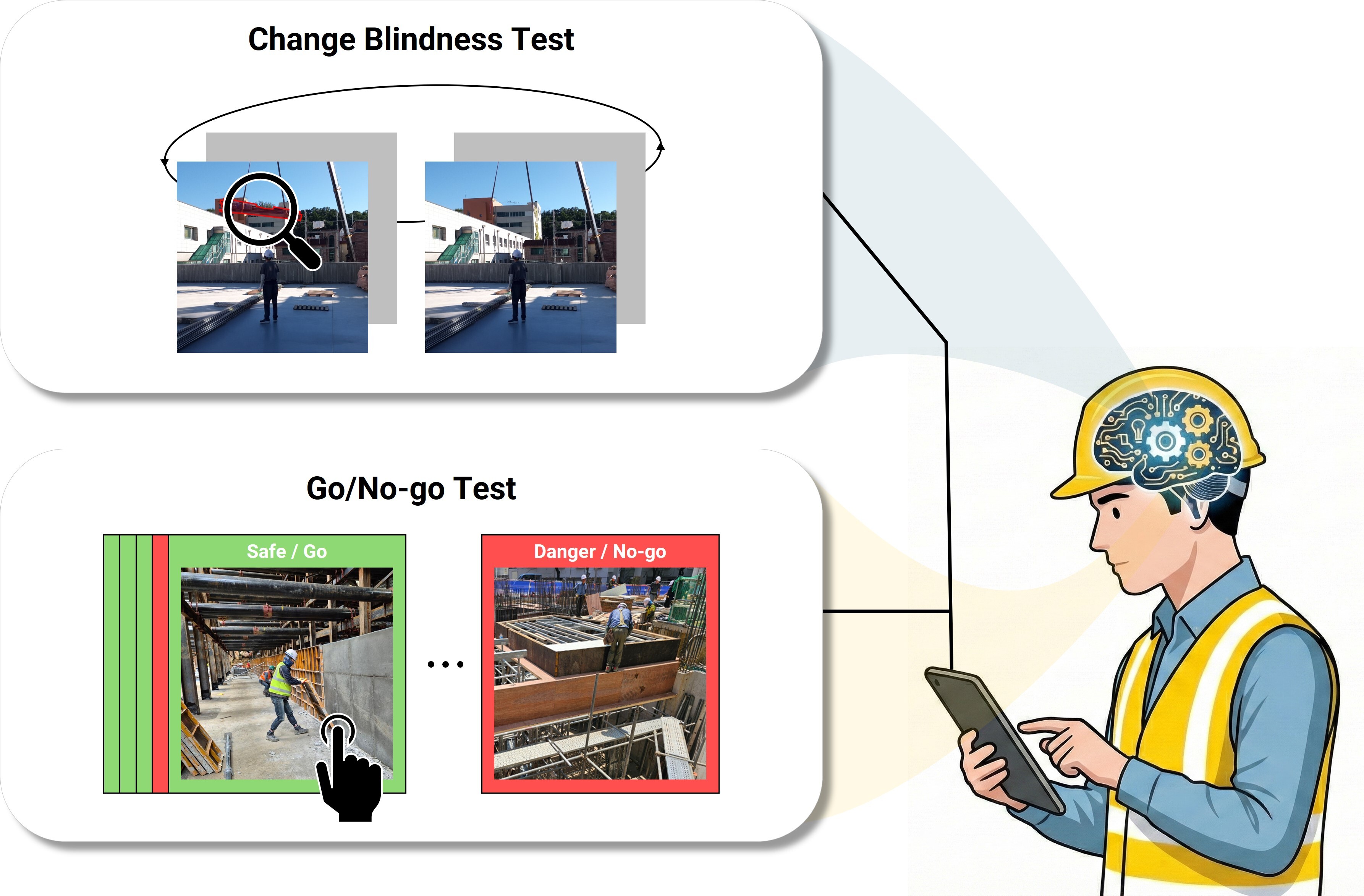
▲ Figure 1. Schematic of the cognitive psychology–based safety assessment system:
The Change Blindness Test evaluates how sensitively workers detect subtle changes or hazards in a work scene, while the Go/No-go Test assesses the ability to quickly and accurately judge risk and to either inhibit or execute responses accordingly.
The most significant achievement of this study is that the newly developed system goes beyond merely measuring safety competency and successfully induces behavioral change among workers. According to field experiment results, 55% of workers who received feedback on their risk perception ability after completing the assessment reported positive changes in their safety behavior at actual construction sites.
In addition, to verify the system’s applicability in real construction environments, the research team conducted safety assessments on both individuals with no construction site experienceand construction workers. The results demonstrated that construction workers recognize hazards more quickly and accurately than non-experts and exhibit superior ability to suppress impulsive actions in dangerous situations.
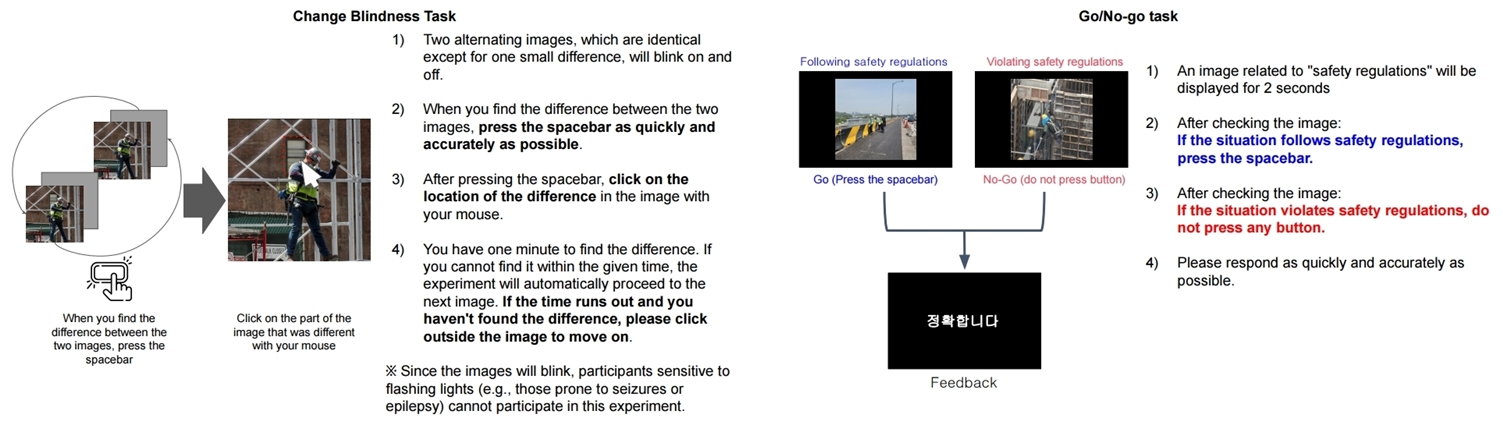
▲ Figure 2. Overview of the cognitive psychology–based safety assessment mechanism (Change Blindness task & Go/No-go task)
Furthermore, comparative experiments were conducted between groups classified as “high-performing” and “low-performing” workers based on their safety behavior history in real construction sites. The results showed that low-performing workers were more easily distracted by irrelevant changes and exhibited more than twice the rate of task abandonment compared to high-performing workers, indicating a clear difference in sustained attention capability between the two groups.
To validate the reliability of the system, the research team conducted a large-scale field study involving 143 construction workers in collaboration with three domestic EPC companies. Using a test-retest method, key indicators such as change detection accuracy and risk judgment ability were measured repeatedly over a two-week interval. The results confirmed that the rankings of these indicators remained consistent over time.
This demonstrates that the system reliably measures inherent individual risk perception traits rather than temporary conditions. Based on these findings, the research team also established criteria for identifying workers with vulnerabilities in risk perception who require targeted safety management.
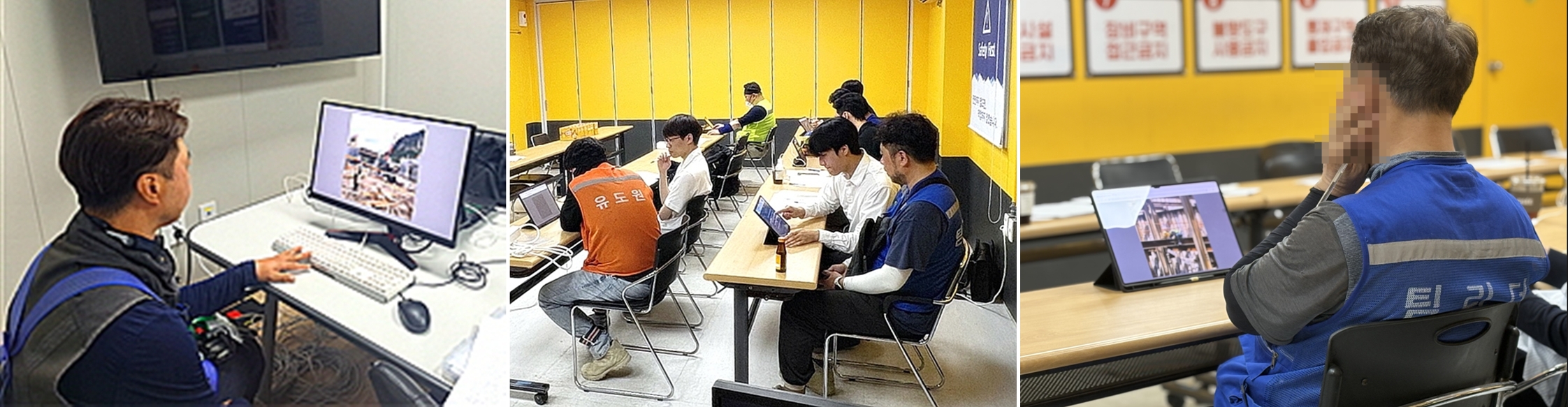
▲ Figure 3. Construction workers participating in the cognitive psychology–based safety assessment developed by the SNU–KAIST joint research team (August 2025)
The system developed by the joint research team operates using common digital devices such as monitors or tablets and requires only simple user input. This allows for the assessment of workers’ risk perception and response abilities without the need for biometric sensors or expensive equipment. As a result, the system is expected to contribute to the prevention of industrial accidents by enabling objective and unbiased evaluation of safety competency across diverse construction site personnel—including foreign workers, inexperienced workers, and older workers—regardless of nationality, experience, or age.
If widely adopted, the system is also expected to establish a personalized, proactive safety management framework in construction sites. Site managers will be able to integrate the system into safety training programs, enabling them to assess individual workers’ risk perception and response capabilities during training. In particular, workers with low sensitivity to hazards can be identified in advance, allowing for the application of targeted intervention programs and customized training protocols tailored to their cognitive characteristics.
Prof. Changbum R. Ahn stated, “Through this field validation, we confirmed that the system not only accurately diagnoses individual risk perception characteristics, but also has a strong educational effect, as the evaluation process itself encourages workers to reflect on their safety habits.” He added, “We plan to further advance this technology by building industry- and occupation-specific datasets, developing it into a core technology for enhancing digital safety management systems in construction.”
Myeongjun Kim, the first author of the study and a Ph.D. candidate in the Department of Architecture and Architectural Engineering at SNU, plans to continue conducting follow-up research on safety technologies in construction based on this work. Building on the findings of this study, he aims to lead the digital transformation of construction safety and to develop innovative safety technologies that integrate cognitive psychology, artificial intelligence (AI), and virtual environments.
This research was supported by the Ministry of Education and the National Research Foundation of Korea through the interdisciplinary convergence research program titled “Development of a Low-Cost Non-Verbal Risk Perception Assessment System for Construction Workers (2023–2026).”
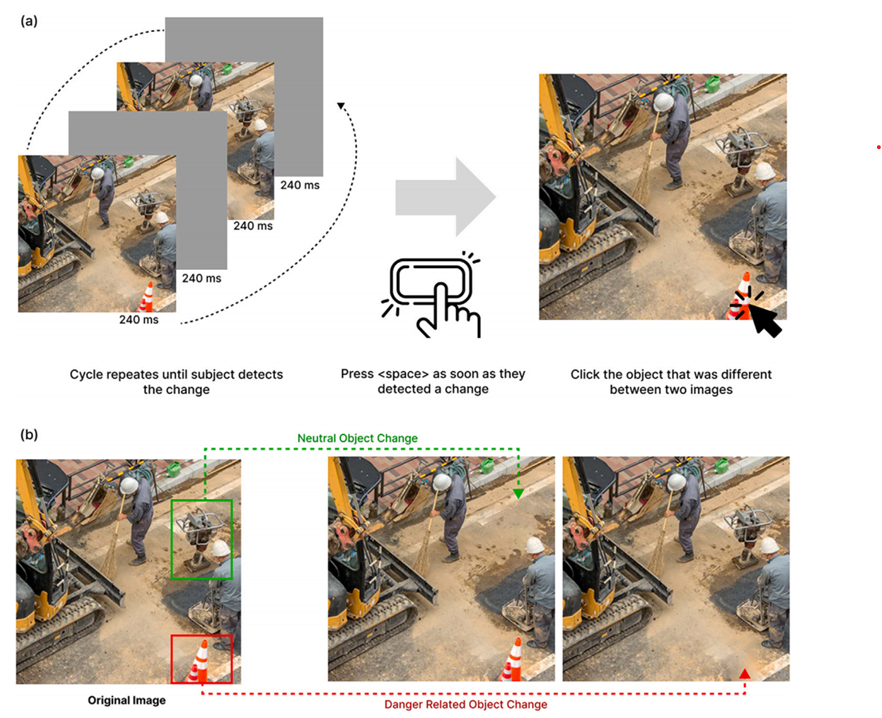
▲ Figure 4. Structure of the Change Blindness task using construction site images and examples of hazard-related and neutral object changes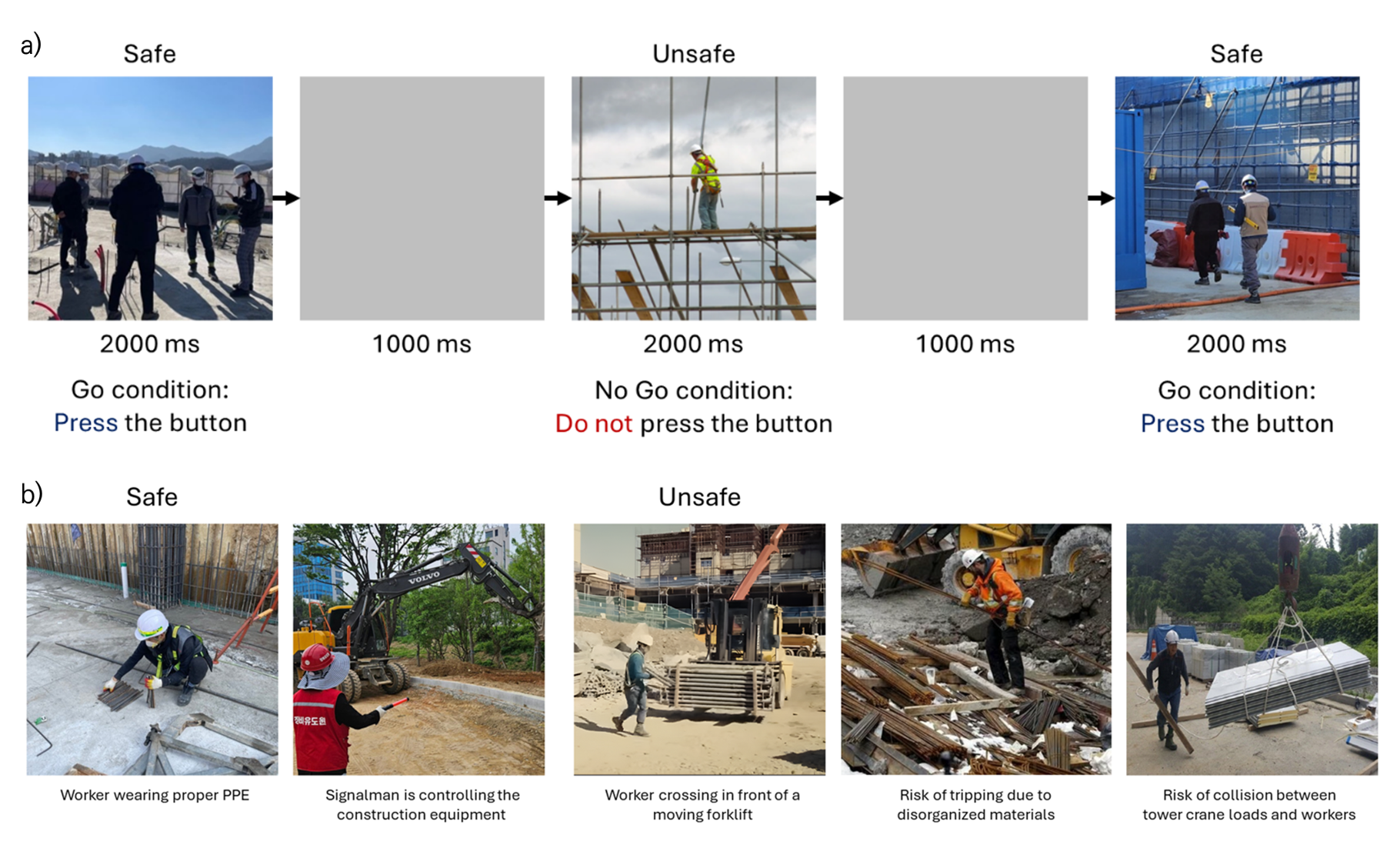
▲ Figure 5. Procedure of the Go/No-Go task using construction site safety and hazard scenarios and examples of stimulus images
[Reference Materials]
- Title/Journal: Development and validation of implicit behavioral tests assessing perceptual sensitivity to construction hazards, Journal of Safety Research
- DOI: https://doi.org/10.1016/j.jsr.2025.06.019
[Contact Information]
Myeongjun Kim, Ph.D. Candidate, Construction Engineering & Management Lab, Department of Architecture and Architectural Engineering, Seoul National University / +82-2-880-8311 / allofme0@snu.ac.kr