loaction
- About
-
Academics
-
Undergraduate Programs
- Civil, Urban and Environmental Engineering
- Architecture and Architectural Engineering
- Mechanical Engineering
- Industrial Engineering
- Energy Resources Engineering
- Nuclear Engineering
- Materials Science and Engineering
- Electrical and Computer Engineering
- Naval Architecture and Ocean Engineering
- Computer Science and Engineering
- Aerospace Engineering
- Chemical and Biological Engineering
-
Graduate Programs
- Civil, Urban and Environmental Engineering
- Architecture and Architectural Engineering
- Mechanical Engineering
- Industrial Engineering
- Energy Systems Engineering
- Materials Science and Engineering
- Electrical and Computer Engineering
- Naval Architecture and Ocean Engineering
- Computer Science and Engineering
- Aerospace Engineering
- Chemical and Biological Engineering
- Interdisciplinary Program in Technology, Management, Economics and Policy
- Interdisciplinary Program in Urban Design
- Interdisciplinary Program in Bioengineering
- Interdisciplinary Program in Artificial Intelligence
- Interdisciplinary Program in Intelligent Space and Aerospace Systems
- Chemical Convergence for Energy and Environment Major
- Multiscale Mechanics Design Major
- Hybrid Materials Major
- Double Major Program
- Open Programs
-
Undergraduate Programs
- Research
- Prospective Students
- Campus Life
- International Office
- Communication
Research Achievements
World-Leading Hydrogen Production Achieved: SNU Chemical Engineering Team Develops Atom-Count-Controlled Cluster Catalyst
-
Uploaded by
대외협력실
-
Upload Date
May 29, 2026
-
Views
593
World-Leading Hydrogen Production Achieved: SNU Chemical Engineering Team Develops Atom-Count-Controlled Cluster Catalyst
- A method for the selective formation of cluster catalysts composed of several dozen atoms is presented
- Expected to accelerate the commercialization of hydrogen technologies based on liquid organic hydrogen carriers
- Published in the internationally renowned journal Science
▲ (From left) Prof. Jungwon Park (Department of Chemical and Biological Engineering, SNU), Dr. Chyan Kyung Song, and Dr. Junhyeok Jung
Seoul National University College of Engineering announced that a research team led by Prof. Jungwon Park of the Department of Chemical and Biological Engineering, in collaboration with research teams led by Prof. Thomas F. Jaramillo and Prof. Matteo Cargnello of the Department of Chemical Engineering at Stanford University, has developed a commercially viable hydrogen production technology by synthesizing uniform cluster catalysts controlled at the atomic level.
The team successfully engineered a novel platinum (Pt) cluster catalyst that maximizes hydrogen production performance while minimizing platinum usage. Notably, the catalyst enables precise control over the number of atoms in each cluster and is immobilized on a support to maintain structural stability during hydrogen production reactions.
The researchers demonstrated the selective formation of ultrasmall clusters on the order of 1 nanometer (nm) and confirmed that the number of atoms within each cluster can be precisely tuned within a range of several dozen atoms. Using this approach, they achieved world-leading hydrogen production per unit of platinum in dehydrogenation reactions based on liquid organic hydrogen carriers (LOHCs). The technology is also amenable to large-scale production, making it a promising candidate for industrial applications in LOHC-based hydrogen systems.
The study, which has drawn global attention, was officially published on May 28 in Science, one of the world’s most prestigious scientific journals.
Hydrogen is widely regarded as a key clean energy source for achieving carbon neutrality. However, it remains challenging to use hydrogen directly at the point of need after production. Technologies for safely storing and transporting large quantities of hydrogen over long distances are therefore essential. Conventional methods such as high-pressure hydrogen gas or liquefied hydrogen involve significant cost and safety challenges. As a result, liquid organic hydrogen carrier (LOHC) technology—allowing hydrogen to be stored and transported similarly to conventional liquid fuels—has recently emerged as a promising alternative.
For LOHC technology to be practically viable, hydrogen must be produced rapidly and reliably from transported carriers at the desired location and time. However, the dehydrogenation process required for hydrogen release is energy-intensive and typically relies on expensive noble metal catalysts such as platinum. Existing catalysts suffer from performance degradation over time and require large quantities of precious metals, limiting economic feasibility.
To enable practical large-scale hydrogen transport and production, new catalyst concepts are needed that can deliver both high activity and long-term stability using minimal amounts of noble metals. Conventional nanoparticle catalysts exhibit low metal utilization efficiency, while single-atom catalysts often lack stability and are not well suited for reactions involving large organic molecules such as LOHCs.
Cluster catalysts composed of several dozen metal atoms have therefore attracted attention as a promising alternative. However, achieving selective formation of uniform clusters and correlating atomically controlled structures with hydrogen production performance remained a major challenge for commercialization.
To address this challenge, the research team focused on developing a technology capable of producing hydrogen rapidly, stably, and over long durations using minimal amounts of noble metals—a key requirement for large-scale hydrogen transport and production. They introduced a novel catalyst design strategy in which ligand*-free platinum atoms are directly anchored onto a support in solution.
* Ligand: a chemical species that surrounds and stabilizes metal atoms
During an air calcination* process, the platinum atoms become mobile and selectively occupy positions on the support where binding is strongest. Subsequent hydrogen reduction activates the system, forming uniform amorphous platinum clusters approximately 1 nm in size.
* Air calcination: a high-temperature process conducted in air to remove organic components and stabilize structures
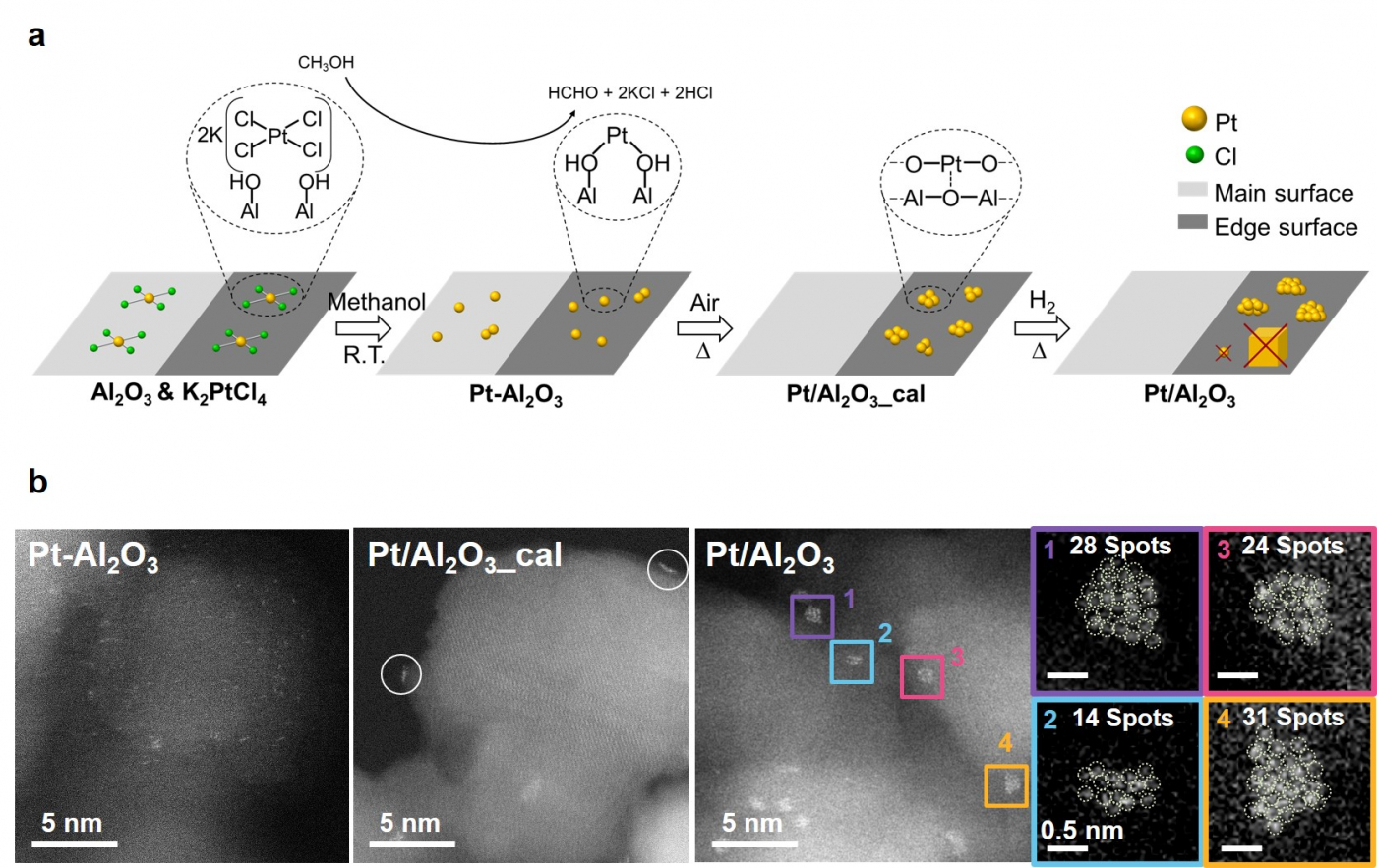
▲ Figure 1. Design and formation of uniform platinum clusters
a. Schematic illustration of the formation of strongly supported platinum clusters
b. Atomic-resolution electron microscopy images at each synthesis stage
In this way, the team successfully avoided the formation of large platinum aggregates or inactive single atoms, instead precisely arranging platinum into ultrasmall cluster structures optimized for hydrogen production efficiency.
They further demonstrated that even when platinum loading was increased by up to five times, the cluster size remained nearly constant. Advanced electron microscopy analysis revealed for the first time that clusters of similar apparent size can consist of varying numbers of atoms—ranging from 13 to 31 atoms. This finding establishes that catalytic performance depends not only on cluster size but also on the exact number of atoms within each cluster.
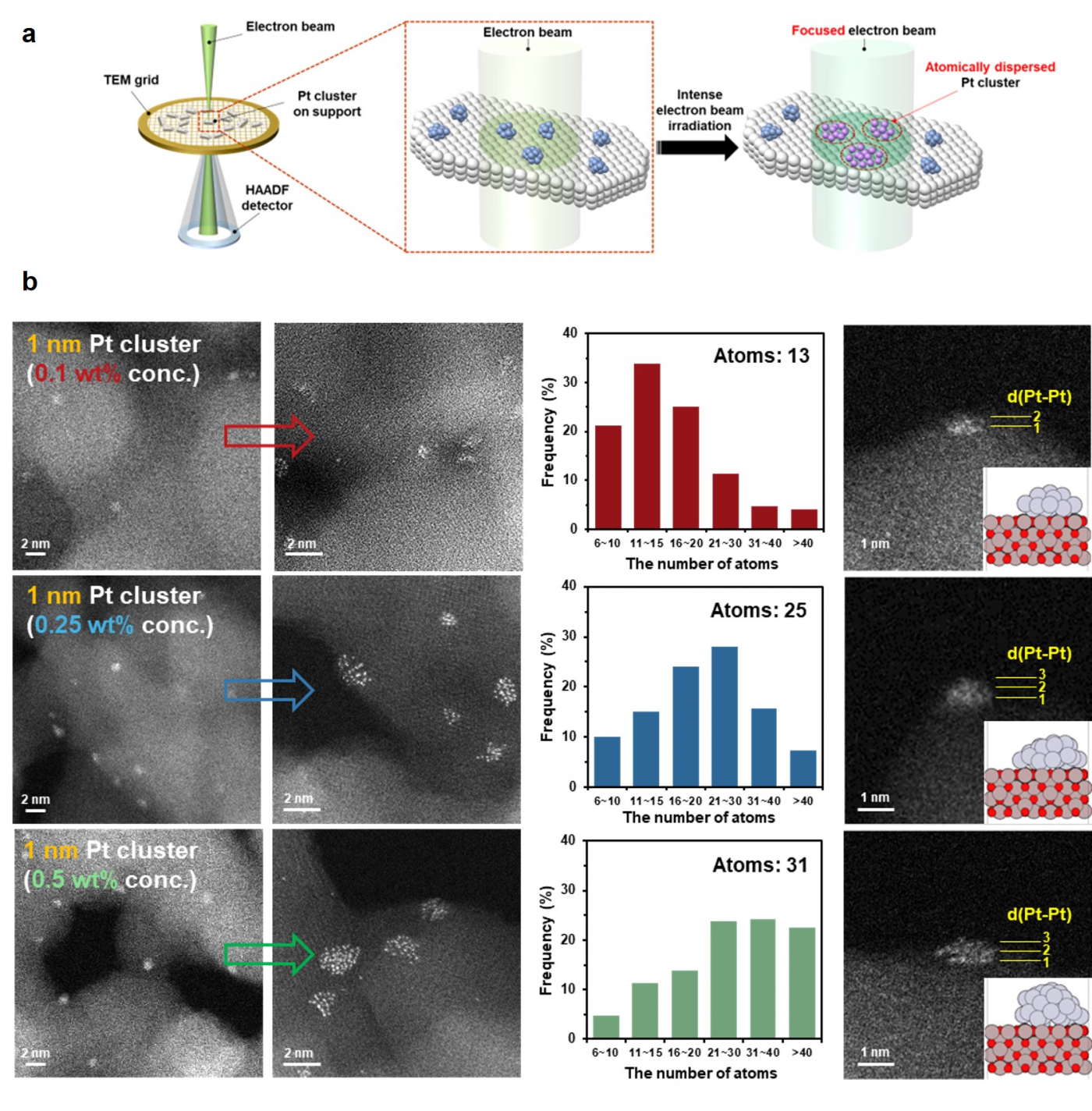
▲ Figure 2. Platinum clusters precisely controlled at the atomic level
a. Schematic of atomic-scale cluster analysis using electron microscopy
b. Results showing variation in atom counts for clusters of similar size
The developed platinum cluster catalyst exhibited superior activity and durability in the dehydrogenation of methylcyclohexane, a representative LOHC, despite using ten times less platinum than conventional commercial catalysts. In particular, the catalyst achieved a hydrogen production rate of up to 50,285 mmol per minute per gram of platinum, corresponding to approximately 160 hydrogen molecules generated per second per platinum atom. This represents world-leading hydrogen production efficiency relative to platinum usage.
The team also established atom-level design principles for hydrogen production catalysts, demonstrating that both catalytic activity and durability depend on the number of atoms within each cluster.
The atomically controlled platinum cluster synthesis method is expected to serve as a key enabling technology for accelerating the commercialization of LOHC-based hydrogen storage and transport systems.
The team confirmed that uniform cluster catalysts can be produced at scales of tens of grams using a single laboratory process, and suggested that there is virtually no theoretical limit to scaling up production. This represents a major advancement over previous approaches, where even gram-scale synthesis was difficult. Because high hydrogen productivity and durability can be achieved with minimal platinum usage, the technology holds strong potential as a cost-effective hydrogen production catalyst platform.
Moreover, the synthesis strategy is not limited to platinum/alumina (Al₂O₃) systems and can be extended to various combinations of metals and supports. It is therefore expected to find broad applications in catalytic processes where reducing noble metal usage is critical. Overall, the technology is anticipated to contribute industrially to scalable, high-efficiency catalyst production and socially to the establishment of clean hydrogen supply chains based on large-scale hydrogen storage and transport.
Prof. Jungwon Park stated, “This study presents a meaningful advance by demonstrating a strategy for synthesizing uniform cluster catalysts that achieve high hydrogen production activity and long-term stability with near-minimal platinum usage in LOHC systems.” He added, “By strongly anchoring atomically controlled platinum clusters onto supports and elucidating the relationship between cluster structure and catalytic activity at the atomic level, we have opened a new direction beyond the limitations of conventional catalyst design.”
He continued, “This strategy, which also demonstrates scalability beyond laboratory conditions, is expected to evolve into a high-efficiency hydrogen production catalyst suitable for industrial applications through further scale-up and support optimization. It will not only accelerate the commercialization of LOHC-based hydrogen technologies but also serve as a broadly applicable method for atomically precise catalyst design.”
Dr. Chyan Kyung Song, the first author of the paper, is continuing research on the synthesis and analysis of atomically controlled cluster structures at the Institute of Chemical Process Innovation at SNU. He plans to expand his research toward applying universal cluster synthesis techniques to challenging chemical reactions such as hydrogen production.
Co-first author Dr. Junhyeok Jung received his Ph.D. from the Department of Chemical and Biological Engineering at SNU and is currently continuing his research at Samsung Electronics.
Meanwhile, this study was supported by the National Research Foundation of Korea’s Top-Tier Research Institution Collaboration Platform and Joint Research Support Program and H2 NEXT ROUND Program (National Hydrogen-Focused Research Lab).
[Reference Materials]
- Title/Journal : Dependence of catalytic properties of strongly supported platinum clusters with atom counts, Science
- DOI : https://doi.org/10.1126/science.aeb3087
[Contact Information]
Prof. Jungwon Park, Multidimensional Materials Chemistry Laboratory, Department of Chemical and Biological Engineering, Seoul National University / +82-2-880-2259 / jungwonpark@snu.ac.kr