loaction
- About
-
Academics
-
Undergraduate Programs
- Civil, Urban and Environmental Engineering
- Architecture and Architectural Engineering
- Mechanical Engineering
- Industrial Engineering
- Energy Resources Engineering
- Nuclear Engineering
- Materials Science and Engineering
- Electrical and Computer Engineering
- Naval Architecture and Ocean Engineering
- Computer Science and Engineering
- Aerospace Engineering
- Chemical and Biological Engineering
-
Graduate Programs
- Civil, Urban and Environmental Engineering
- Architecture and Architectural Engineering
- Mechanical Engineering
- Industrial Engineering
- Energy Systems Engineering
- Materials Science and Engineering
- Electrical and Computer Engineering
- Naval Architecture and Ocean Engineering
- Computer Science and Engineering
- Aerospace Engineering
- Chemical and Biological Engineering
- Interdisciplinary Program in Technology, Management, Economics and Policy
- Interdisciplinary Program in Urban Design
- Interdisciplinary Program in Bioengineering
- Interdisciplinary Program in Artificial Intelligence
- Interdisciplinary Program in Intelligent Space and Aerospace Systems
- Chemical Convergence for Energy and Environment Major
- Multiscale Mechanics Design Major
- Hybrid Materials Major
- Double Major Program
- Open Programs
-
Undergraduate Programs
- Research
- Prospective Students
- Campus Life
- International Office
- Communication
Research Achievements
One Magnetic Elastomer, Two Modes: Move on Command, Vanish on Demand
-
Uploaded by
대외협력실
-
Upload Date
Jun 04, 2026
-
Views
300
One Magnetic Elastomer, Two Modes: Move on Command, Vanish on Demand
▲ (From left) Jieun Han, Ph.D. candidate in the Department of Materials Science and Engineering at Seoul National University; Hyun An, integrated M.S./Ph.D. student in the Department of Materials Science and Engineering at Seoul National University; Min Sang Kwon, Professor in the Department of Materials Science and Engineering at Seoul National University; Seung-Kyun Kang, Professor in the Department of Materials Science and Engineering at Seoul National University
The rapid expansion of soft robots and smart electronic devices is driving demand for materials that can not only move and adapt, but also complete their missions without leaving behind unwanted traces. As these technologies are increasingly explored for healthcare, environmental monitoring, infrastructure inspection, and security applications, robots and devices are expected to operate in places where human access is limited—such as narrow pipes, sealed spaces, underground facilities, and hazardous environments. However, once deployed, these systems can be difficult or impossible to retrieve. If left behind, they may cause contamination, equipment damage, or information leakage. Existing systems also often require separate stimuli or control units for actuation and degradation, making them complex and difficult to operate in opaque or confined environments.
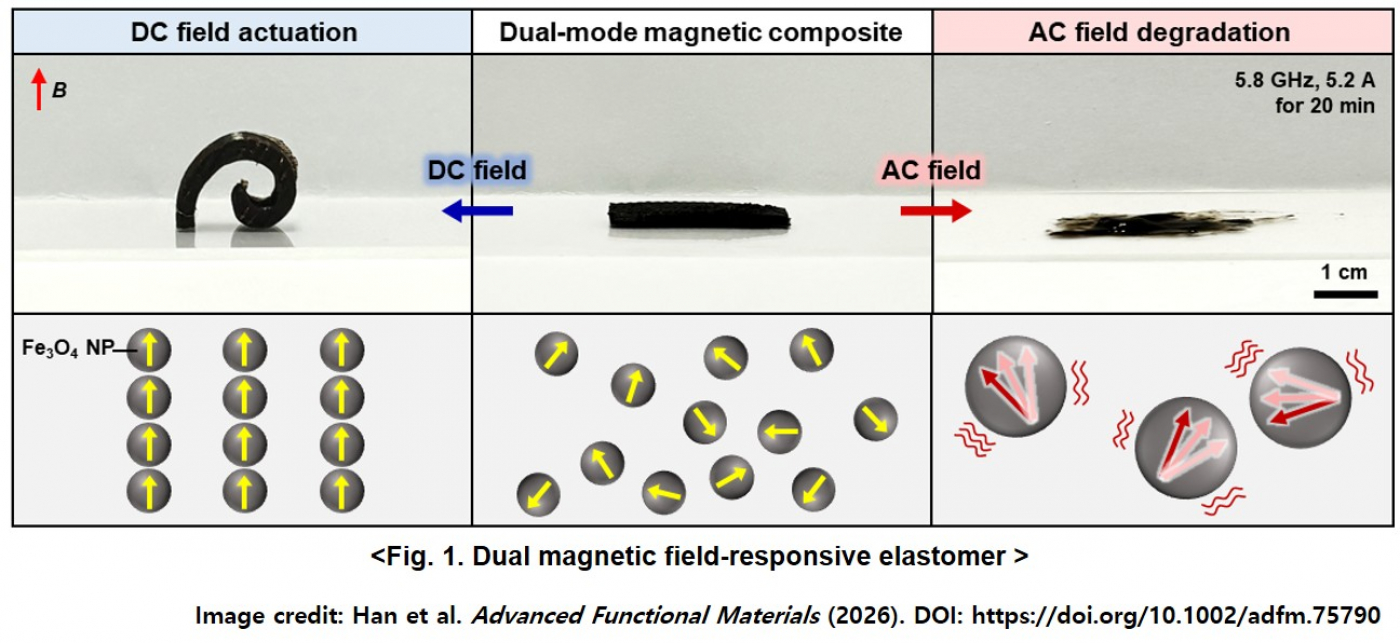
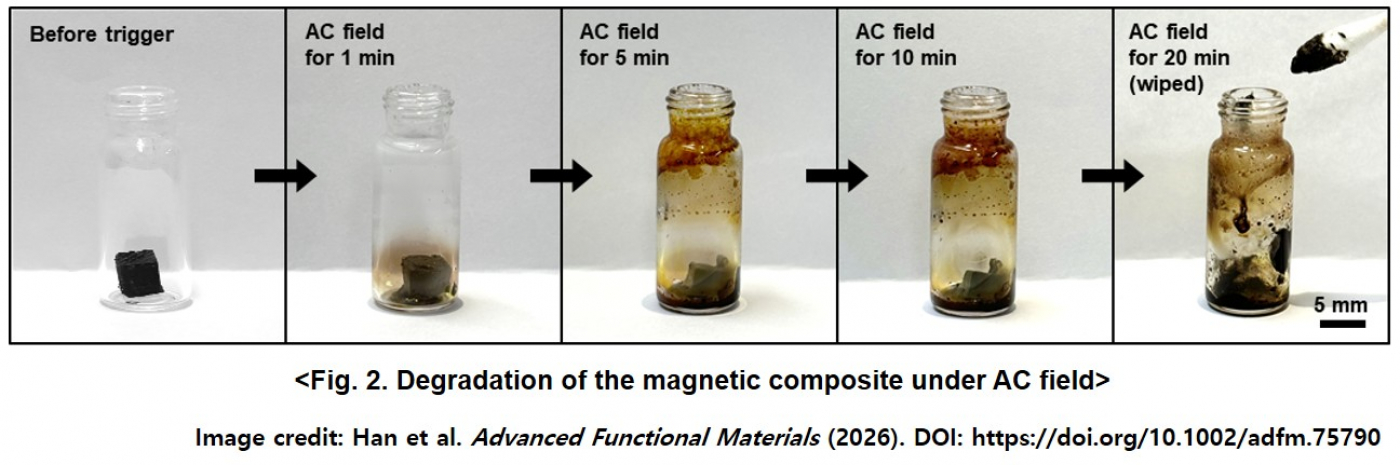
In response to these challenges, a research team led by Professor Seung-Kyun Kang at Seoul National University has developed a dual-mode magnetic elastomer that controls both motion and degradation through magnetic-field switching. The material is a silicone elastomer composite embedded with Fe3O4 magnetic nanoparticles, which act as a driving component under a direct-current (DC) magnetic field and as a heat-generating component under a gigahertz-range alternating-current (AC) magnetic field. This design enables both operation and end-of-life control using a single material platform and a remotely delivered magnetic stimulus. Under a DC magnetic field, the magnetic elastomer undergoes shape reconfiguration and soft actuation, enabling movement and functional deformation. Under a GHz-range AC magnetic field, the Fe3O4 nanoparticles generate intense localized heat through ferromagnetic resonance. The team demonstrated an ultrafast temperature rise exceeding 200°C within one second, triggering rapid degradation of the silicone elastomer matrix without additional light exposure or external heating. Spectroscopic and chemical analyses confirmed that the degradation process involves cleavage of Si–O bonds in the silicone network. Importantly, the material maintains the mechanical properties needed for soft robotic applications, exhibiting high stretchability with an elongation at break exceeding 460%. The team further demonstrated its potential by implementing a magnetically controlled soft robotic system that can move and degrade when triggered, as well as a degradable switch for selective LED control, highlighting its promise for secure electronics and mission-completing robotic platforms.
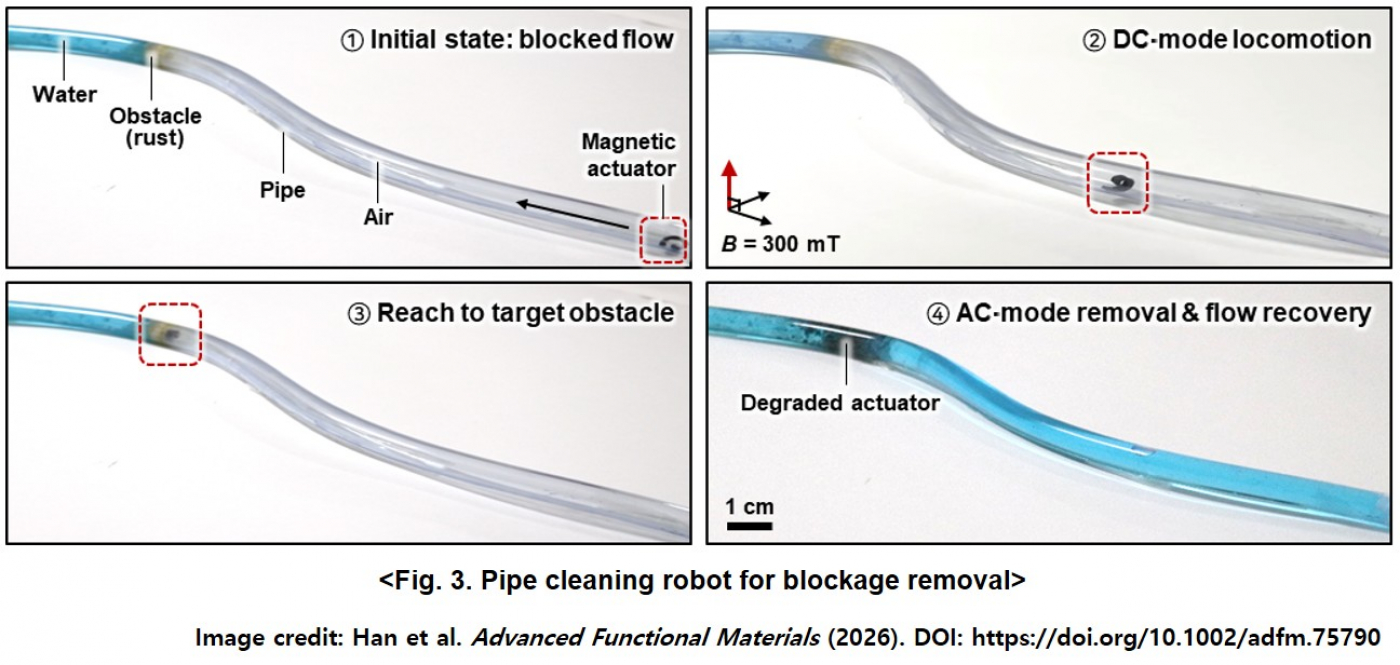
Professor Kang stated, “This research demonstrates a magnetic elastomer that integrates actuation and degradation within a single material system. By controlling both motion and end-of-life behavior using magnetic fields, this platform could enable next-generation soft robots and secure electronic devices for environments where retrieval is difficult.” The study presents a new strategy for lifecycle-aware smart materials, in which a single magnetic elastomer platform combines remote motion control, programmable lifetime, and simplified system architecture. The technology is expected to open new opportunities for soft robots that can navigate clogged pipes and disappear after clearing blockages, exploration robots that do not require retrieval, and secure electronic devices that can eliminate physical traces after completing their function.
The study was published in Advanced Functional Materials
[Reference Materials]
- Resources : Han, Jieun et al. Dual-Mode Magnetic Elastomer for On-Demand Motion and Degradation. Advanced Functional Materials (2026).
- DOI : https://doi.org/10.1002/adfm.75790
[Contact Information]
Prof. Seung-Kyun Kang, Department of Materials Science and Engineering, Seoul National University / +82-2-880-5756 / kskg7227@snu.ac.kr