loaction
- About
-
Academics
-
Undergraduate Programs
- Civil, Urban and Environmental Engineering
- Architecture and Architectural Engineering
- Mechanical Engineering
- Industrial Engineering
- Energy Resources Engineering
- Nuclear Engineering
- Materials Science and Engineering
- Electrical and Computer Engineering
- Naval Architecture and Ocean Engineering
- Computer Science and Engineering
- Aerospace Engineering
- Chemical and Biological Engineering
-
Graduate Programs
- Civil, Urban and Environmental Engineering
- Architecture and Architectural Engineering
- Mechanical Engineering
- Industrial Engineering
- Energy Systems Engineering
- Materials Science and Engineering
- Electrical and Computer Engineering
- Naval Architecture and Ocean Engineering
- Computer Science and Engineering
- Aerospace Engineering
- Chemical and Biological Engineering
- Interdisciplinary Program in Technology, Management, Economics and Policy
- Interdisciplinary Program in Urban Design
- Interdisciplinary Program in Bioengineering
- Interdisciplinary Program in Artificial Intelligence
- Interdisciplinary Program in Intelligent Space and Aerospace Systems
- Chemical Convergence for Energy and Environment Major
- Multiscale Mechanics Design Major
- Hybrid Materials Major
- Double Major Program
- Open Programs
-
Undergraduate Programs
- Research
- Prospective Students
- Campus Life
- International Office
- Communication
Research Achievements
SNU-Led Team Develops Biomimetic Water Harvesting System that Extracts Clean Water from Wet Soil, Inspired by Desert Horned Lizard
-
Uploaded by
대외협력실
-
Upload Date
Jul 06, 2026
-
Views
663
SNU-Led Team Develops Biomimetic Water Harvesting System that Extracts Clean Water from Wet Soil, Inspired by Desert Horned Lizard
- First fluid dynamics-based explanation of the desert horned lizard’s jaw motion during drinking
- Expected applications in portable water harvesting devices and compact purification systems for extreme environments
- Findings published in leading international journal PNAS (Proceedings of the National Academy of Sciences)
▲ (From left) Seungjoo Lee, Ph.D. candidate at Seoul National University; Sohyun Jung, Professor at DGIST; Wonjung Kim, Professor at Yonsei University; Sung Jae Kim, Professor at Seoul National University; Ho-Young Kim, Professor at Seoul National University
Seoul National University College of Engineering announced that a joint research team led by Prof. Ho-Young Kim of the Department of Mechanical Engineering at SNU, together with Ph.D. candidate Seungjoo Lee and Dr. Junhee Choi, and Prof. Sung Jae Kim of the Department of Electrical and Computer Engineering, in collaboration with Prof. Wonjung Kim of Yonsei University, Prof. Sohyuni Jung of DGIST, and Dr. Wonseok Kim of Harvard Medical School, has, for the first time, uncovered the physical mechanism by which the desert horned lizard (Phrynosoma platyrhinos) drinks water. The team also developed an innovative biomimetic water-harvesting system capable of extracting clean drinking water from contaminated soil.
This interdisciplinary study, involving researchers from multiple institutions in Korea and abroad, has been recognized for its excellence and published in PNAS (Proceedings of the National Academy of Sciences), one of the world’s leading multidisciplinary scientific journals. Notably, the study was selected as a highlighted paper in PNAS’s “In This Issue” section, where the journal’s editor-in-chief and editorial board handpick the most noteworthy papers published each week, drawing significant global attention.
The desert horned lizard, which inhabits arid environments, absorbs water through microchannels on its skin via capillary action when it rains or when the soil becomes wet, drawing moisture toward its head. However, the precise mechanism by which the lizard subsequently swallows this water into its mouth has remained an unsolved question in biology for decades.
Using high-speed camera observations, the research team discovered that when drinking, the lizard repeatedly performs asymmetric jaw movements, slowly opening its mouth and then closing it rapidly. Fluid dynamics analysis revealed that slower jaw opening minimizes the loss of residual water around the jaw, thereby enabling more water to be pushed into the mouth.
Building on this capillary pumping principle observed in the lizard’s skin and mouth region, the researchers developed, for the first time, an artificial biomimetic system capable of harvesting water from wet soil. The device uses a porous medium* (sponge) to absorb moisture from the soil and employs a motor-driven artificial jaw that mimics asymmetric motion to collect water.
* Porous medium: A material containing numerous small pores that serve as pathways for fluids such as water or air to pass through
Notably, the team coated the porous medium inside the system with an ion-exchange material (Nafion), enabling simultaneous water collection and purification by removing over 95% of harmful heavy metals. In addition, the study demonstrated that this jaw-inspired pumping mechanism is more energy-efficient than conventional methods that extract water by simply compressing a sponge, highlighting its potential for development into portable water-harvesting devices.
Professor Ho-Young Kim of SNU stated, “This study not only reveals the long-hidden survival strategy of the desert horned lizard through fluid dynamics but also translates it into a functional mechanical system. It represents a key technological foundation for next-generation water resource solutions that can secure safe drinking water with minimal energy use, even in extremely arid or heavily contaminated environments.”
Professor Sung Jae Kim of SNU, a co-researcher in the study, added, “Just as we use taxis for short distances and airplanes for long distances, water purification methods can vary depending on the required volume. This technology can be applied to compact water purification devices that secure essential drinking water in resource-limited environments.”
The first author, Seungjoo Lee, a Ph.D. candidate in the Department of Mechanical Engineering at SNU, plans to continue research on fluid control technologies at Seoul National University based on these findings.
This research was supported by the National Research Foundation of Korea (NRF, Project No. 2018-052541)
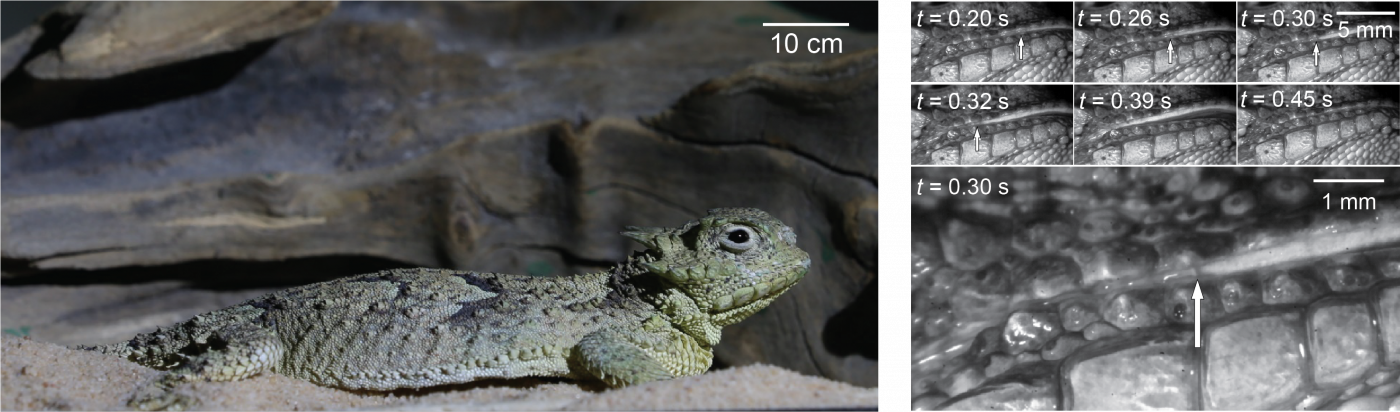
▲ Figure 1. (Left) Desert horned lizard (Phrynosoma platyrhinos) inhabiting an arid environment. (Right) Magnified image of a water film formed between the lizard’s jaws, captured using a high-speed camera
[Reference Materials]
- Title/Journal : Soil Water Harvest Inspired by Desert Horned Lizards Phrynosoma platyrhinos, PNAS(Proceedings of the National Academy of Sciences)
- DOI : https://www.pnas.org/doi/10.1073/pnas.2609344123
[Contact Information]
Professor Ho-Young Kim, Microfluids & Soft Matter Laboratory, Department of Mechanical Engineering, Seoul National University / hyk@snu.ac.kr