loaction
- About
-
Academics
-
Undergraduate Programs
- Civil, Urban and Environmental Engineering
- Architecture and Architectural Engineering
- Mechanical Engineering
- Industrial Engineering
- Energy Resources Engineering
- Nuclear Engineering
- Materials Science and Engineering
- Electrical and Computer Engineering
- Naval Architecture and Ocean Engineering
- Computer Science and Engineering
- Aerospace Engineering
- Chemical and Biological Engineering
-
Graduate Programs
- Civil, Urban and Environmental Engineering
- Architecture and Architectural Engineering
- Mechanical Engineering
- Industrial Engineering
- Energy Systems Engineering
- Materials Science and Engineering
- Electrical and Computer Engineering
- Naval Architecture and Ocean Engineering
- Computer Science and Engineering
- Aerospace Engineering
- Chemical and Biological Engineering
- Interdisciplinary Program in Technology, Management, Economics and Policy
- Interdisciplinary Program in Urban Design
- Interdisciplinary Program in Bioengineering
- Interdisciplinary Program in Artificial Intelligence
- Interdisciplinary Program in Intelligent Space and Aerospace Systems
- Chemical Convergence for Energy and Environment Major
- Multiscale Mechanics Design Major
- Hybrid Materials Major
- Double Major Program
- Open Programs
-
Undergraduate Programs
- Research
- Prospective Students
- Campus Life
- International Office
- Communication
Research Achievements
SNU Engineering Team Develops Eco-Friendly Spiderweb-Inspired Pressure Sensor for Robotic Hands Potentially Assisting Patients with Parkinson’s Disease
-
Uploaded by
대외협력실
-
Upload Date
Jul 08, 2026
-
Views
596
SNU Engineering Team Develops Eco-Friendly Spiderweb-Inspired Pressure Sensor for Robotic Hands Potentially Assisting Patients with Parkinson’s Disease
- A Flexible Pressure Sensor Achieving High Sensitivity, Fast Response, and Excellent Durability
- A Promising Core Technology for Wearable AI Healthcare Robots, Rehabilitation Assistive Devices, and Human–Machine Interfaces
- Published in Nature Communications, a leading international scientific journal
▲ (From left)Professor Tae-Woo Lee (Seoul National University), Jing Dai Visiting researcher (Ph.D. candidate, The University of Electronic Science and Technology of China, UESTC), Kwan-Nyeong Kim (Ph.D candidate, Seoul National University)
A high-performance biodegradable pressure sensor has been developed as a key technology for wearable AI healthcare robotics and user-friendly robotic systems.
Seoul National University College of Engineering announced that a research team led by Professor Tae-Woo Lee in the Department of Materials Science and Engineering has developed an eco-friendly artificial spiderweb pressure sensor* inspired by the multiscale architecture of natural spiderwebs. The sensor simultaneously achieves high sensitivity, fast response time, and excellent mechanical stability.
* Artificial spiderweb pressure sensor: A flexible pressure sensor that mimics the multilayered fiber and mesh structures of spiderwebs to efficiently transmit pressure and convert it into electrical signals.
Capable of real-time detection of human pulse, respiration, vocalization, and finger movements, the sensor can be integrated with robotic hand control systems and is expected to find broad applications in Parkinson’s disease rehabilitation assistive devices, eco-friendly wearable devices, and user-friendly robotics.
The research was published on July 4 in Nature Communications, a world-renowned international academic journal.
Previously, Professor Lee’s research team published a series of studies in leading scientific journals, including papers in Nature in January, February, and April of this year, as well as in Science in January. With four papers published in these two flagship journals, widely regarded as the two pillars of scientific publishing, the team has demonstrated outstanding research excellence. In addition, the team published another study in Nature Materials in June, further proving its world-class competitiveness in the development of wearable display materials and devices, as well as in securing core device technologies.
Wearable electronics are evolving beyond simple health-monitoring devices such as smartwatches into human–machine interface (HMI)* technologies that detect users’ movements and biosignals in real time and connect them with robots, assistive devices, and medical systems. In particular, flexible pressure sensors, which can be attached to the skin or joints to directly measure various pressure-related signals from the human body, such as pulse, respiration, voice, and joint movement, are gaining attention as core components for wearable healthcare AI robots, rehabilitation robots, and user-friendly robotic systems.
* Human–machine interface: A technology that converts human biosignals or movements into input signals for machines, robots, or computer systems, enabling interaction between humans and machines.
However, conventional flexible pressure sensors have faced limitations in simultaneously achieving high sensitivity, fast response time, and excellent mechanical stability. This is because complex structures designed to accurately detect even subtle pressure can be easily damaged by repeated pressure and bending, whereas more robust structures tend to show lower sensitivity to small pressure changes.
In addition, most wearable electronic devices made from non-degradable materials generate waste after use. This has increased the need to develop sustainable flexible pressure sensors based on biodegradable materials.
To address these challenges, Professor Tae-Woo Lee’s research team developed a multiscale artificial spiderweb pressure sensor inspired by the multilayered fiber structure, mesh structure, and core–shell structure of natural spiderwebs.
Spiderwebs can rapidly detect subtle vibrations while distributing external impacts across the entire structure to maintain stability. By applying this principle to sensor design, the research team proposed a three-dimensional fiber network that can effectively transmit pressure while maintaining durability under repeated use.
First, the team fabricated a spiderweb-like fiber framework by electrospinning polylactic acid (PLA),* a biodegradable polymer, onto a copper mesh. The fibers were then coated with conductive carbon ink and silver nanowires to form a conductive network on the fiber surface. In this structure, when pressure is applied, the contact area between the conductive particles and nanowires increases, and electron transport pathways are rapidly formed at the nanometer scale. As a result, even small pressure changes are amplified and converted into electrical signals.
* Polylactic acid: A biodegradable polymer material that naturally decomposes after use and can be utilized as an eco-friendly material for electronic devices.
* Electrospinning: A process that uses a high-voltage electric field to draw a polymer solution into ultrafine fibers. It is widely used to fabricate flexible and breathable nanofiber films.
By simultaneously optimizing changes in conductive pathways and pressure transmission, the artificial spiderweb pressure sensor achieved both high sensitivity and excellent durability. In other words, the team resolved the conventional trade-off between sensitivity and durability in flexible pressure sensors through a nature-inspired structural design.
When attached to the human wrist and neck, the sensor measured various biosignals in real time, including pulse, respiration, vocalization, and joint movement. The measured pressure signals were then analyzed using an artificial neural network, enabling precise classification of individual physiological states with high accuracy. This suggests that the sensor developed by Professor Lee’s team can go beyond simple biosignal monitoring and be applied as an intelligent wearable system capable of interpreting the user’s physiological state.
In another experiment, the sensor attached to a finger was integrated with a robotic hand control system. The sensor detected the user’s bending angle and pressure intensity and converted them into control signals for the robotic hand. As a result, the robotic hand adjusted its gripping force and angle according to the user’s movements and successfully performed complex finger gestures.
The artificial spiderweb pressure sensor developed by Professor Tae-Woo Lee’s research team is expected to be applied across a wide range of fields, including rehabilitation assistance for patients with Parkinson’s disease who have difficulty controlling fine motor movements, intelligent prosthetic hands, wearable AI healthcare robots, user-friendly robots, soft robotics, and remote healthcare systems. Furthermore, with its ability to wirelessly transmit and visualize biosignals in real time via Bluetooth, together with the advantage of biodegradable material design, the sensor could be expanded into a next-generation smart healthcare platform with enhanced sustainability.
This research achievement is also expected to strengthen Korea’s overall national competitiveness in wearable electronics technology.
Professor Tae-Woo Lee stated, “This study represents an achievement in resolving the long-standing trade-off among high sensitivity, fast response, and repeated mechanical stability in flexible pressure sensors by mimicking the structural principles of natural spiderwebs. In particular, by simultaneously realizing high-performance pressure sensing and environmental friendliness based on biodegradable materials, this work suggests a new direction for sustainable wearable electronics.”
He added, “We plan to further develop this technology into a core platform technology for next-generation human–machine interfaces that combine user-friendliness with sustainability.”
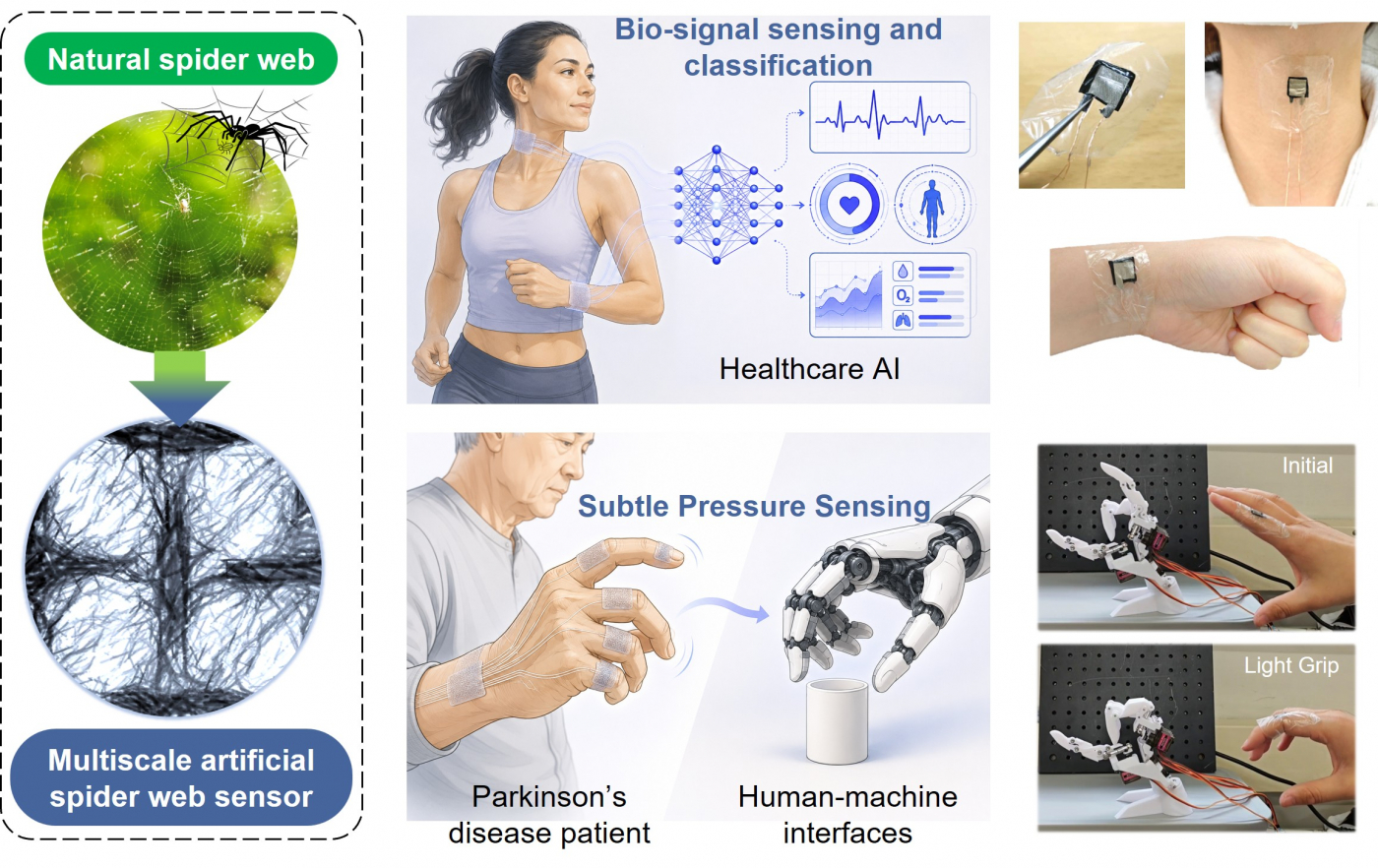
▲ Figure. Multiscale Artificial Spiderweb Pressure Sensor using Biodegradable Materials and Its Applications in Healthcare AI, Movement Monitoring of Patients with Parkinson’s Disease, and Human–Machine Interfaces
[Reference Materials]
- Title/Journal: Multiscale artificial spider web for comprehensive pressure sensing and human-machine interaction / Nature Communications
- DOI: https://doi.org//10.1038/s41467-026-74200-y
[Contact Information]
Professor Tae-Woo Lee, Department of Materials Science and Engineering, Seoul National University / +82-2-880-8021 / twlees@snu.ac.kr