loaction
- About
-
Academics
-
Undergraduate Programs
- Civil, Urban and Environmental Engineering
- Architecture and Architectural Engineering
- Mechanical Engineering
- Industrial Engineering
- Energy Resources Engineering
- Nuclear Engineering
- Materials Science and Engineering
- Electrical and Computer Engineering
- Naval Architecture and Ocean Engineering
- Computer Science and Engineering
- Aerospace Engineering
- Chemical and Biological Engineering
-
Graduate Programs
- Civil, Urban and Environmental Engineering
- Architecture and Architectural Engineering
- Mechanical Engineering
- Industrial Engineering
- Energy Systems Engineering
- Materials Science and Engineering
- Electrical and Computer Engineering
- Naval Architecture and Ocean Engineering
- Computer Science and Engineering
- Aerospace Engineering
- Chemical and Biological Engineering
- Interdisciplinary Program in Technology, Management, Economics and Policy
- Interdisciplinary Program in Urban Design
- Interdisciplinary Program in Bioengineering
- Interdisciplinary Program in Artificial Intelligence
- Interdisciplinary Program in Intelligent Space and Aerospace Systems
- Chemical Convergence for Energy and Environment Major
- Multiscale Mechanics Design Major
- Hybrid Materials Major
- Double Major Program
- Open Programs
-
Undergraduate Programs
- Research
- Prospective Students
- Campus Life
- International Office
- Communication
Research Achievements
SNU Researchers Develop Next-Generation Metamaterial Enabling Long-Range Wave Control Beyond Conventional Limits
-
Uploaded by
대외협력실
-
Upload Date
Jul 15, 2026
-
Views
540
SNU Researchers Develop Next-Generation Metamaterial Enabling Long-Range Wave Control Beyond Conventional Limits
- Proposes a new design principle for nonlocal metamaterials that precisely control vibrations and waves
- Expected applications in vibration reduction, ultrasound diagnostics, medical imaging, and next-generation sensing technologies
- Published in the prestigious international journal Advanced Materials

▲ (From left) Seung Han Kim (Integrated M.S./Ph.D. student, Department of Mechanical Engineering, Seoul National University), Myung Hwan Bae (Ph.D., Korea Research Institute of Standards and Science), Ye Jeong Shin (Integrated M.S./Ph.D. student, Department of Mechanical Engineering, Seoul National University), and Professor Joo Hwan Oh (Department of Mechanical Engineering, Seoul National University)
Seoul National University College of Engineering announced that a research team led by Professor Joo Hwan Oh of the Department of Mechanical Engineering, in collaboration with Dr. Myung Hwan Bae of the Korea Research Institute of Standards and Science (KRISS), has developed a new elastic metamaterial platform that enables the free design of how externally applied forces and vibrations propagate.
The team proposed a design principle that allows nonlocal metamaterials—in which forces or vibrations applied in one region can interact not only with adjacent areas but also with distant regions—to be more easily extended into diverse structural configurations.
They further demonstrated experimentally that this design overcomes the longstanding issue of interference among multiple vibrations in conventional nonlocal metamaterials, enabling more precise control over the propagation and motion of elastic waves.
The newly developed technology is therefore expected to serve as a foundational platform for next-generation vibration control, as well as for high-performance sensors, ultrasonic systems, and advanced mechanical devices.
The research findings were published on June 23 in the globally renowned journal Advanced Materials.
Elastic metamaterials are artificial materials composed of engineered microstructures arranged in periodic patterns, enabling unprecedented control over the propagation of waves and vibrations. They are emerging as next-generation materials in wave engineering.
Recent studies have explored enhancing wave transmission in elastic metamaterials to improve the precision of medical ultrasound and the performance of acoustic and underwater sensors. At the same time, efforts have been made to suppress waves to reduce noise and vibration in vehicles or enhance underwater stealth capabilities in submarines.
However, conventional elastic metamaterials have suffered from a fundamental limitation: their ability to strongly transmit or block waves typically operates only within a very narrow frequency band.
To overcome this limitation, nonlocal metamaterials have recently been proposed, in which unit structures are designed so that forces or vibrations can interact not only with neighboring regions but also with distant ones. This concept enables enhanced transmission and suppression of waves across a broader frequency range.
Despite this promise, most studies on nonlocal metamaterials have remained theoretical, with only a few attempts at practical implementation. Designing structures that enable long-range interactions has led to highly complex geometries, making fabrication difficult and often introducing unwanted wave phenomena due to interference among different vibrations.
To address these challenges, a new structural platform is required—one that is simple, scalable, and capable of minimizing undesired wave effects.
To tackle this challenge, Professor Oh’s team proposed a novel structural design approach called “Metaspire,” successfully overcoming the critical limitations of nonlocal metamaterials.
One of the main difficulties in designing nonlocal metamaterials lies in incorporating additional structures for long-range interactions without interfering with the original unit structures. This typically results in highly complex architectures and unintended wave behaviors.
The researchers introduced an innovative concept of rotating unit structures in a sequential pattern, which naturally creates space for embedding long-range interaction pathways.
By applying this design, they demonstrated that nonlocal interactions can be implemented without increasing structural complexity, and that the system can be easily expanded even when multiple interaction pathways are required. Moreover, the approach effectively suppresses complex and undesirable wave phenomena observed in previous designs.
Through numerical simulations and experimental validation, the team confirmed that the proposed structure can successfully realize complex nonlocal metamaterials while eliminating unwanted wave effects. They also demonstrated that wave transmission and suppression—previously limited to narrow frequency ranges—can now be flexibly designed across a much broader frequency spectrum.
This study is significant in that it presents a generalizable platform for designing nonlocal metamaterials in elastic wave systems in a simpler and more systematic way. Notably, the proposed design is not limited to one-dimensional systems but can be readily extended to two- and three-dimensional structures, paving the way for a wide range of future metamaterial applications.
From an academic perspective, the work is expected to expand nonlocal metamaterial research beyond theoretical studies toward practical implementation and application. Technologically, it provides a realistic design solution to overcome the critical limitation of narrow frequency operation.
The proposed Metaspire platform is anticipated to accelerate research and development in metamaterial-based applications, including vibration reduction systems, ultra-precise wave control devices, medical ultrasound technologies, and next-generation sensors operating over wide frequency ranges.
Professor Joo Hwan Oh stated, “This research is meaningful in that it introduces a new design paradigm for systems utilizing elastic waves and vibrations, and demonstrates and validates novel wave phenomena in nonlocal metamaterials experimentally.” He added, “We plan to further develop this technology into practical applications, such as ultrasonic imaging and next-generation sensing systems that can benefit everyday life.”
The first author of the paper, Seung Han Kim, is an integrated M.S./Ph.D. student in the Department of Mechanical Engineering at Seoul National University. He is currently conducting research on wave control using elastic metamaterials under the supervision of Professor Oh. His future research will focus on developing new wave control principles by combining long-range nonlocal interactions with various resonance phenomena, aiming to expand applications across multiple engineering fields.
This work was supported by the National Research Foundation of Korea (NRF) through the STEAM Research Program (RS-2023-00251628), the Young Researcher Program (RS-2024-00343120), and the Basic Research Laboratory Program (RS-2024-00406514).
Experimental support was also provided by the Non-Destructive Measurement Group at the Korea Research Institute of Standards and Science (KRISS).
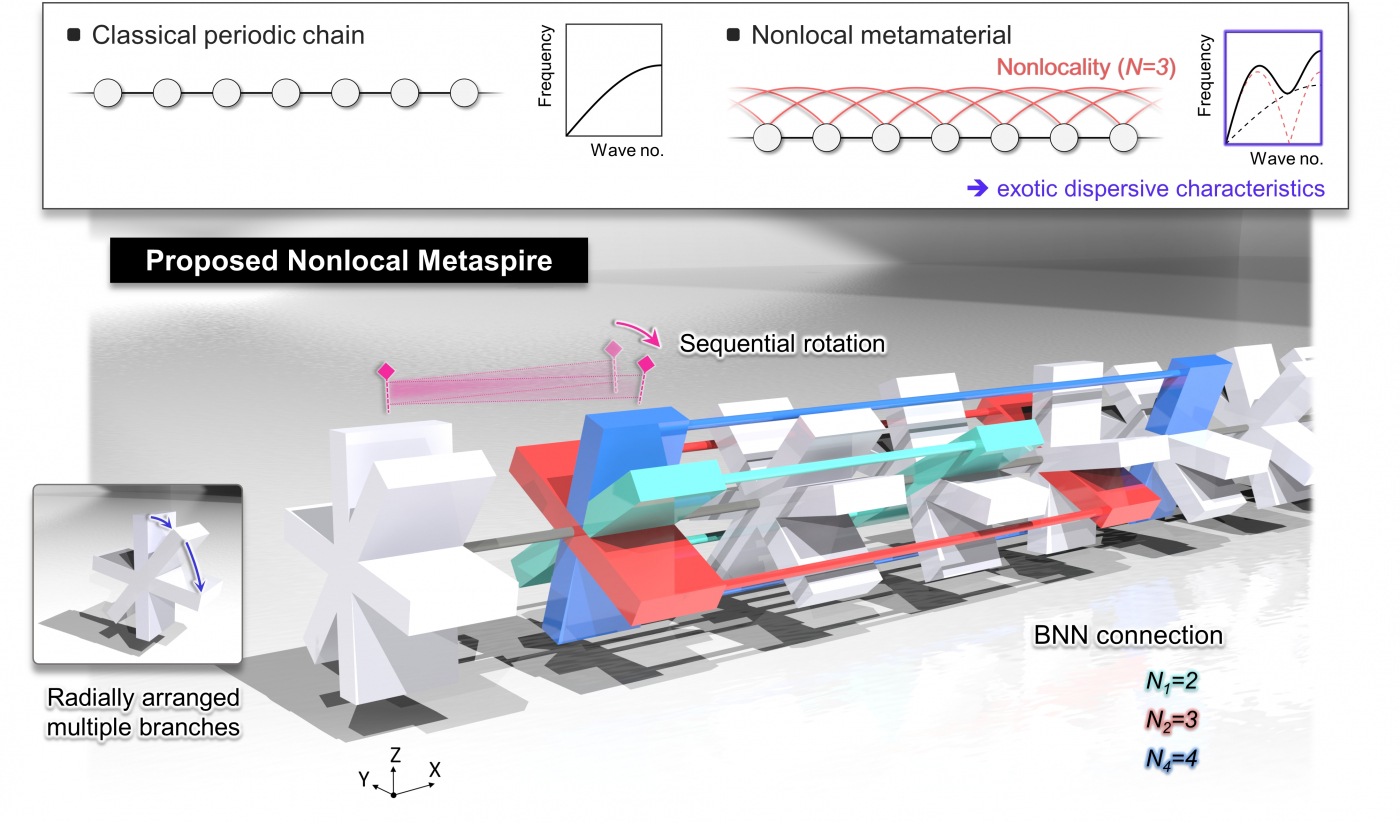
▲ Figure 1. Structure and operating principle of the nonlocal Metaspire
Nonlocal connections between distant structures are realized through a sequential rotational arrangement, inducing unique dispersion characteristics.
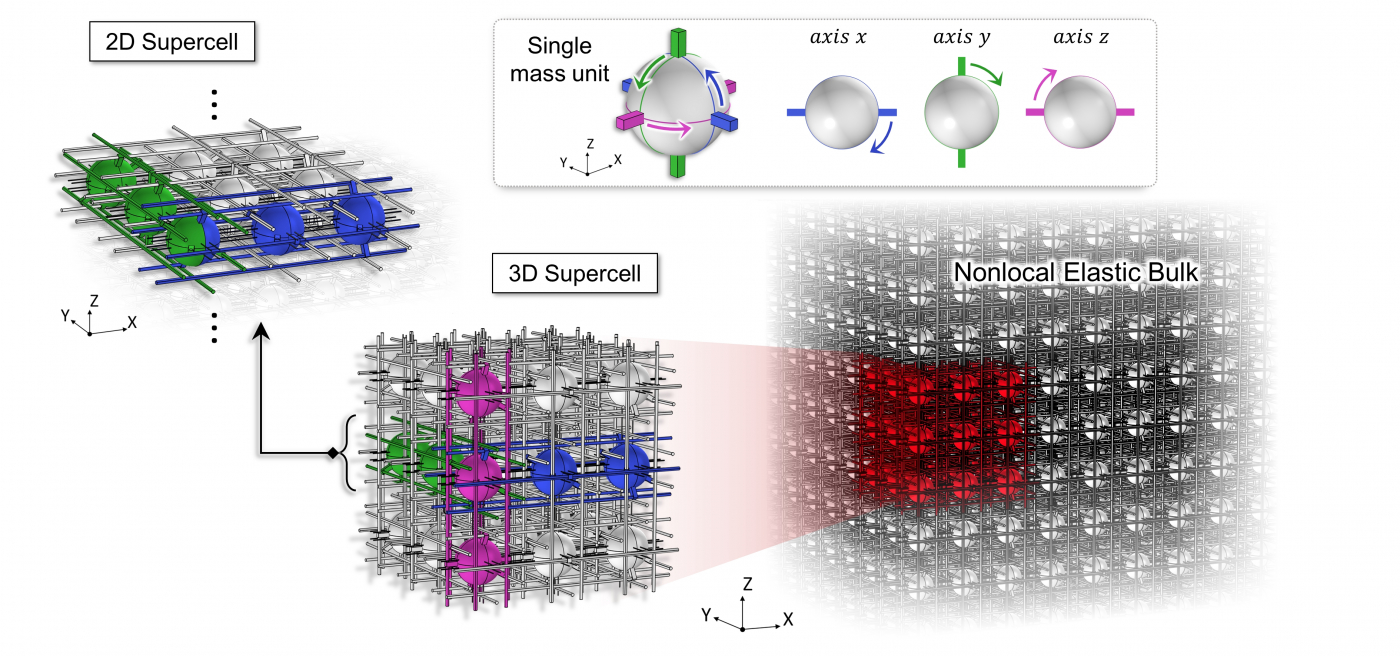
▲ Figure 2. Two-dimensional unit structure of the Metaspire and its extension to a three-dimensional nonlocal elastic medium
A nonlocal elastic material is realized through the design of unit mass elements and their arrangement in 2D and 3D configurations.
[Reference Materials]
- Title/Journal : Nonlocal Metaspire: A Scalable Elastic Material Platform With Decoupled Mechanical Modes, Advanced Materials
- DOI : http://doi.org/10.1002/adma.73822
[Contact Information]
Professor Joo Hwan Oh, MetaStructure Lab., Department of Mechanical Engineering, Seoul National University / ojh86@snu.ac.kr