loaction
- About
-
Academics
-
Undergraduate Programs
- Civil, Urban and Environmental Engineering
- Architecture and Architectural Engineering
- Mechanical Engineering
- Industrial Engineering
- Energy Resources Engineering
- Nuclear Engineering
- Materials Science and Engineering
- Electrical and Computer Engineering
- Naval Architecture and Ocean Engineering
- Computer Science and Engineering
- Aerospace Engineering
- Chemical and Biological Engineering
-
Graduate Programs
- Civil, Urban and Environmental Engineering
- Architecture and Architectural Engineering
- Mechanical Engineering
- Industrial Engineering
- Energy Systems Engineering
- Materials Science and Engineering
- Electrical and Computer Engineering
- Naval Architecture and Ocean Engineering
- Computer Science and Engineering
- Aerospace Engineering
- Chemical and Biological Engineering
- Interdisciplinary Program in Technology, Management, Economics and Policy
- Interdisciplinary Program in Urban Design
- Interdisciplinary Program in Bioengineering
- Interdisciplinary Program in Artificial Intelligence
- Interdisciplinary Program in Intelligent Space and Aerospace Systems
- Chemical Convergence for Energy and Environment Major
- Multiscale Mechanics Design Major
- Hybrid Materials Major
- Double Major Program
- Open Programs
-
Undergraduate Programs
- Research
- Prospective Students
- Campus Life
- International Office
- Communication
Research Achievements
‘Forgetting’ Becomes an AI Capability: SNU–Sungkyunkwan University Team Demonstrates First AI Semiconductor That Forgets on Its Own
-
Uploaded by
대외협력실
-
Upload Date
Aug 11, 2026
-
Views
34
‘Forgetting’ Becomes an AI Capability: SNU–Sungkyunkwan University Team Demonstrates First AI Semiconductor That Forgets on Its Own
- First demonstration of an AI semiconductor device that retains recent information while autonomously forgetting older information
- Achieves 90.4% handwritten-digit recognition after compressing input data by 75%… paving the way for ultrafast, low-power edge AI hardware
- Research published in the internationally renowned journal Advanced Science
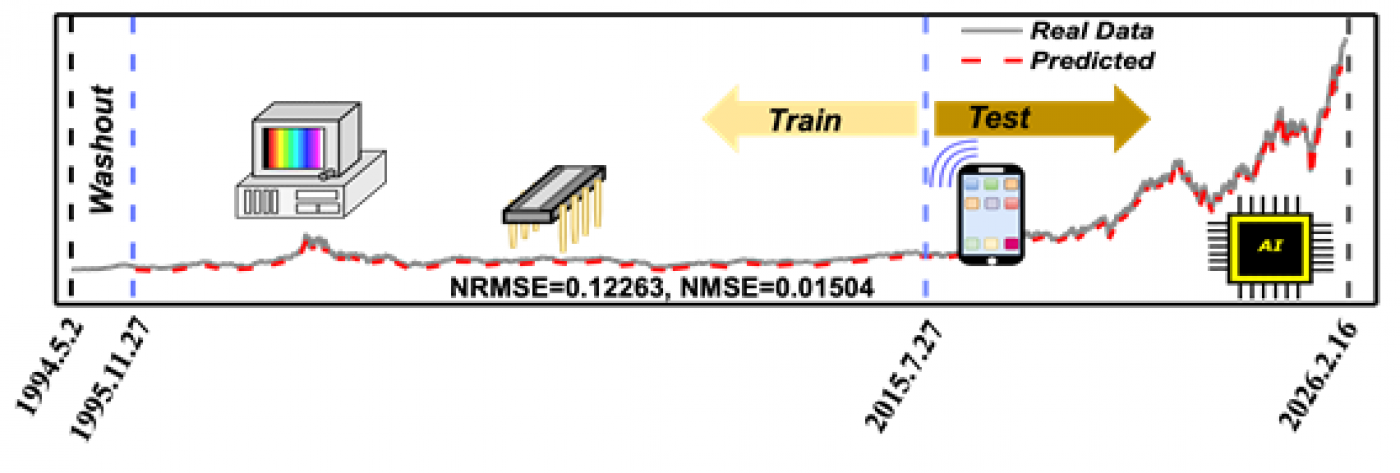
▲ The SNU–Sungkyunkwan University research team successfully performed semiconductor stock-market forecasting using the device’s “ability to forget.”
For the first time, researchers have demonstrated that the “ability to forget” can serve as a new computational function for artificial intelligence.
A research team led by Professor Min Hyuk Park of the Department of Materials Science and Engineering at Seoul National University College of Engineering, together with a team led by Professor Jung Ho Yoon of Sungkyunkwan University, has developed an antiferroelectric-based AI semiconductor device that temporarily remembers recent inputs while autonomously forgetting older information. The researchers successfully turned “natural forgetting,” previously regarded as a limitation of such devices, into a core computational function for processing time-series information.
The technology can continuously process data that arrives over time—such as speech, biosignals, and environmental sensor data—without requiring a separate reset process. It is expected to serve as a key technology for low-power edge AI systems, including speech-recognition devices, wearable healthcare devices, autonomous-driving sensors, and industrial Internet of Things (IoT) applications.
The findings were published in the internationally renowned journal Advanced Science. The technology enables continuous processing of complex time-series signals without a separate reset process and represents the first demonstration of a zirconium oxide (ZrO₂)-based antiferroelectric tunnel junction (AFTJ) as a physical reservoir computing (PRC) device.
Time-varying information such as speech, electrocardiogram signals, and environmental sensor data must be processed not only according to its current value but also in the context of immediately preceding inputs. The principle is similar to how people need to remember what they have just heard in order to understand the meaning of a conversation. Conventional AI hardware, however, has faced limitations in speed and power efficiency because data must repeatedly move between memory and computing units. Reservoirs based on nonvolatile devices may also require a reset process to erase previous states, creating a need for device-level short-term memory that retains only recent information for a certain period while autonomously erasing older information.
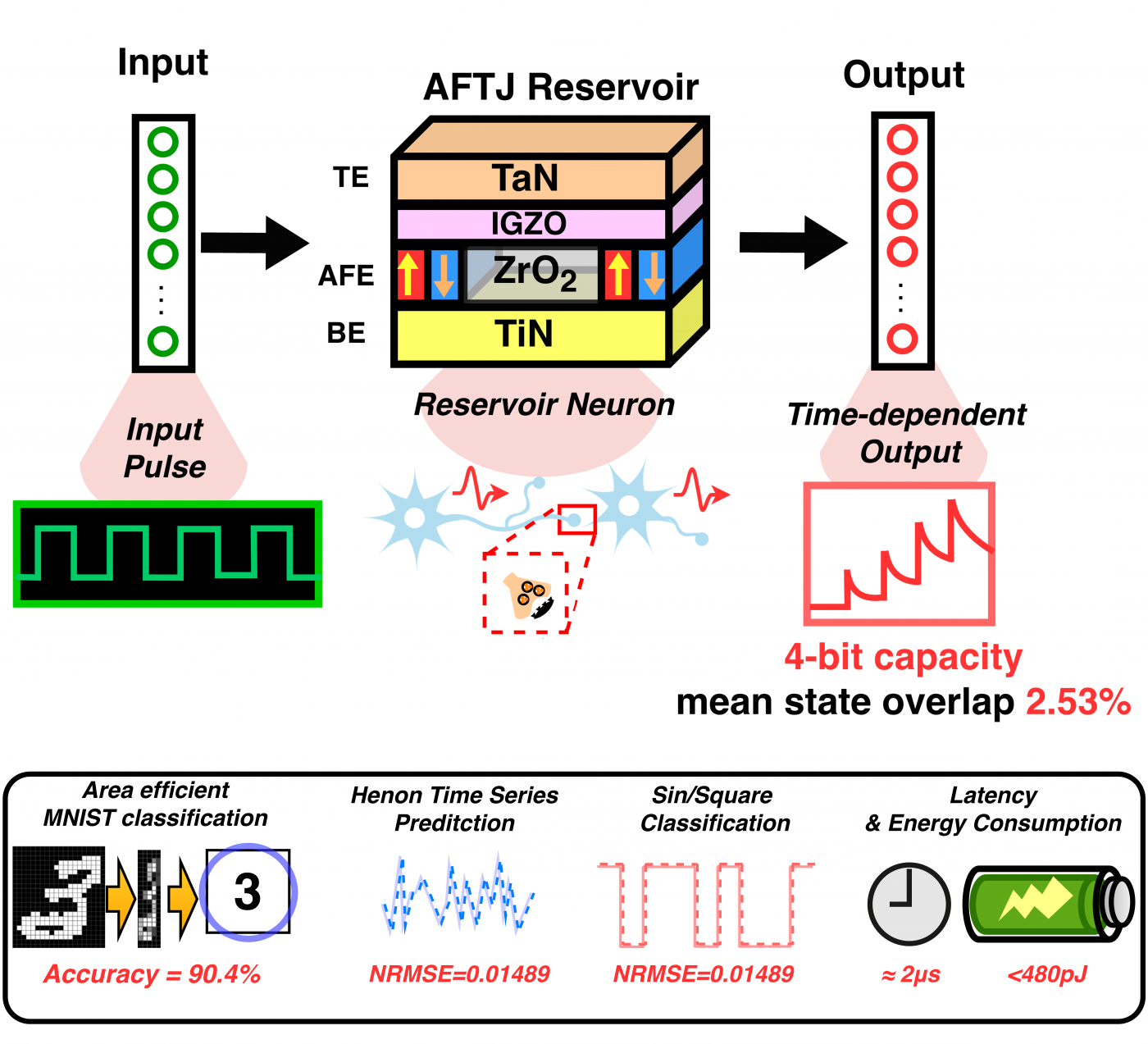
▲ Operating principle of the antiferroelectric tunnel junction (AFTJ) device, in which the current state varies according to the input history when voltage is applied and naturally returns to its original state over time after the voltage is removed. The research team used this “natural forgetting” characteristic to continuously process time-series information without a separate reset process.
To address this challenge, the researchers focused on a characteristic of antiferroelectrics in which their state changes when a voltage is applied and spontaneously returns to its original state once the voltage is removed. They fabricated a two-terminal device combining zirconium oxide with amorphous indium gallium zinc oxide (a-IGZO) and adjusted the IGZO composition so that even small changes in state could be read as distinct differences in current. The optimized device exhibited an on/off current ratio of approximately 890 and distinguished all 16 possible combinations of 4-bit inputs as different current states.
The device also demonstrated strong performance in validation tests. In handwritten-digit recognition, it achieved 90.4% recognition accuracy even after reducing the input data by 75%. A circuit model incorporating the characteristics of the actual device accurately predicted both a Hénon chaotic signal and real-world changes in the Philadelphia Semiconductor Index, achieving normalized root mean square error (NRMSE) values of 0.01489 and 0.12263, respectively, demonstrating its ability to process time-series information.
* Hénon chaotic signal: A representative form of nonlinear time-series data generated using simple mathematical equations, in which tiny differences in initial conditions become increasingly amplified over time, making future values difficult to predict.
* Philadelphia Semiconductor Index: An index that tracks the share-price movements of major semiconductor design, manufacturing, and equipment companies listed on U.S. stock exchanges, providing time-series data that reflect the complex and irregular fluctuations of real financial markets.
Based on a device area of 40,000 square micrometers (μm²), the fabricated device operated in approximately 2 microseconds, with energy consumption of 480 picojoules or less per operation. Compared with existing memristor-based PRC devices, this represents the fastest operating speed and the third-lowest energy consumption. The researchers project that further miniaturizing the device to an area of 100 μm² could improve its operating speed to approximately 192 nanoseconds and reduce energy consumption to 115 femtojoules or less.
The significance of the study lies in integrating reset-free continuous processing, multistate representation, data compression, high-speed operation, and low energy consumption into a single two-terminal device. In particular, by introducing a device architecture capable of continuously processing time-series data without a separate reset procedure, the research expands the possibilities for next-generation low-power edge AI hardware.
The technology could eventually be applied to low-power edge AI hardware that processes voice commands, wearable biosignals, and environmental and industrial sensor data close to where the data are generated. Further device miniaturization and array-level integration are expected to enable even faster and more energy-efficient information processing. Because the technology can briefly retain past inputs and learn patterns of change over time, it is also expected to enable low-power AI hardware capable of rapidly and energy-efficiently predicting future values in complex time-series data, including stock-market fluctuations.

▲ (From left) Professor Min Hyuk Park of Seoul National University; Professor Jung Ho Yoon of Sungkyunkwan University; Dr. Dong Hyun Lee of Brookhaven National Laboratory in the United States; Taegyu Kwon, Ph.D. student at Seoul National University; and Moonseek Jeong, Ph.D. student at Seoul National University.
Professor Min Hyuk Park said, “The key to this study is that we treated the tendency of an antiferroelectric to spontaneously return to its original state after voltage removal not as a limitation, but as a computational function—‘forgetting.’ By implementing nonlinear transformation, short-term memory, and natural resetting together in a single two-terminal device, we have broadened the range of device options available for low-power time-series AI hardware.”
He added, “Going forward, we plan to reduce the device area and conduct validation at the array and circuit levels, ultimately extending the technology to edge AI systems capable of processing speech, biosignals, and environmental signals on site.”
Co-first authors Taegyu Kwon and Moonseek Jeong, both Ph.D. students in the Department of Materials Science and Engineering at Seoul National University, are currently conducting research on ferroelectric-based neuromorphic devices under the supervision of Professor Min Hyuk Park. Kwon focuses on analyzing the mechanisms of antiferroelectrics and developing devices that utilize them, while Jeong focuses on improving the performance of neuromorphic devices using oxide semiconductors. Both researchers plan to continue follow-up studies on antiferroelectric-based neuromorphic devices and physical reservoir computing.
The research was supported by the Next-Generation Intelligent Semiconductor Technology Development Program of the Ministry of Science and ICT, through the National Research Foundation of Korea (NRF).
[Reference Materials]
Title / Journal: Volatile ZrO2 Antiferroelectric Tunnel Junctions for Rapid, Energy-Efficient Physical Reservoir Computing, Advanced Science
DOI: https://doi.org/10.1002/advs.76692
[Contact Information]
Professor Min Hyuk Park, Department of Materials Science and Engineering
Seoul National University / +82-2-880-7160 / minhyuk.park@snu.ac.kr