loaction
- About
-
Academics
-
Undergraduate Programs
- Civil, Urban and Environmental Engineering
- Architecture and Architectural Engineering
- Mechanical Engineering
- Industrial Engineering
- Energy Resources Engineering
- Nuclear Engineering
- Materials Science and Engineering
- Electrical and Computer Engineering
- Naval Architecture and Ocean Engineering
- Computer Science and Engineering
- Aerospace Engineering
- Chemical and Biological Engineering
-
Graduate Programs
- Civil, Urban and Environmental Engineering
- Architecture and Architectural Engineering
- Mechanical Engineering
- Industrial Engineering
- Energy Systems Engineering
- Materials Science and Engineering
- Electrical and Computer Engineering
- Naval Architecture and Ocean Engineering
- Computer Science and Engineering
- Aerospace Engineering
- Chemical and Biological Engineering
- Interdisciplinary Program in Technology, Management, Economics and Policy
- Interdisciplinary Program in Urban Design
- Interdisciplinary Program in Bioengineering
- Interdisciplinary Program in Artificial Intelligence
- Interdisciplinary Program in Intelligent Space and Aerospace Systems
- Chemical Convergence for Energy and Environment Major
- Multiscale Mechanics Design Major
- Hybrid Materials Major
- Double Major Program
- Open Programs
-
Undergraduate Programs
- Research
- Prospective Students
- Campus Life
- International Office
- Communication
Research Achievements
SNU Professor Jeong Woo Han’s Joint Research Team Uncovers AI-Guided Design Principle for Next-Generation Solid Oxide Cell Air Electrodes
-
Uploaded by
대외협력실
-
Upload Date
Aug 11, 2026
-
Views
28
SNU Professor Jeong Woo Han’s Joint Research Team Uncovers AI-Guided Design Principle for Next-Generation Solid Oxide Cell Air Electrodes
- Develops composite air electrode with balanced ionic and electronic conductivity, boosting fuel-cell performance 2.6-fold and electrolysis performance 4.4-fold
- Technology draws attention as a key solution for renewable energy storage and utilization
- AI-based multiscale simulations explore 2,860 interface structures and reveal the atomic-level mechanism behind performance enhancement
- Published in Nature Energy and selected as the journal’s cover article
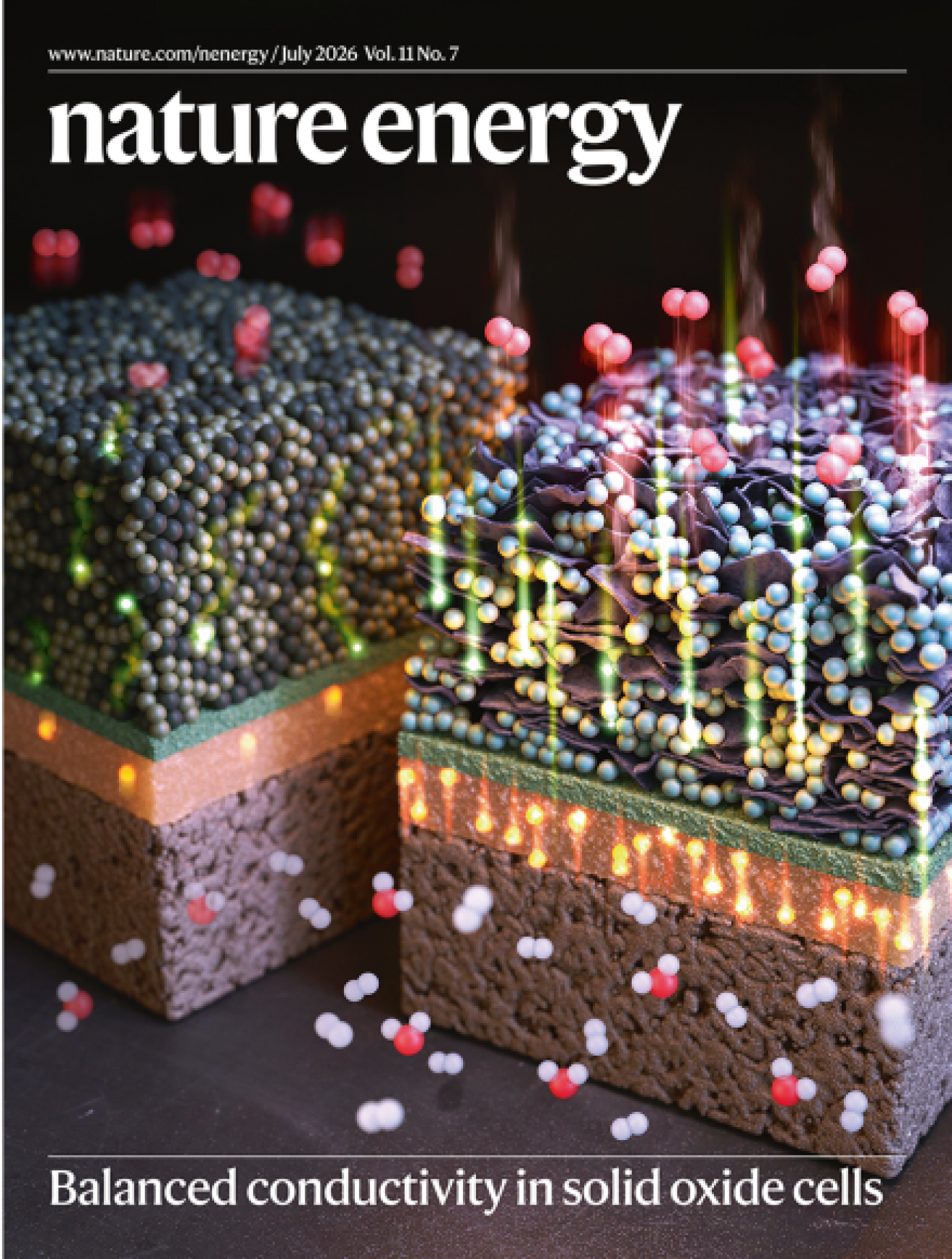
▲ Cover of the July issue of Nature Energy
Researchers have proposed a new air-electrode design principle that could significantly improve the performance of reversible solid oxide cells (RSOCs), which can store surplus electricity generated from renewable energy as hydrogen and convert it back into electricity when needed.
A research team led by Professor Jeong Woo Han of the Department of Materials Science and Engineering at Seoul National University College of Engineering, in collaboration with teams led by Professor Jun-Young Park of Sejong University, Professor Sun-Ju Song of Chonnam National University, and Professor Ryan O’Hayre of the Colorado School of Mines in the United States, has developed a composite air electrode with a balance between ionic and electronic conductivity and identified the mechanism responsible for its enhanced performance.
One of the biggest challenges facing renewable energy is how to store surplus electricity. On particularly windy days, for example, wind farms can generate large amounts of electricity, but that power may simply go unused if there is insufficient demand. Reversible solid oxide cells offer a solution to this problem because a single device can both produce hydrogen and generate electricity, making them a key technology for renewable energy storage and utilization. By introducing a new material that enables balanced transport of ions and electrons, the research team proposed a new design principle that overcomes a fundamental limitation of conventional air electrodes and achieved world-leading fuel-cell and electrolysis performance.
The findings were published in the international energy journal Nature Energy and selected as the cover article for its July issue.
The performance of a reversible solid oxide cell is largely determined by how efficiently oxygen-ion exchange reactions occur at the air electrode. However, the rate of oxygen reactions at the air electrode has long been a major bottleneck to improving cell performance. For roughly four decades, the industry-standard air electrode has used a structure combining a mixed ionic-electronic conductor (MIEC), which transports both oxygen ions and electrons, with an auxiliary conductor, GDC, which primarily transports oxygen ions. In this configuration, oxygen-ion exchange reactions are concentrated near the triple-phase boundary (TPB), the narrow region where the two materials meet.
The problem is that GDC’s ability to transport electrons is approximately 1,000 times lower than its ability to transport oxygen ions. Much like an eight-lane highway feeding into a one-lane alley, this imbalance creates a bottleneck in electron transport, restricting oxygen reactions to the narrow boundaries where the two materials meet. This inability to fully utilize the entire electrode has been regarded as a fundamental limitation of conventional air electrodes.
To overcome this problem, the research team replaced conventional GDC with the proton conductor BCZYYb7111, a new air-electrode material with more balanced ion and electron transport capabilities. The researchers combined it with GCCCO, a strontium-free, misfit-layered mixed conductor, to create a new composite air electrode.
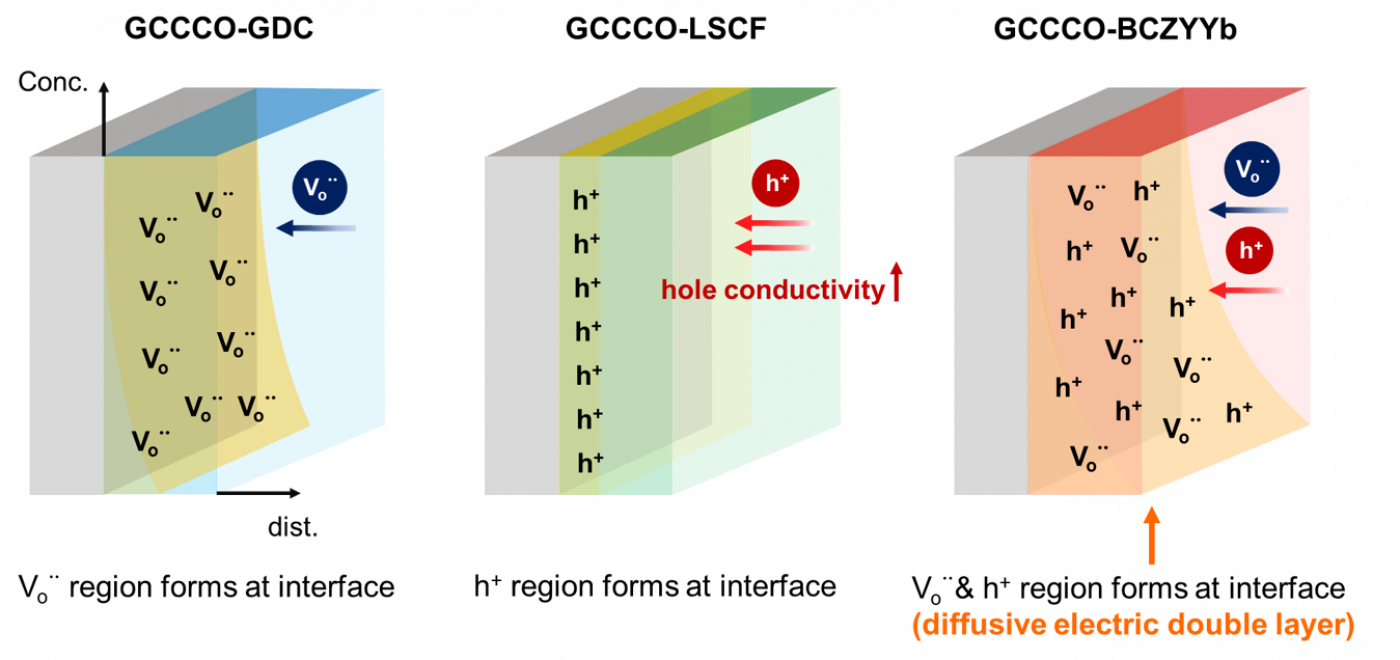
▲ Figure 1. Schematic illustration of charge-carrier distributions at the interfaces of GCCCO-GDC, GCCCO-LSCF, and GCCCO-BCZYYb composite air electrodes.
Left: At the GCCCO-GDC interface, only an oxygen-vacancy region forms. Center: At the GCCCO-LSCF interface, only a hole-rich region forms. Right: At the GCCCO-BCZYYb interface, oxygen vacancies and holes form simultaneously, creating a diffuse electrical double layer. This demonstrates that a balance between ionic and electronic conductivity is key to superior oxygen-ion exchange characteristics.
The resulting electrode achieved a maximum power density of 7.08 W·cm⁻² in fuel-cell mode and 7.88 A·cm⁻² at 1.3 V in electrolysis mode, representing world-leading performance among RSOC air electrodes reported to date. Compared with conventional LSCF-GDC air electrodes, fuel-cell performance improved 2.6-fold, while electrolysis performance increased 4.4-fold.
The researchers also confirmed that the design strategy could be applied not only to GCCCO but also to a variety of other air-electrode materials, including LSCF, PBSCF, LSC, and BSCF. Across all of these materials, replacing conventional GDC with BCZYYb7111 improved fuel-cell performance by 38–129% and electrolysis performance by 50–104%. The electrodes also maintained excellent stability during more than 200 hours of long-term operation, rapid thermal cycling, and conditions involving interruption of the air supply.
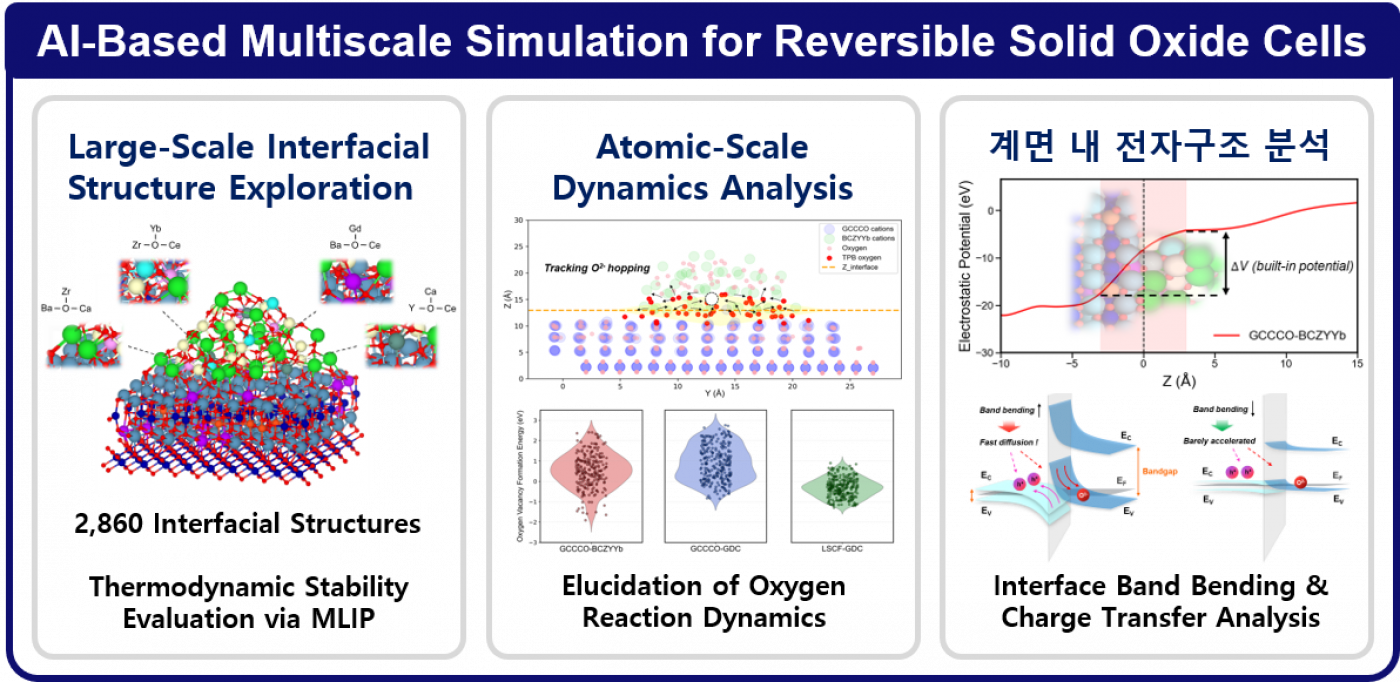
▲ Figure 2. Overview of AI-based multiscale simulations for reversible solid oxide cells.
Left: Large-scale modeling and thermodynamic stability evaluation of 2,860 interface structures using machine-learning interatomic potentials. Center: Analysis of oxygen-vacancy formation-energy distributions and oxygen-ion diffusion behavior. Right: DFT-based analysis of interfacial energy bands and charge transfer driven by the built-in interfacial potential.
To determine the origin of this performance improvement, the team established a multiscale simulation framework combining AI-based machine-learning interatomic potentials (MLIPs), molecular dynamics (MD), and density functional theory (DFT), and analyzed a total of 2,860 interface structures.
The analysis showed that the new composite air electrode facilitates the formation of oxygen vacancies, enables faster oxygen-ion transport, and generates a strong built-in potential at the interface that promotes the movement of both ions and electrons. The researchers quantitatively demonstrated at the atomic level that these three factors work together to substantially accelerate oxygen-ion exchange reactions.
The significance of the study lies not simply in the development of a new material, but in the introduction of an entirely new design criterion for air electrodes in reversible solid oxide cells. If applied to practical cells, this design principle could enable more hydrogen to be produced with the same amount of electricity, lowering the cost of green hydrogen production while also improving fuel-cell power-generation efficiency. The technology is also expected to find applications in a wide range of industries, including hydrogen refueling stations, fuel-cell power plants, and marine fuel-cell systems, helping address the intermittency of renewable energy and contributing to the establishment of a carbon-free hydrogen energy circular economy.

▲ (From left) WonJun Lee, Ph.D. student in the Department of Materials Science and Engineering at Seoul National University; Jinuk Moon, integrated M.S.-Ph.D. student in the Department of Materials Science and Engineering at Seoul National University; Professor Sun-Ju Song, School of Materials Science and Engineering at Chonnam National University and corresponding author; Professor Jun-Young Park, Department of Nanotechnology and Advanced Materials Engineering at Sejong University and corresponding author; and Professor Jeong Woo Han, Department of Materials Science and Engineering at Seoul National University and corresponding author.
Professor Jeong Woo Han said, “Composite air-electrode interfaces involve a complex interplay of variables, including crystal orientation and atomic arrangement, making large-scale exploration virtually impossible using conventional first-principles calculations alone. By systematically exploring 2,860 interface structures through AI-based multiscale simulations, we were able, for the first time, to quantitatively identify the atomic-level mechanisms underlying the performance enhancement of RSOC composite air electrodes.”
He added, “This study proposes a new design criterion for RSOC air electrodes—that ionic and electronic conductivity must be balanced. We expect this principle to serve as a starting point for future material selection and cell design.”
WonJun Lee, a Ph.D. student in the Department of Materials Science and Engineering at Seoul National University and co-first author of the study, said, “We demonstrated the potential of AI-based simulations to analyze thousands of interface structures within a short period of time—structures that would be difficult to explore through experiments alone. Going forward, we plan to further advance this framework and extend our research to next-generation cell systems, including protonic ceramic fuel cells (PCFCs) and reversible protonic ceramic electrochemical cells (RPCECs).”
The research was supported by the Ministry of Science and ICT of the Republic of Korea and the National Research Foundation of Korea (NRF).
[Reference Materials]
- Title / Journal: Composite air electrodes based on BaCe0.7Zr0.1Y0.1Yb0.1O3−δ for reversible solid oxide cells, Nature Energy
- DOI: https://doi.org/10.1038/s41560-026-02042-5
[Contact Information]
Professor Jeong Woo Han, Department of Materials Science and Engineering
Seoul National University / +82-2-880-1608 / jwhan98@snu.ac.kr