- About
- Academics
-
Undergraduate Programs
- Civil and Environmental Engineering
- Architecture and Architectural Engineering
- Mechanical Engineering
- Industrial Engineering
- Energy Resources Engineering
- Nuclear Engineering
- Materials Science and Engineering
- Electrical and Computer Engineering
- Naval Architecture and Ocean Engineering
- Computer Science and Engineering
- Aerospace Engineering
- Chemical and Biological Engineering
-
Graduate Programs
- Civil and Environmental Engineering
- Architecture and Architectural Engineering
- Mechanical Engineering
- Industrial Engineering
- Energy Systems Engineering
- Materials Science and Engineering
- Electrical and Computer Engineering
- Naval Architecture and Ocean Engineering
- Computer Science and Engineering
- Chemical and Biological Engineering
- Aerospace Engineering
- Interdisciplinary Program in Technology, Management, Economics and Policy
- Interdisciplinary Program in Urban Design
- Interdisciplinary Program in Bioengineering
- Interdisciplinary Program in Artificial Intelligence
- Interdisciplinary Program in Intelligent Space and Aerospace Systems
- Chemical Convergence for Energy and Environment Major
- Multiscale Mechanics Design Major
- Hybrid Materials Major
- Double Major Program
- Open Programs
-
Undergraduate Programs
- Research
- Campus Life
- Communication
- Prospective Students
- International Office
SNU’s “Dr. Rain” Professor Han Moo Young Changes S-Trap Toilets to Linear-trap Toilets
-
Uploaded by
관리자
-
Upload Date
2018.04.09
-
Views
1,016
SNU’s “Dr. Rain” Professor Han Moo Young Changes S-Trap Toilets to Linear-trap Toilets
- “Just One Year and Toilet Replacement Cost Breaks Even”...
- Active Researches Conducted Outside of Korea
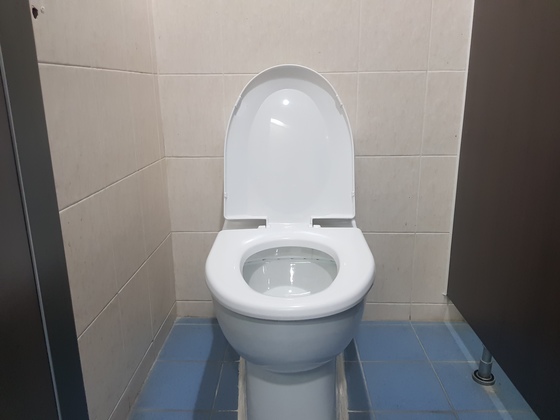
▲ A Linear-trap Toilet Installed at a Male Restroom Inside of a SNU College of Engineering Building
“The effect is impressive as expected. The new toilets save a lot of water.”
SNU College of Engineering (Dean Cha Kook-Heon) Professor Han Moo Young from Department of Civil and Environmental Engineering comments with joy. Professor Han, also known as SNU’s “Water Expert,” urged the administration office to “replace school’s restroom toilets to linear-trap toilets for water conservation.” Hence, SNU has replaced 427 toilets since February of last year.
The effect was immediate. SNU Gwanak Campus has reduced its water use by 4.8% during first half of last year. This is equivalent to approximately 86 million 700 thousand Korean Won. Professor Han explains, “The outcome of switching just around 500 toilets is massive. If thousands were replaced, immense amount of water can be saved. Note that, water use dropped by 6% in 2016.”
S-trap toilets comprise majority of the toilets installed in Korea. According Professor Han’s research team, one flush requires about 12L of fresh water. Han criticizes, “Logically, the S-trap toilets just have to use lots of water. While other countries have installed water-efficient linear-trap toilets and vacuum toilets, the lack of environmental consciousness, especially in water, in Korea has led to the continued use of S-trap toilets.”
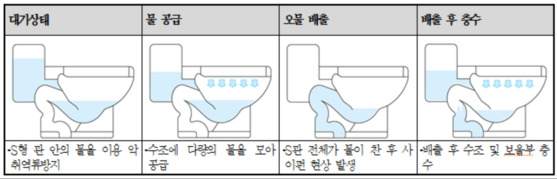
▲ Mechanism of S-trap Toilet
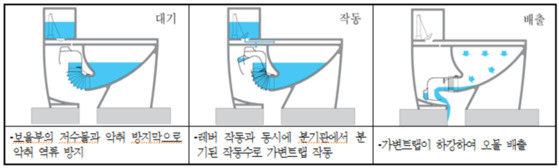
▲ Mechanism of Linear-trap Toilet
The new linear-trap toilets implemented need only 4.5L of water per flush. While this is a significant reduction of less than half of what previous toilets required, no reports on side-effects in water pressure and odor has been received. Students who have been using the new toilets for the past year all agreeably replied that they have not experienced any inconveniences like clogging. Thus, SNU is planning to replace 186 more toilets by this February.
This linear-trap toilet is about 40,000 Korean Won more expensive than the usual toilet. However, Han calculates that, “Even taking replacement cost into consideration, all additional fees needed for the new toilet breaks even after a year of using it. Water conservation can be just these simple acts.” He adds that the technology used in manufacturing linear-trap toilets commonly used in US, Australia, and Germany does not require high sophistication.
In May of 2016, SNU has drawn up the “Water Saving Plan for Creating a Sustainable, Eco-friendly Campus.” Water supply facilities will be reviewed to set up a more systematic control of expenses.
As a part of this plan, SNU has replaced 64 decrepit water gauges and 370-meters worth of old pipes last year. A new water monitoring system is currently being built and the school plans to further install new toilets to restrooms.
Han points out, “It is nice to research new technologies like the solar power, but people also have to take note of some easier energy saving methods that are already available. I hope more people will take interest in water conservation.”
-
PrevSNU Graduate School of Engineering Practice Hosts “EPM Congress 2018”
-
NextSNU iTEC and Global Solar Volunteer Corps Build Smart Solar Generators in Tanzania