- About
- Academics
-
Undergraduate Programs
- Civil and Environmental Engineering
- Architecture and Architectural Engineering
- Mechanical Engineering
- Industrial Engineering
- Energy Resources Engineering
- Nuclear Engineering
- Materials Science and Engineering
- Electrical and Computer Engineering
- Naval Architecture and Ocean Engineering
- Computer Science and Engineering
- Aerospace Engineering
- Chemical and Biological Engineering
-
Graduate Programs
- Civil and Environmental Engineering
- Architecture and Architectural Engineering
- Mechanical Engineering
- Industrial Engineering
- Energy Systems Engineering
- Materials Science and Engineering
- Electrical and Computer Engineering
- Naval Architecture and Ocean Engineering
- Computer Science and Engineering
- Chemical and Biological Engineering
- Aerospace Engineering
- Interdisciplinary Program in Technology, Management, Economics and Policy
- Interdisciplinary Program in Urban Design
- Interdisciplinary Program in Bioengineering
- Interdisciplinary Program in Artificial Intelligence
- Interdisciplinary Program in Intelligent Space and Aerospace Systems
- Chemical Convergence for Energy and Environment Major
- Multiscale Mechanics Design Major
- Hybrid Materials Major
- Double Major Program
- Open Programs
-
Undergraduate Programs
- Research
- Campus Life
- Communication
- Prospective Students
- International Office
Content of the press release and paper is embargoed until 1800 London time / 1300 US Eastern Time on 18 April 2018
-
Uploaded by
관리자
-
Upload Date
2018.04.19
-
Views
822
Content of the press release and paper is embargoed until 1800 London time / 1300 US Eastern Time on 18 April 2018
Peptide Induces Chirality Evolution in a Single Gold Nanoparticle
For the first time, scientists have successfully made optically active, chiral gold nanoparticles, using amino acids and peptides. Many chemicals significant to life have mirror-imaged twins (left handed and right handed structures) and such characteristics are conventionally called as chirality. This study describes how the chirality, typically observed in organic molecules, can be extended to three-dimensional metallic nanostructures. The newly discovered synthesis method was described in Nature (April 19th) and was featured on the cover.
The Korean research teams of Seoul National University (SNU), Pohang University of Science and Technology (POSTECH) and LG Display (LGD), showed the direct transfer of peptide handedness to the nanoparticles’ morphology during their growth. Mirror imaged twins of the peptide induced the oppositely twisted chiral nanoparticles, which are further tunable with the sequence variation. The chiral gold nanoparticles with different handedness interact differently with the circularly polarized visible light to display extensive color modulation. As a result, color change is possible by controlling the light polarization, which has a potential application in a future display.
In newly synthesized gold nanoparticles, chiral elements are arranged on cube-like structures with a side length of only about 100 nm. They can be easily dispersed in solution and deposited on the substrates, while maintaining high chiro-optical activities.
“Based on the understanding of interface between peptides and inorganic materials, we have built a new platform technology to control the crystallographic asymmetry,” explains Professor Ki Tae Nam at SNU, who lead this collaborative project. Also he also added, “This finding can make a direct and immediate impact on optical devices and could be further applied for the development of enantioselective bioinspired catalysts in near future.”
“The potential applications include active color display, holography, chirality sensor and all-angle negative refractive index materials,” explains Professor Junsuk Rho at POSTECH, the co-corresponding author.
Lead authors of the Nature paper, “Amino acid and peptide directed synthesis of chiral plasmonic gold nanoparticles”, are Hye-Eun Lee and Hyo-Yong Ahn (SNU). Other authors are JunghoMun (POSTECH), Yoon Young Lee (SNU), Minkyung Kim (POSTECH), Nam Heon Cho (SNU), Kiseok Chang (LGD), and Wook Sung Kim (LGD and POSTECH).
This research was funded by the National Research Foundation of Korea, under the Ministry of Science, ICT and Future Planning and LGD-SNU Incubation Program.
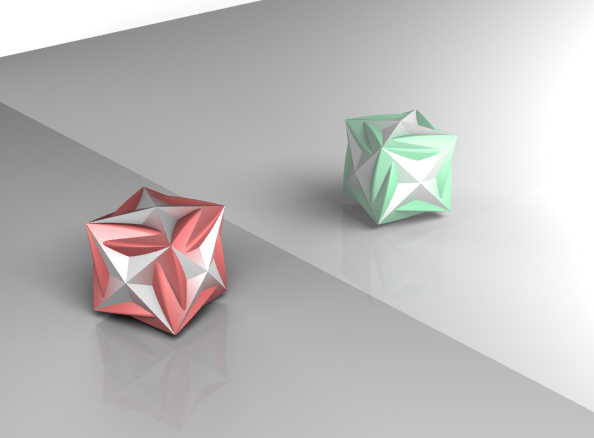
[Figure 1] Schematic geometry of chiral gold nanoparticle, mirror imaged twins, synthesized with the chiral peptide additives.
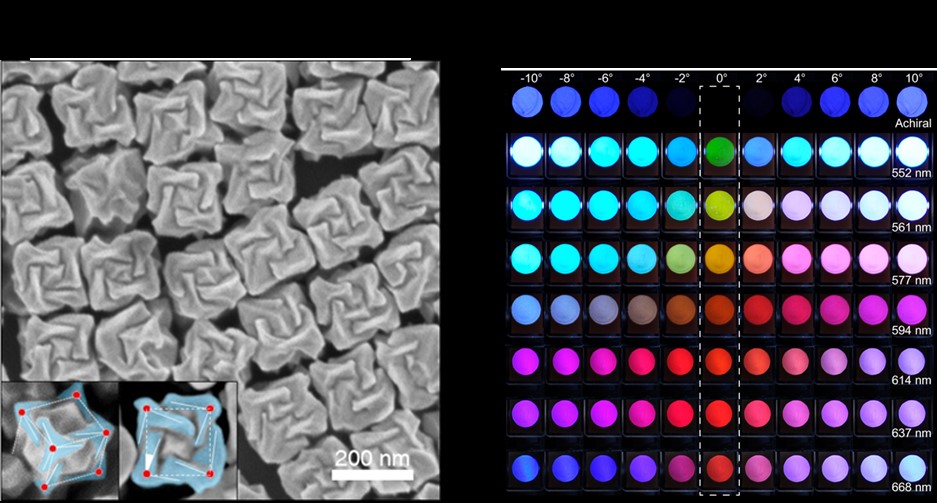
[Figure2] Electron microscope image of synthesized chiral gold nanoparticles (LEFT), where chiral components are highlighted in blue. Potential application in a color display as a three dimensional polarizer. (Right)