- About
- Academics
-
Undergraduate Programs
- Civil and Environmental Engineering
- Architecture and Architectural Engineering
- Mechanical Engineering
- Industrial Engineering
- Energy Resources Engineering
- Nuclear Engineering
- Materials Science and Engineering
- Electrical and Computer Engineering
- Naval Architecture and Ocean Engineering
- Computer Science and Engineering
- Aerospace Engineering
- Chemical and Biological Engineering
-
Graduate Programs
- Civil and Environmental Engineering
- Architecture and Architectural Engineering
- Mechanical Engineering
- Industrial Engineering
- Energy Systems Engineering
- Materials Science and Engineering
- Electrical and Computer Engineering
- Naval Architecture and Ocean Engineering
- Computer Science and Engineering
- Chemical and Biological Engineering
- Aerospace Engineering
- Interdisciplinary Program in Technology, Management, Economics and Policy
- Interdisciplinary Program in Urban Design
- Interdisciplinary Program in Bioengineering
- Interdisciplinary Program in Artificial Intelligence
- Interdisciplinary Program in Intelligent Space and Aerospace Systems
- Chemical Convergence for Energy and Environment Major
- Multiscale Mechanics Design Major
- Hybrid Materials Major
- Double Major Program
- Open Programs
-
Undergraduate Programs
- Research
- Campus Life
- Communication
- Prospective Students
- International Office
Yu Song-Geun of the Department of Mechanical Engineering Develops a Technology for Ocean Cleanup Robot
-
Uploaded by
관리자
-
Upload Date
2018.04.24
-
Views
1,944
Yu Song-Geun of the Department of Mechanical Engineering Develops a Technology for Ocean Cleanup Robot
- A Student on Doctor’s Course at Department of Mechanical and Aerospace Engineering
- From “Whale Robots” to Drone… Received Patents in Korea and US
- Engineering Knowledge Supplemented by Professor Rhee Shin Hyung of the Department of Naval Architecture and Ocean Engineering

▲ Prototype Images of Fixed Cleanup Machine (Left) and Marine Debris Cleanup Drone (Right)
- From “Whale Robots” to Drone… Received Patents in Korea and US
- Engineering Knowledge Supplemented by Professor Rhee Shin Hyung of the Department of Naval Architecture and Ocean Engineering
▲ Prototype Images of Fixed Cleanup Machine (Left) and Marine Debris Cleanup Drone (Right)
Last December, Yu Song-Geun (30), an art undergraduate currently attending SNU Department of Mechanical Engineering graduate school, has created a robot that cleans marine debris using vortex.
This is a notable achievement as these inventions of complex robot are usually thought to be only possible at national research centers or large corporation that possess huge budgets.
Yu who is an undergraduate from SNU Department of Industrial Design (College of Art) is currently on the doctorate course at SNU College of Engineering’s Department of Mechanical Engineering Graduate School. Yu who has been researching the field of ocean vacuum states, “When I was an undergraduate senior back in 2012, I came across a news on rubbish-riddled oceans and felt an urge to combat marine debris. As my graduation piece, I decided to build a robot that can collect ocean garbage.”
Many around Yu asked in doubt “why do you want to purposely choose a difficult project” or “does an art student even know how to make a robot.” At the start, to people’s concern, Yu faced numerous failures. The prototype that he designed was a 2-m long whale-shaped robot that floats on surfaces of water to gulp in debris through the mouth.
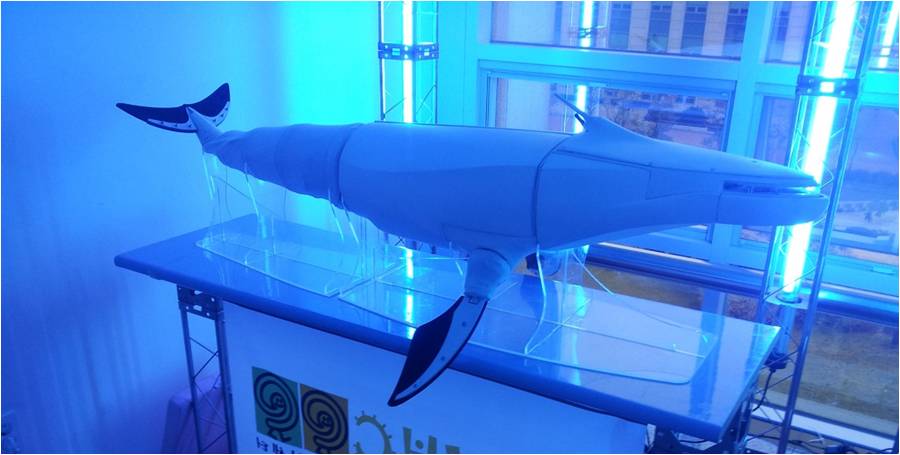
▲ Whale Robot, the SNU Department of Design (Industrial Design) Graduation Project Built by Yu Song-Geun
Contrary to the smooth designing process, the robot faced hardships in meeting the engineering criteria to keep it waterproof, buoyant, and balanced. The “whale” consistently lost its balance and subsided.
Yu states, “I felt the need of some scientific knowledge to back-up my project so I ended up knocking on, to an art student, the unfamiliar doors of engineering. I met up with Professor Rhee Shin Hyung (Department of Naval Architecture and Ocean Engineering) and other College of Engineering professor to receive their advices.”
With the help of the professors, at the end of 2012, Yu succeeded in building a floating robot that can also open its mouth. However, the robot born limitations like being able to only take in small amounts of debris, inefficiency of repeatedly opening and closing its mouth, etc.
Finally, Yu entered the Engineering graduate school in 2014 to create an even upgraded ocean cleanup robot.
At graduate school, he was inspired by water vortex that sucks up its surrounding and thought that this could by the key to resolution. Thus, he has launched his new project to create a fixed marine cleanup robot.
Yu explains, “A vortex forms when the turbine spins the wings in water. This vortex sucks in the water and debris in its vicinity and the internal storage web filters the debris.”
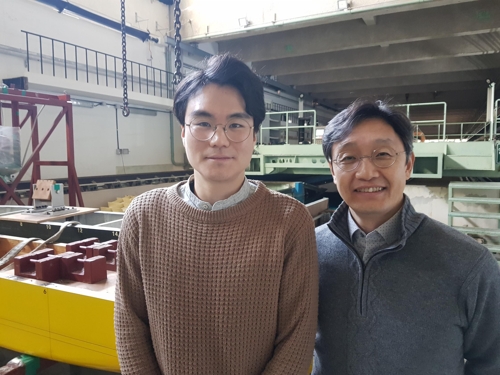
▲ Professor Rhee Shin Hyung (Right) and Department of Mechanical Engineering Graduate Student Yu Song-Geun (Left)
This technology is credited with national patent in 2015 and has furthermore received patent in US in 2017. Patent application preceded the actual completion of the technology in December 2017 for real-life application, because the application itself only requires design and concept.
Yu states, “Mobile robots, or drones, are also on their way. By applying the vortex technology to drones, cleanup machine that move around on seas and ponds to suck in debris can be created.”