- About
- Academics
-
Undergraduate Programs
- Civil and Environmental Engineering
- Architecture and Architectural Engineering
- Mechanical Engineering
- Industrial Engineering
- Energy Resources Engineering
- Nuclear Engineering
- Materials Science and Engineering
- Electrical and Computer Engineering
- Naval Architecture and Ocean Engineering
- Computer Science and Engineering
- Aerospace Engineering
- Chemical and Biological Engineering
-
Graduate Programs
- Civil and Environmental Engineering
- Architecture and Architectural Engineering
- Mechanical Engineering
- Industrial Engineering
- Energy Systems Engineering
- Materials Science and Engineering
- Electrical and Computer Engineering
- Naval Architecture and Ocean Engineering
- Computer Science and Engineering
- Chemical and Biological Engineering
- Aerospace Engineering
- Interdisciplinary Program in Technology, Management, Economics and Policy
- Interdisciplinary Program in Urban Design
- Interdisciplinary Program in Bioengineering
- Interdisciplinary Program in Artificial Intelligence
- Interdisciplinary Program in Intelligent Space and Aerospace Systems
- Chemical Convergence for Energy and Environment Major
- Multiscale Mechanics Design Major
- Hybrid Materials Major
- Double Major Program
- Open Programs
-
Undergraduate Programs
- Research
- Campus Life
- Communication
- Prospective Students
- International Office
SNU Professor Kim Ho-Young’s Research Team Reveals the Principles Behind Liquid Absorption and Expansion
-
Uploaded by
관리자
-
Upload Date
2018.05.10
-
Views
940
SNU Professor Kim Ho-Young’s Research Team Reveals the Principles Behind Liquid Absorption and Expansion
- Featured on the Prestigious Scientific Journal “Science Advances”
- Selected as This Week’s Research Highlight of “Nature Communications”

▲ SNU Department of Mechanical and Aerospace Engineering Professor Kim Ho-Young
- Selected as This Week’s Research Highlight of “Nature Communications”
▲ SNU Department of Mechanical and Aerospace Engineering Professor Kim Ho-Young
Korean researchers reveal the principles behind how dry materials like sponges and breads swell while absorbing water.
SNU College of Engineering (Dean Cha Kook-Heon) announces on 2nd that the research team led by Professor Kim Ho-Young of the Department of Mechanical and Aerospace Engineering has uncovered the concept of liquid absorption and expansion.
Kim’s team is the first in the world to scan the pores of a saturated sponge with electron microscope. The scan demonstrates that the pores are riddled with small holes that coalesce with other holes in vicinity. It is this phenomenon that influences the overall flow of water.
Based on the scans, the research team mathematically simulates the process of swelling due to liquid absorption. When water rises up high in the sponge, swelling due to absorption slows as gravity counteracts to allow little portion of holes to be soaked. Hence the team derives a formula that correlates velocity of internal liquid and degree of expansion with the physical properties of that liquid and material.
This research is sponsored by Samsung Research Funding and Incubation Center for Future Technology and the National Research Foundation of Korea (NRF). Its findings have been published online on the March 31st issue of the prestigious “Science Advances” and have also been nominated as this week’s Research Highlight of the “Nature Communications.”
Professor Kim states, “Materials that change their shape or move with ambient moist or water appeal to researchers studying the area of soft robots that take energy from their surrounding rather than electricity. These materials will also come handy in the recently-popular molecular gastronomy.”
Meanwhile, sponge is a material made from cellulose, which is extracted from plants. It is the typical absorption-expansion substance that is widely used in various industrial fields and everyday life. Rice, wheat, bread, and contact lens also share similar properties with sponge.
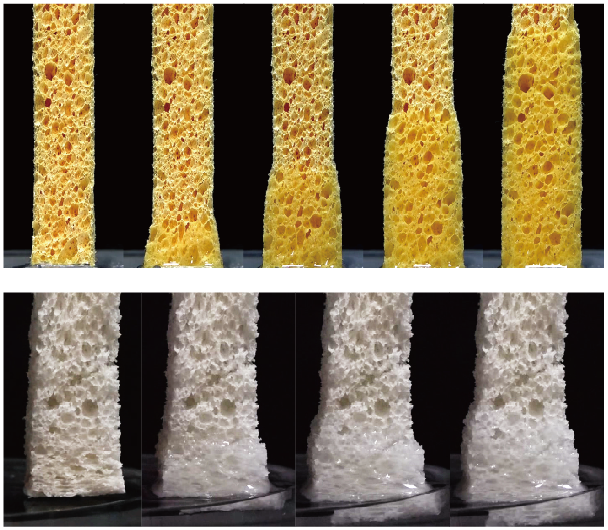
▲ Absorption-Expansion Process of Cellulose Sponge (Top), Absorption-Expansion Process of Bread (Bottom)
-
PrevSNU College of Engineering Opens “Water and Sanitation Appropriate Technology Center” in Vietnam