- About
- Academics
-
Undergraduate Programs
- Civil and Environmental Engineering
- Architecture and Architectural Engineering
- Mechanical Engineering
- Industrial Engineering
- Energy Resources Engineering
- Nuclear Engineering
- Materials Science and Engineering
- Electrical and Computer Engineering
- Naval Architecture and Ocean Engineering
- Computer Science and Engineering
- Aerospace Engineering
- Chemical and Biological Engineering
-
Graduate Programs
- Civil and Environmental Engineering
- Architecture and Architectural Engineering
- Mechanical Engineering
- Industrial Engineering
- Energy Systems Engineering
- Materials Science and Engineering
- Electrical and Computer Engineering
- Naval Architecture and Ocean Engineering
- Computer Science and Engineering
- Chemical and Biological Engineering
- Aerospace Engineering
- Interdisciplinary Program in Technology, Management, Economics and Policy
- Interdisciplinary Program in Urban Design
- Interdisciplinary Program in Bioengineering
- Interdisciplinary Program in Artificial Intelligence
- Interdisciplinary Program in Intelligent Space and Aerospace Systems
- Chemical Convergence for Energy and Environment Major
- Multiscale Mechanics Design Major
- Hybrid Materials Major
- Double Major Program
- Open Programs
-
Undergraduate Programs
- Research
- Campus Life
- Communication
- Prospective Students
- International Office
Flexible organic electronics mimic biological mechanosensory nerves
-
Uploaded by
관리자
-
Upload Date
2018.06.01
-
Views
870
Flexible organic electronics mimic
biological mechanosensory nerves
- Artificial nerves can be used for neurorobotics and neuroprosthetics.
- Seoul National University and Stanford University
Researchers at Seoul National University and Stanford University developed artificial mechanosensory nerves using flexible organic devices to emulate biological sensory afferent nerves. They used the artificial mechanosensory nerves to control a disabled insect leg and distinguish braille characters.
Compared to conventional digital computers, biological nervous system is powerful for real-world problems, such as visual image processing, voice recognition, tactile sensing, and movement control. This inspired scientists and engineers to work on neuromorphic computing, bioinspired sensors, robot control, and prosthetics. The previous approaches involved implementations at the software level on conventional digital computers and circuit designs using classical silicon devices which have shown critical issues related to power consumption, cost, and multifunction.
The work, reported June 1 in Science, describes artificial mechanosensory nerves based on flexible organic devices to emulate biological mechanosensory nerves. “The recently found mechanisms of information processing in biological mechanosensory nerves were adopted in our artificial system,” said Zhenan Bao at Stanford University.
The artificial mechanosensory nerves are composed of three essential components: mechanoreceptors (resistive pressure sensors), neurons (organic ring oscillators), and synapses (organic electrochemical transistors). The pressure information from artificial mechanoreceptors can be converted to action potentials through artificial neurons. Multiple action potentials can be integrated into an artificial synapse to actuate biological muscles and recognize braille characters.
Devices that mimic the signal processing and functionality of biological systems can simplify the design of bioinspired system or reduce power consumption. The researchers said organic devices are advantageous because their functional properties can be tuned, they can be printed on a large area at a low cost, and they are flexible like soft biological systems.
Wentao Xu, a researcher at Seoul National University, and Yeongin Kim and Alex Chortos, graduate students at Stanford University, used their artificial mechanosensory nerves to detect large-scale textures and object movements and distinguish braille characters. They also connected the artificial mechanosensory nerves to motor nerves in a detached insect leg and control muscles.
Professor Tae-Woo Lee, a Professor at Seoul National University said, “Our artificial mechanosensory nerves can be used for bioinspired robots and prosthetics compatible with and comfortable for humans.” Lee said, “The development of human-like robots and prosthetics that help people with neurological disabilities can benefit from our work.”
This work was funded by the Ministry of Science and ICT, South Korea; by Seoul National University (SNU); by Samsung Electronics; by the National Science Foundation(NSF).
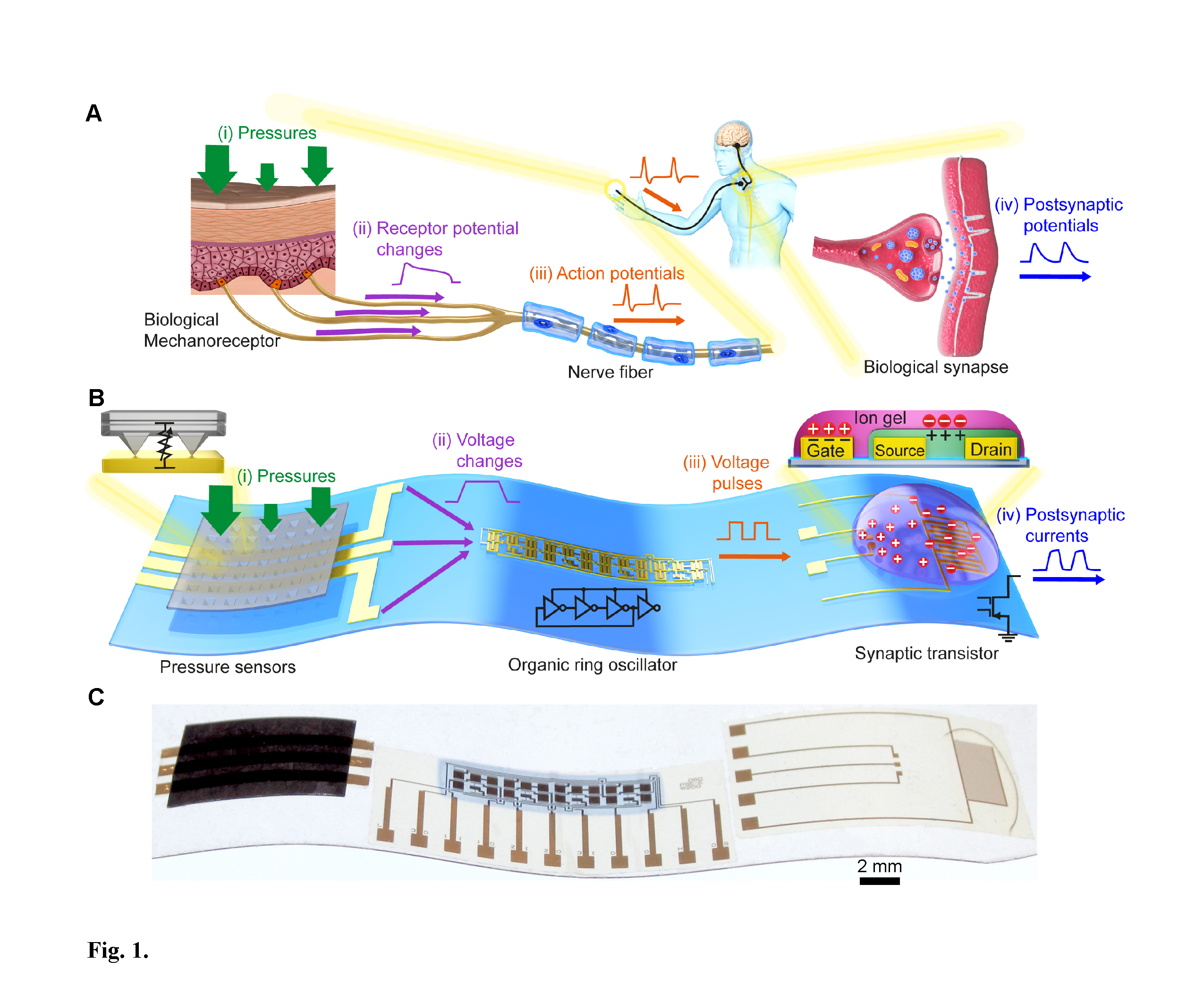
▲ Figure1. Comparison between a biological mechanosensory nerve and an artificial mechanosensory nerve
(A) A biological mechanosensory nerve. Mechanoreceptors receive pressures and change receptor potentials. The nerve fiber of a sensory neuron generates action potentials depending on the receptor potential changes. The action potentials are delivered through biological synapses to next neurons at a spinal cord.
(B) An artificial mechanosensory nerve. Pressure sensors, organic ring oscillators, and synaptic transistors mimic biological mechanoreceptors, biological neurons, and biological synapses, respectively. The same colors represent corresponding parts.
(C) A photograph of an artificial mechanosensory nerve.
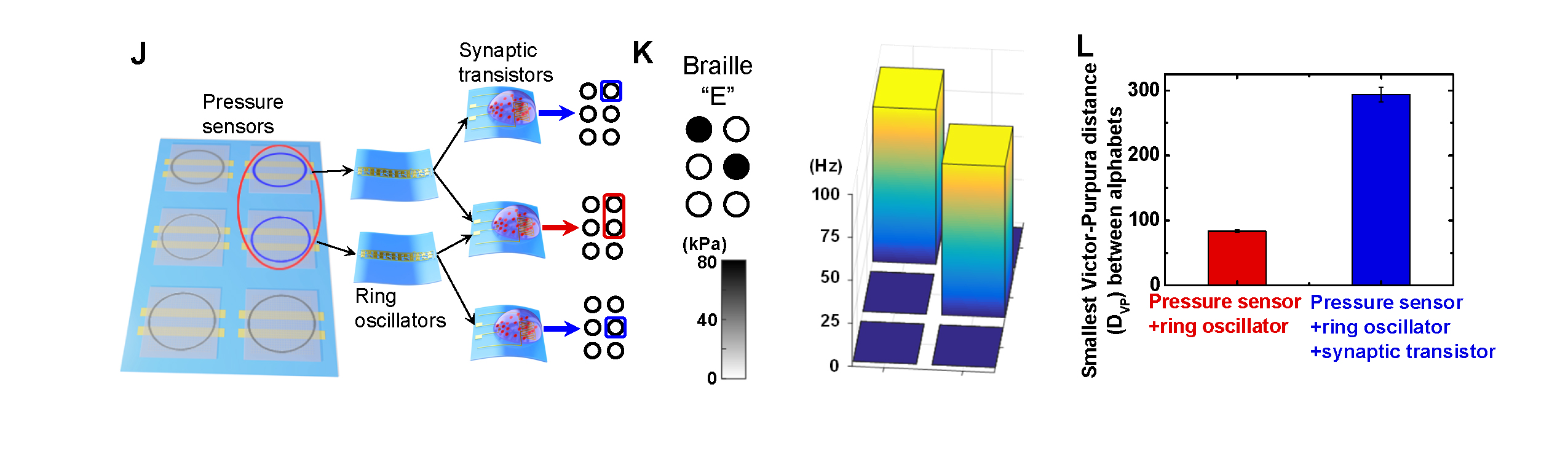
▲ Figure2. Braille reading using an artificial mechanosensory nerve
(J) An artificial mechanosensory nerve with a pressure sensor array of 2 × 3 pixels. Ring oscillators and synaptic transistors were connected to the pressure sensors and process the pressure information.
(K) The outputs of the artificial mechanosensory nerve in (J) when a braille character “E” was pressed.
(L) The performance of artificial mechanosensory nerves with and without synaptic transistors. The synaptic transistors help our system to distinguish braille characters clearly.
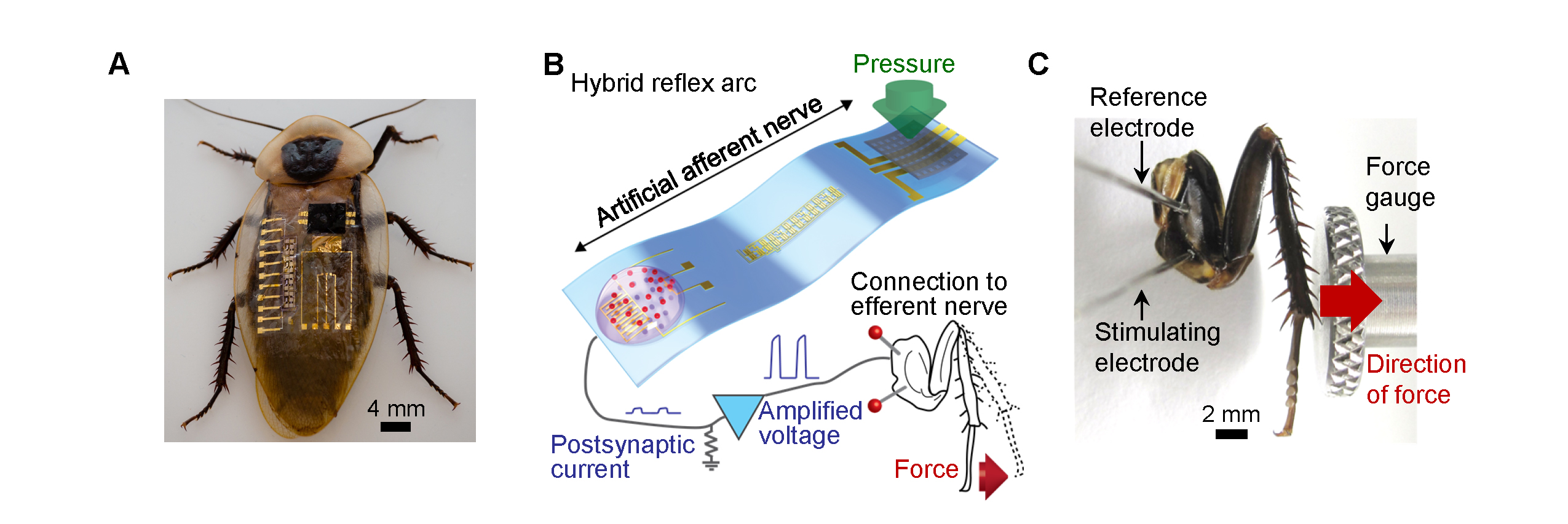
▲ Figure3. Movement controls using the connection between an artificial sensory (afferent) nerve and biological motor (efferent) nerves
(A) An insect and an artificial mechanosensory nerve used in this experiment.
(B) An artificial mechanosensory nerve was connected to biological motor nerves to make a hybrid reflex arc and control the movements of a detached insect leg.
(C) The experiment set-up used to measure the force of the movements of the disabled insect leg.
-
PrevSNU Researchers developed electronic skins that wirelessly activate fully soft robots
-
NextSNU Wins a Medal at the International Collegiate Programming Contest for Two Consecutive Years