- About
- Academics
-
Undergraduate Programs
- Civil and Environmental Engineering
- Architecture and Architectural Engineering
- Mechanical Engineering
- Industrial Engineering
- Energy Resources Engineering
- Nuclear Engineering
- Materials Science and Engineering
- Electrical and Computer Engineering
- Naval Architecture and Ocean Engineering
- Computer Science and Engineering
- Aerospace Engineering
- Chemical and Biological Engineering
-
Graduate Programs
- Civil and Environmental Engineering
- Architecture and Architectural Engineering
- Mechanical Engineering
- Industrial Engineering
- Energy Systems Engineering
- Materials Science and Engineering
- Electrical and Computer Engineering
- Naval Architecture and Ocean Engineering
- Computer Science and Engineering
- Chemical and Biological Engineering
- Aerospace Engineering
- Interdisciplinary Program in Technology, Management, Economics and Policy
- Interdisciplinary Program in Urban Design
- Interdisciplinary Program in Bioengineering
- Interdisciplinary Program in Artificial Intelligence
- Interdisciplinary Program in Intelligent Space and Aerospace Systems
- Chemical Convergence for Energy and Environment Major
- Multiscale Mechanics Design Major
- Hybrid Materials Major
- Double Major Program
- Open Programs
-
Undergraduate Programs
- Research
- Campus Life
- Communication
- Prospective Students
- International Office
News
SNU Researchers Revive Hard-to-Synthesize Materials Using AI, Developing an LLM-Based Materials Redesign Technology
-
Uploaded by
대외협력실
-
Upload Date
2025.12.17
-
Views
758
SNU Researchers Revive Hard-to-Synthesize Materials Using AI, Developing an LLM-Based Materials Redesign Technology
- New Method Transforms Hard-to-Synthesize Materials into Synthetically Feasible Forms
- SynCry Model Successfully Redesigned 3,395 Structures, Accelerating Development of Advanced Materials for Semiconductors and Batteries
- Findings Published in Prestigious Chemistry Journal Journal of the American Chemical Society (JACS)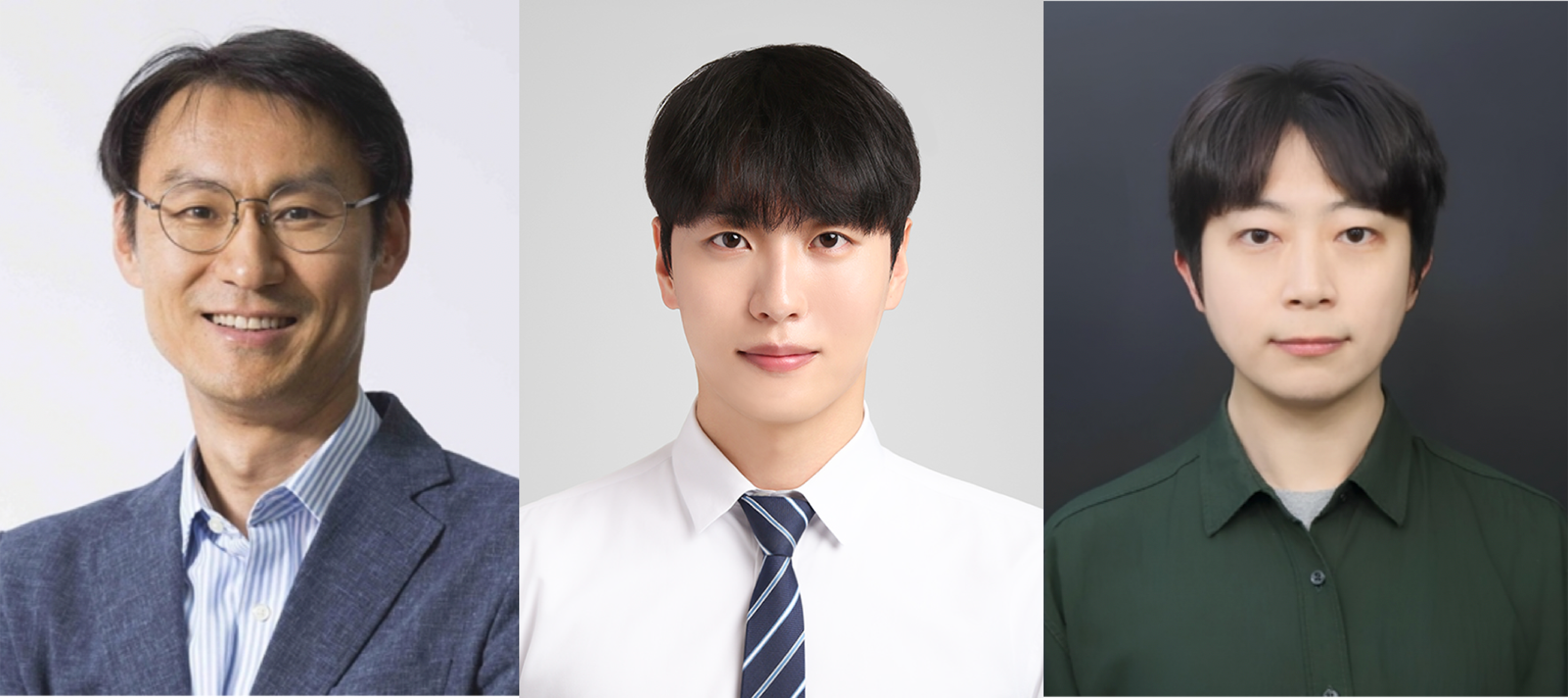
▲ (From left) Prof. Yousung Jung, Department of Chemical and Biological Engineering, Seoul National University (corresponding author); Jaehwan Choi, Integrated MS–PhD Program, Department of Chemical and Biological Engineering, Seoul National University (co–first author); and Dr. Seongmin Kim, Postdoctoral Researcher, SNU Institute of Advanced Chemical Engineering (co–first author)
A research team led by Prof. Yousung Jung of the Department of Chemical and Biological Engineering at Seoul National University (SNU) has developed an innovative AI-based technology that uses large language models (LLMs) to redesign new materials that were previously difficult to synthesize into forms that are experimentally feasible.
Rather than stopping at the conventional task of predicting a material’s synthesizability*, the study goes a step further by presenting a practical solution for redesigning materials deemed difficult to synthesize. The technology is expected to significantly accelerate the development of novel advanced materials, including next-generation semiconductor materials and high-efficiency battery materials.
* Synthesizability: A concept used to evaluate whether a new material can be synthesized experimentally. Traditionally, this has been assessed primarily based on thermodynamic stability, but this study demonstrates that LLMs enable far more refined predictions.
The research was conducted with Jaehwan Choi, an integrated MS–PhD student at SNU, and Dr. Seongmin Kim, a postdoctoral researcher, serving as co–first authors. The results were published on October 6, 2025, in the internationally renowned chemistry journal Journal of the American Chemical Society (JACS).
Advances in computational chemistry and artificial intelligence have enabled researchers to identify large numbers of theoretically promising material candidates. However, the challenge of actually synthesizing these materials in the laboratory has remained a major bottleneck. While previous research has focused on predicting synthesizability, it has not addressed how to transform materials deemed difficult to synthesize into synthetically feasible structures.
To address this limitation, the research team developed a new LLM-based framework called “SynCry.” This model represents the crystal structures of new materials as invertible textual descriptions and learns, through iterative fine-tuning*, how to transform structures predicted to be difficult to synthesize into ones that are experimentally feasible.
* Iterative fine-tuning: A method in which pairs of successfully redesigned structures are repeatedly incorporated into training, progressively improving the model’s redesign performance.
The results showed that SynCry began with 514 successful structure transformations and, through iterative fine-tuning, ultimately succeeded in redesigning 3,395 structures into synthesizable forms. Particularly noteworthy is that 34 of the top 100 redesigned structures, despite not being present in the training dataset, matched materials that have been experimentally synthesized and reported in the scientific literature. This demonstrates that SynCry goes beyond mimicking training data and is capable of generating genuinely new, synthesizable material structures.
This redesign capability demonstrates that LLMs can move beyond simple prediction to become practical tools for materials design through a “learn-and-regenerate” strategy. The approach has the potential to dramatically shorten the development timeline for advanced materials and to recover numerous candidate materials that were previously discarded due to synthesis difficulties.
Prof. Yousung Jung stated, “This study is the first to demonstrate that AI can directly redesign new materials starting from structures that are difficult to synthesize. We plan to expand this work to a wider range of material systems and larger datasets, ultimately developing a practical tool for discovering new materials.”
Jaehwan Choi, an integrated MS–PhD student, commented, “This research began with a simple question: could we bring back virtual materials that had been discarded because they were considered too difficult to synthesize? Moving forward, I aim to develop general-purpose AI agents, including language models, to further accelerate materials discovery.” Dr. Seongmin Kim, who has long conducted research on LLM-based synthesizability prediction, added, “This achievement is an important example showing that AI can play a creative design role in materials science.”
Jaehwan Choi plans to pursue research on developing general-purpose AI agents, including large language models, to automate the identification of synthesis mechanisms and optimal synthesis pathways for inorganic materials. Dr. Seongmin Kim, currently working at the SNU Institute of Advanced Chemical Engineering, plans to continue follow-up research that integrates machine learning and materials science to explore paradigm shifts in new materials development.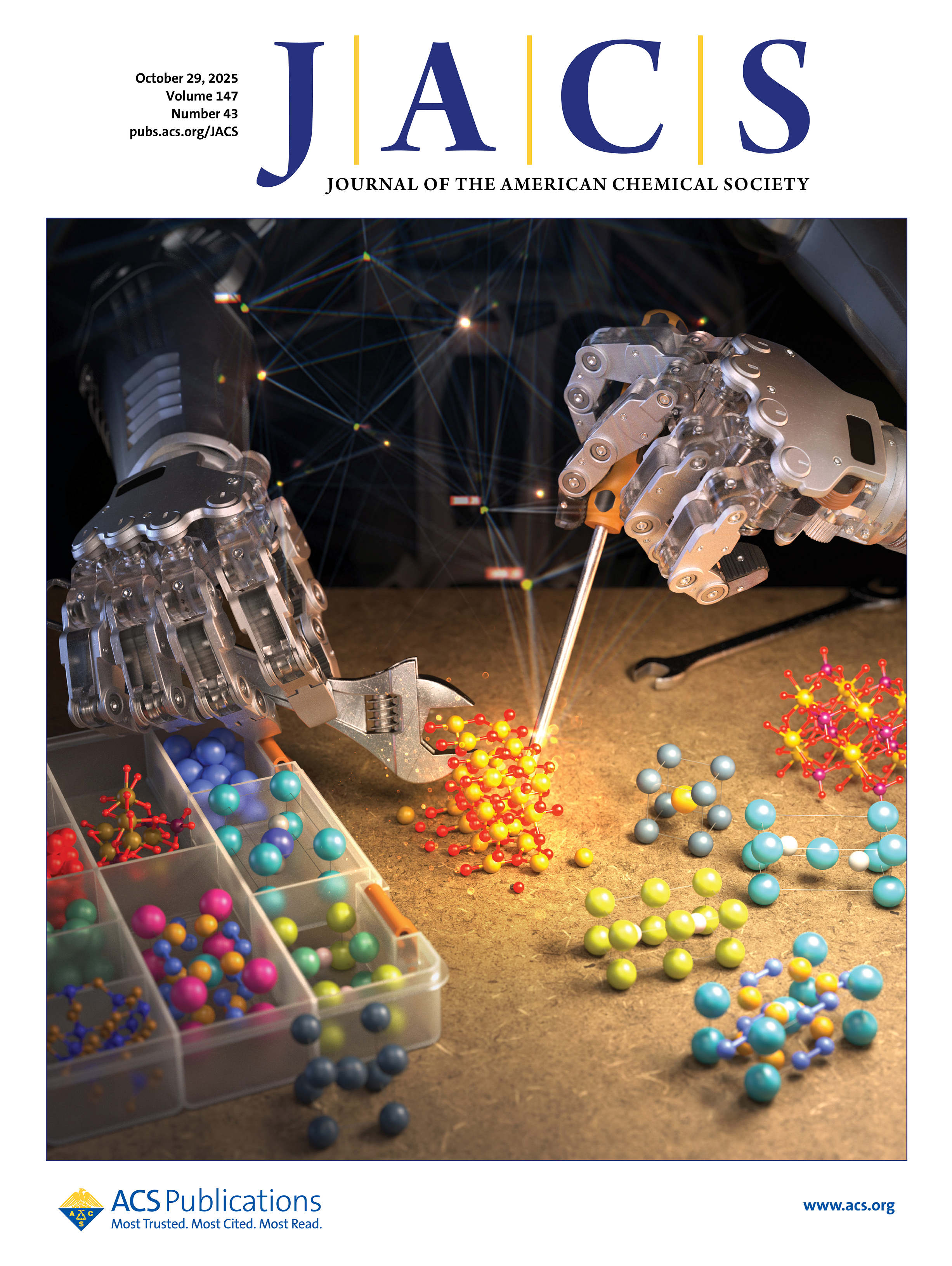
▲ Figure 1. Cover image of the Journal of the American Chemical Society publication.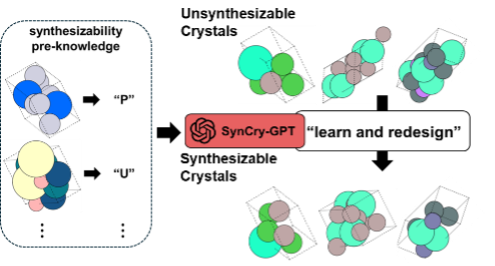
▲ Figure 2. Schematic illustration of the materials redesign process: After pretraining a large language model on synthesizability information for inorganic materials, materials predicted to be difficult to synthesize are redesigned into synthesizable forms. This process implements a human-like “learn and redesign” strategy in which knowledge is acquired and then applied.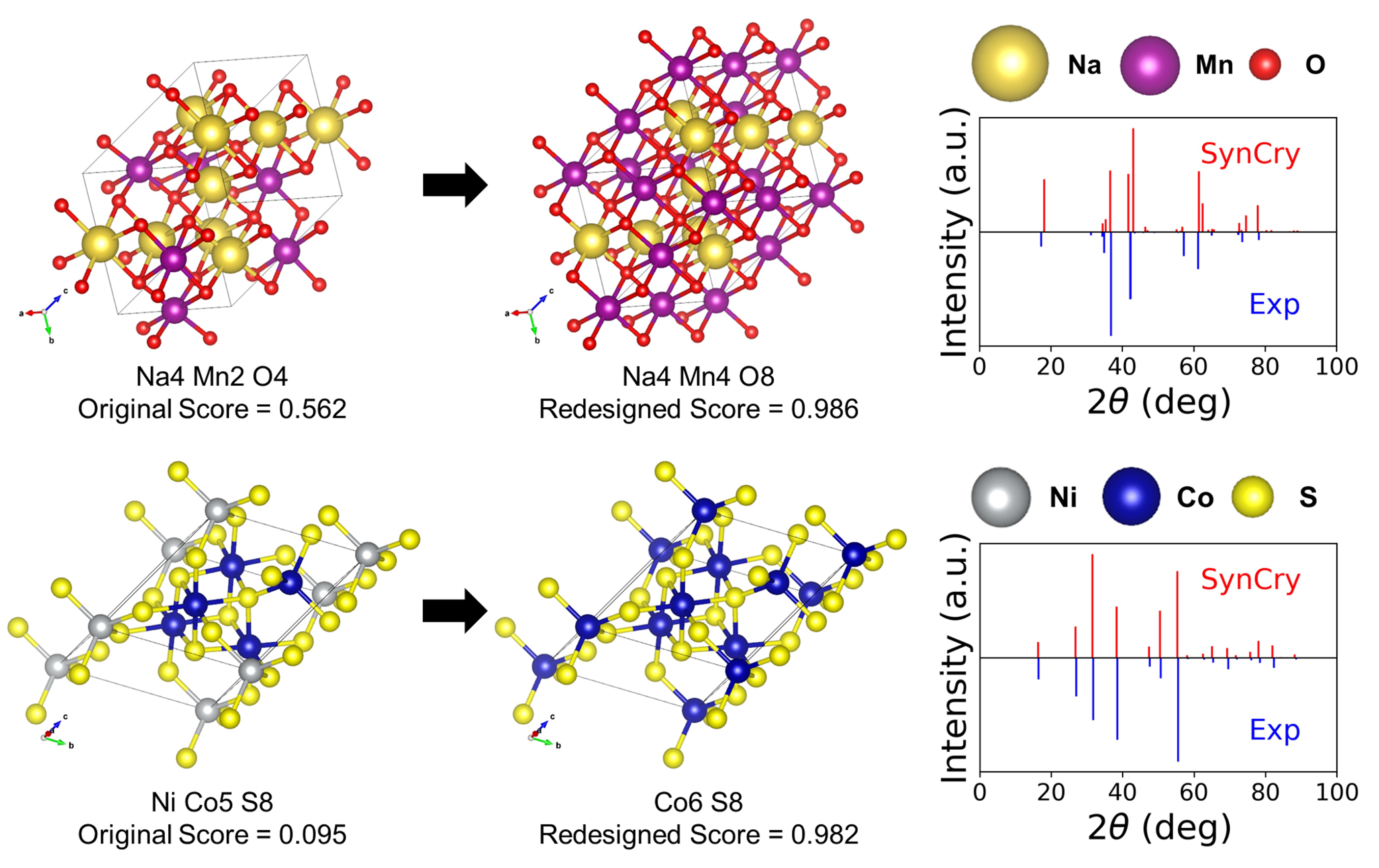
▲ Figure 3. Examples of redesigned materials: X-ray diffraction (XRD) comparisons confirmed that the redesigned structures correspond to experimentally validated materials. These materials—such as sodium manganese oxides and nickel–cobalt sulfides—are actively studied in the battery and electrocatalysis fields.
[Reference Materials]
- Paper title/Journal: “Synthesis-Aware Materials Redesign via Large Language Models”, Journal of American Chemical Society
- DOI: https://pubs.acs.org/doi/10.1021/jacs.5c07743
[Contact Information]
Jaehwan Choi, Integrated MS–PhD student, Department of Chemical and Biological Engineering, Seoul National University / jaehwanchoi@snu.ac.kr