- About
- Academics
-
Undergraduate Programs
- Civil and Environmental Engineering
- Architecture and Architectural Engineering
- Mechanical Engineering
- Industrial Engineering
- Energy Resources Engineering
- Nuclear Engineering
- Materials Science and Engineering
- Electrical and Computer Engineering
- Naval Architecture and Ocean Engineering
- Computer Science and Engineering
- Aerospace Engineering
- Chemical and Biological Engineering
-
Graduate Programs
- Civil and Environmental Engineering
- Architecture and Architectural Engineering
- Mechanical Engineering
- Industrial Engineering
- Energy Systems Engineering
- Materials Science and Engineering
- Electrical and Computer Engineering
- Naval Architecture and Ocean Engineering
- Computer Science and Engineering
- Chemical and Biological Engineering
- Aerospace Engineering
- Interdisciplinary Program in Technology, Management, Economics and Policy
- Interdisciplinary Program in Urban Design
- Interdisciplinary Program in Bioengineering
- Interdisciplinary Program in Artificial Intelligence
- Interdisciplinary Program in Intelligent Space and Aerospace Systems
- Chemical Convergence for Energy and Environment Major
- Multiscale Mechanics Design Major
- Hybrid Materials Major
- Double Major Program
- Open Programs
-
Undergraduate Programs
- Research
- Campus Life
- Communication
- Prospective Students
- International Office
News
SNU Mechanical Engineering Graduate Student Chanyoung Oh Wins Best Poster Award at MRS 2025
-
Uploaded by
대외협력실
-
Upload Date
2025.12.26
-
Views
572
SNU Mechanical Engineering Graduate Student Chanyoung Oh Wins Best Poster Award at MRS 2025
- Research Excellence Recognized at the World’s Leading Conference in Materials Science and Engineering
- Ion-Beam-Based Metal Surface Nanopatterning Offers a New Route to Advanced Lithium-Ion Battery Electrodes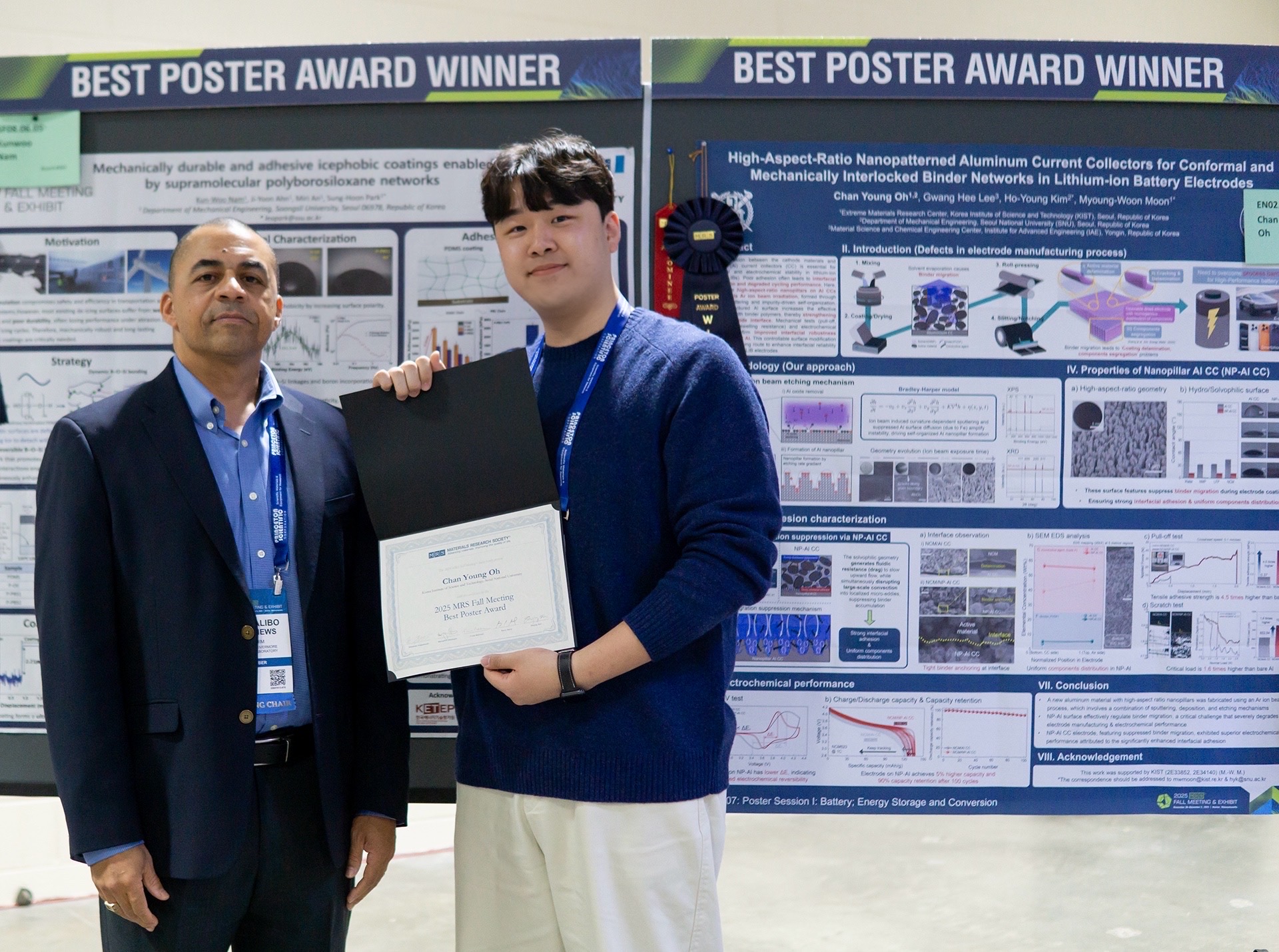
▲ (From left) Manyalibo Matthews, Chair of the MRS Poster Awards Committee, and Chanyoung Oh, integrated MS–PhD student in the Department of Mechanical Engineering at Seoul National University
Seoul National University College of Engineering announced that Chanyoung Oh, an integrated master’s–doctoral student in Prof. Ho-Young Kim’s laboratory in the Department of Mechanical Engineering, received the Best Poster Award at the 2025 Materials Research Society (MRS) Fall Meeting, held in Boston, USA, from November 30 to December 5.
The Materials Research Society (MRS) is the world’s largest and most prestigious academic society in the field of materials science and engineering, attracting tens of thousands of researchers each year and hosting more than 50 symposia annually. During the concurrent poster sessions, over 1,000 research presentations from around the world were evaluated. Through a comprehensive assessment of scientific quality, originality, and presentation, Mr. Oh was selected as one of only six final awardees, corresponding to an acceptance rate of approximately 0.6 percent, demonstrating that the originality and excellence of his research have been internationally recognized.
At the poster session, Mr. Oh presented his research titled “High-Aspect-Ratio Nanopatterned Aluminum Current Collectors for Conformal and Mechanically Interlocked Binder Networks in Lithium-ion Battery Electrodes.”
In lithium-ion battery manufacturing, the phenomenon known as binder migration, in which binders concentrate near the evaporation surface during slurry drying due to solvent evaporation, has long been recognized as a critical issue. This phenomenon leads to inhomogeneous material distribution and reduced interfacial adhesion within electrodes, ultimately shortening battery lifespan.
To address this challenge, the research team developed a technique that uses an argon (Ar) ion-beam process to form micro- to nanoscale surface patterns, ranging from several hundred nanometers to several micrometers, on metal current collectors such as aluminum and copper. These nanopatterns, characterized by high aspect ratios and enhanced wettability, act as physical “anchors” that suppress binder migration toward the evaporation surface during drying.
As a result, the uniformity of binder distribution was significantly improved compared to conventional electrodes, and the adhesion strength at the electrode–current collector interface was markedly enhanced. These structural improvements led to greater mechanical stability of the electrodes and a substantial increase in charge–discharge cycle life. The research team presented detailed mechanisms and quantitative experimental results, which received high praise from the award committee.
Beyond simple metal surface processing, this study is also notable for proposing a new strategy for metal surface modification. In the early stages of the research, high-aspect-ratio nanostructures were prone to collapse during repeated experiments and suffered from limited reproducibility. In resolving these challenges, the team discovered that the ion-beam process responds sensitively to the crystallographic orientation of aluminum, a finding that became a key scientific outcome of the study.
Prof. Ho-Young Kim of Seoul National University commented, “It is important to recognize that improvements in battery performance can originate not only from electrode materials themselves, but also from interfaces that are not directly visible,” adding, “This study is significant in that it experimentally demonstrates how precise microstructural control can directly translate into enhanced battery performance and stability, with both academic and industrial implications.”
Mr. Oh, who is jointly supervised by Prof. Ho-Young Kim of SNU and Dr. Myung-Woon Moon of the Korea Institute of Science and Technology (KIST), said, “It is a great honor to have my research recognized at such a prestigious international conference,” and added, “I am deeply grateful to my advisors for their generous guidance and to my laboratory colleagues who worked tirelessly alongside me.”
The research is expected to make a substantial contribution to improving the efficiency and reliability of manufacturing processes for high-performance secondary batteries, which are a core technology for next-generation energy storage systems.
[Reference Materials]
- Official announcement of awardees for the 2025 MRS Fall Meeting poster sessions: https://www.mrs.org/meetings-events/annual-meetings/2025-mrs-fall-meeting/meeting-events/posters/poster-sessions
[Contact Information]
Prof. Ho-Young Kim, Department of Mechanical Engineering, Seoul National University / +82-2-880-9286 / hyk@snu.ac.kr