- About
- Academics
-
Undergraduate Programs
- Civil and Environmental Engineering
- Architecture and Architectural Engineering
- Mechanical Engineering
- Industrial Engineering
- Energy Resources Engineering
- Nuclear Engineering
- Materials Science and Engineering
- Electrical and Computer Engineering
- Naval Architecture and Ocean Engineering
- Computer Science and Engineering
- Aerospace Engineering
- Chemical and Biological Engineering
-
Graduate Programs
- Civil and Environmental Engineering
- Architecture and Architectural Engineering
- Mechanical Engineering
- Industrial Engineering
- Energy Systems Engineering
- Materials Science and Engineering
- Electrical and Computer Engineering
- Naval Architecture and Ocean Engineering
- Computer Science and Engineering
- Chemical and Biological Engineering
- Aerospace Engineering
- Interdisciplinary Program in Technology, Management, Economics and Policy
- Interdisciplinary Program in Urban Design
- Interdisciplinary Program in Bioengineering
- Interdisciplinary Program in Artificial Intelligence
- Interdisciplinary Program in Intelligent Space and Aerospace Systems
- Chemical Convergence for Energy and Environment Major
- Multiscale Mechanics Design Major
- Hybrid Materials Major
- Double Major Program
- Open Programs
-
Undergraduate Programs
- Research
- Campus Life
- Communication
- Prospective Students
- International Office
News
SNU Researchers Successfully Implement Topological Non-Abelian Photonic Computing Platforms Using Photonic Integrated Circuits
-
Uploaded by
대외협력실
-
Upload Date
2026.02.02
-
Views
378
SNU Researchers Successfully Implement Topological Non-Abelian Photonic Computing Platforms Using Photonic Integrated Circuits
- First Demonstration of Programmable Matrix-valued Coupling Between Optical Elements on a Photonic Integrated Circuit
- Findings Published in the International Physics Journal Physical Review Letters
▲ (From left) Prof. Sunkyu Yu (co-corresponding author), Prof. Namkyoo Park (co-corresponding author), Prof. Xianji Piao of the University of Seoul (co-corresponding author), and Gyunghun Kim, researcher at SNU and first author
Seoul National University College of Engineering announced that a research team led by Prof. Sunkyu Yu and Prof. Namkyoo Park of the Department of Electrical and Computer Engineering, in collaboration with Prof. Xianji Piao of the School of Electrical and Computer Engineering at the University of Seoul and Prof. Jensen Li of the University of Exeter (UK), has successfully implemented a programmable spinor lattice on a photonic integrated circuit (PIC). This platform enables the realization of non-Abelian physics, in which the outcome of operations depends on their sequence, within an integrated photonic system.
* Non-Abelian: A property whereby the result changes when the sequence of operations is altered (e.g., AB ≠ BA). In topological quantum computing, this property forms the core principle of gate operations.
* Spinor / pseudo-spin modes: A spinor represents a two-dimensional state expressed as a vector. In photonics, different internal degrees of freedom—such as polarization, path, or resonator modes—can be treated as spin-like variables, referred to as pseudo-spins.
Through this achievement, the research team demonstrated that the operating principles of topological qubits can be classically emulated, and further proposed the possibility of realizing novel topological physical phenomena that differ from previously known implementations.
* Qubit: The fundamental unit of quantum computation, analogous to a classical bit. A qubit can exist in superpositions of 0 and 1 and can provide potentially superior computational performance through quantum features, such as superpositions and entanglement.
The results of this study were published on January 30 in Physical Review Letters, one of the world’s most prestigious journals in physics.
Research aimed at achieving low-power, ultrafast computation using photonic integrated circuits has been actively pursued. However, the fragility of light to defects and errors has posed significant challenges to practical implementation. As an alternative, increasing attention has been directed toward exploiting topological properties to realize defect-resilient and stable optical computing.
Non-Abelian physics is characterized by the fundamental dependence of outcomes on the sequence of operations, even when the same unit operations are applied. This principle is also central to topological quantum computing, which is being actively explored by organizations such as Microsoft. In particular, non-Abelian properties offer new design freedom by enabling robust control of light states that are inherently resistant to defects.
However, the realization of large-scale photonic integrated circuits has faced persistent challenges, including (1) error accumulation caused by fabrication variations and (2) degraded reproducibility due to interactions between devices, both of which hinder stable computation. Implementing non-Abelian properties further requires precise control of coupling between multiple internal degrees of freedom of light, expressed as matrices incorporating both amplitude and phase information. Until now, no systematic design methodology capable of supporting such control had been established.
To address these challenges, the research team proposed—for the first time—the concept of the photonic integrated circuit, which enables universal, matrix-valued control of couplings between the physical properties of light, and successfully discovered and realized new non-Abelian dynamics and topological photonic characteristics.
The researchers first introduced a photonic building block capable of matrix-valued-coupling operations by exploiting evanescent couplings between pseudo-spin modes through optical elements. Using this platform, they demonstrated braiding operations, which are a core mechanism of topological quantum computing, by allowing photonic modes to freely intertwine. This showed that non-Abelian quantum phenomena can be emulated by “braiding” light states in a knot-like manner.
* Braiding: An operation in which (non-Abelian) particles are exchanged along intersecting paths, such that the sequence of exchanges itself performs a computation. Even identical exchanges can yield different outcomes depending on their order.
In addition, the researchers observed a unique phenomenon termed a “non-Abelian interface” at the boundary between distinct topological materials. At this interface, topologically protected optical states were found to undergo hybridization, resulting in the reopening of an energy bandgap. This finding reveals a new photonic degree of freedom that enables the simultaneous realization of high error resistance and efficient programmability, both of which are essential for optical computation.
* Topological protection: A property by which physical states remain robust against small structural defects or noise due to their topological nature.
* Hybridization: A phenomenon in which different optical states strongly couple and transform into new combined states at an interface.
* Bandgap: A forbidden frequency (energy) range in which waves (electrons or light) cannot propagate.
This study is significant in that it establishes a direct link between topological physics, non-Abelian dynamics, and reconfigurable photonic integrated circuits. In particular, it offers a means to reduce the repeated fine-tuning and stabilization costs that have been unavoidable in conventional photonic computing systems sensitive to defects. The proposed platform also provides design freedom that simultaneously satisfies robust, error-resistant operation and flexible, user-defined control.
Moreover, by classically emulating non-Abelian phenomena in an optical system, this work is expected to enable future verification of complex topological quantum operations, such as non-Abelian braiding, and to facilitate the realization of high-dimensional information processing and photonic computing based on topological principles.
Co-corresponding authors Prof. Sunkyu Yu and Prof. Namkyoo Park stated, “This study successfully maximized the range of topological degrees of freedom that can be implemented in photonic integrated circuits,” adding, “Our long-term goal is to realize defect-resilient photonic artificial intelligence within silicon photonic integrated circuits.”
Gyunghun Kim, the first author of the paper, commented, “This research allowed us to gain a deeper understanding of non-Abelian phenomena, and we hope that these results will find broad applications across AI and quantum technologies.”
Gyunghun Kim, who led this research as an undergraduate intern in the Department of Electrical and Computer Engineering at SNU, is currently pursuing a PhD at the Massachusetts Institute of Technology (MIT), where he is conducting research on superconducting quantum computers.
This research was supported by the Innovation Research Center (IRC) program of the Ministry of Science and ICT (SNU Hybrid Quantum Computing Center; NextQuantum), the Basic Research Laboratory (BRL) program (Electron–Photon Hybrid Memristive Device Laboratory), the Young Researcher Program, and the SNU Creative-Pioneering Researcher Program.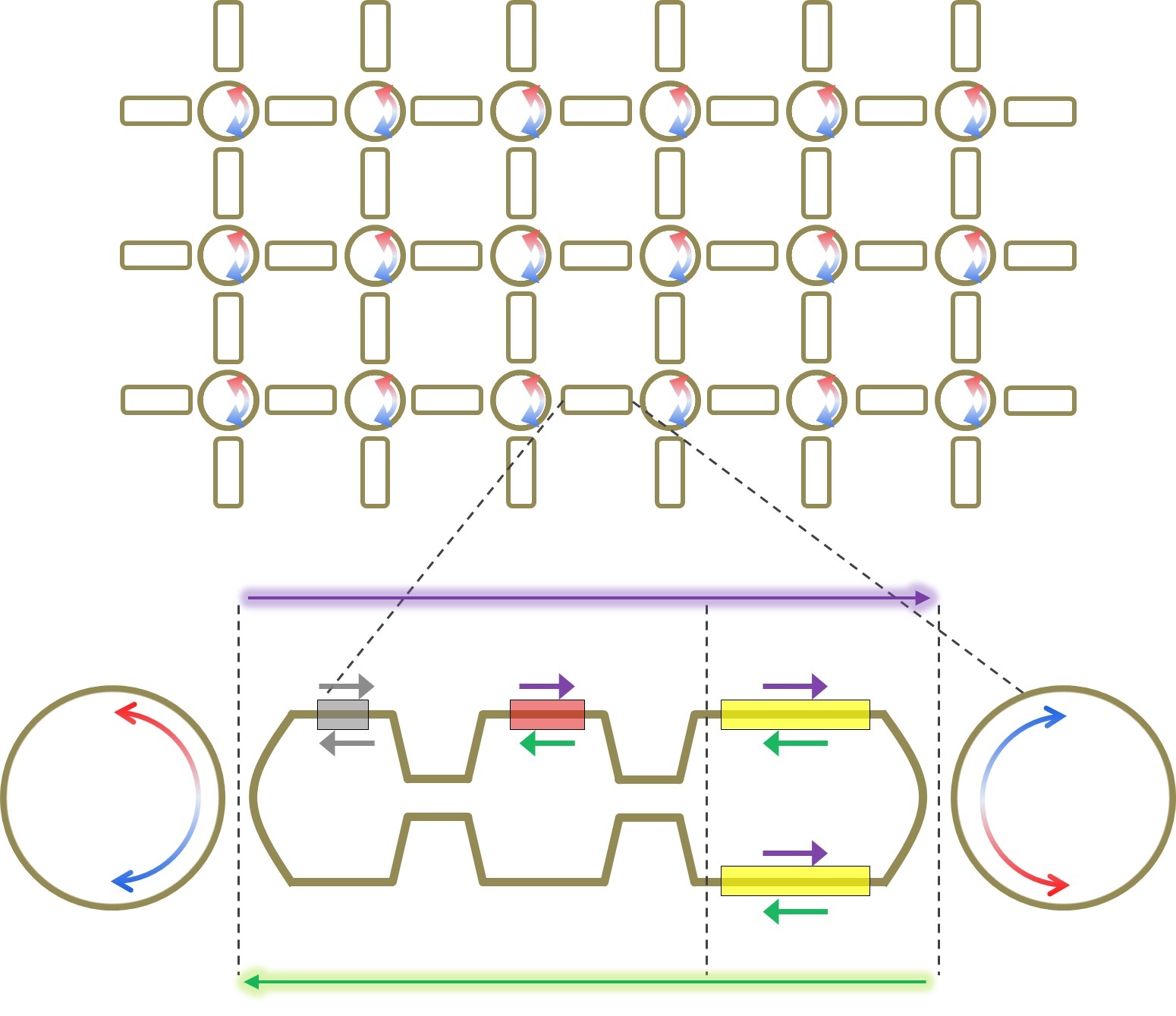
▲ Figure 1. Non-Abelian photonic integrated circuit developed in this study, in which couplings between optical devices are implemented for the first time in the form of fully programmable matrix-valued operations.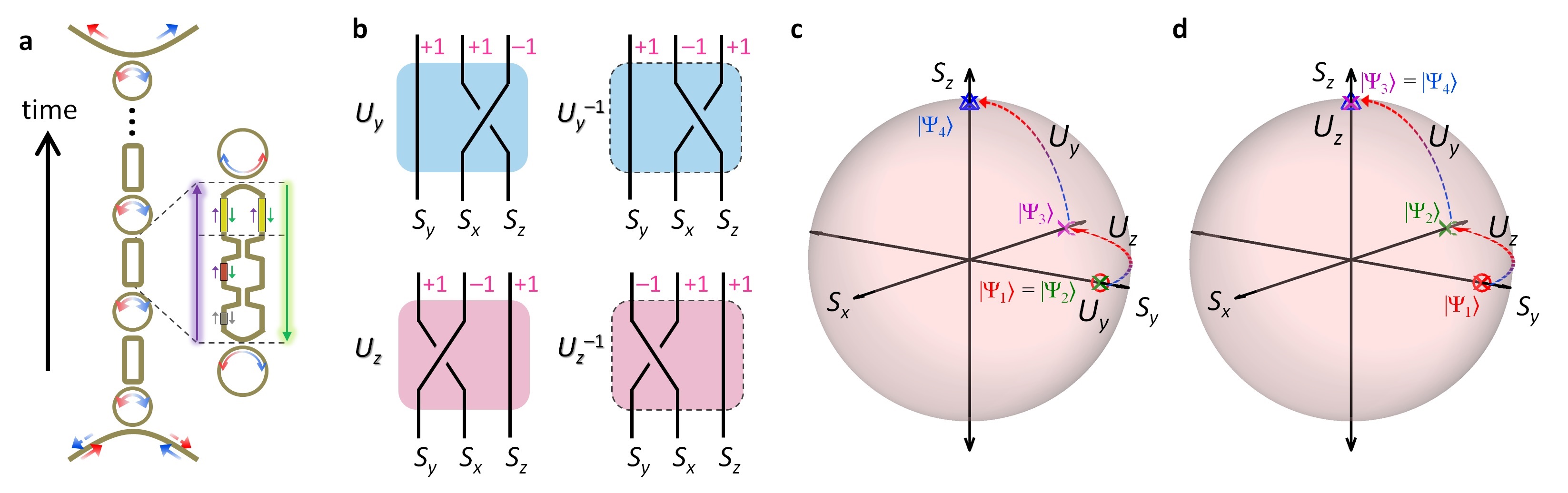
▲ Figure 2. Optical implementation of braiding operations—one of the key computational processes in topological quantum computing—realized classically on a photonic integrated circuit.
[Reference Materials]
- Title / Journal: Programmable lattices for non-Abelian topological photonics and braiding, Physical Review Letters
- DOI: https://doi.org/10.1103/rgfy-n6zd
[Contact Information]
- Prof. Sunkyu Yu, Department of Electrical and Computer Engineering, Seoul National University / +82-2-880-7281 / sunkyu.yu@snu.ac.kr
- Prof. Namkyoo Park, Department of Electrical and Computer Engineering, Seoul National University / +82-2-880-1820 / nkpark@snu.ac.kr