loaction
- About
-
Academics
-
Undergraduate Programs
- Civil, Urban and Environmental Engineering
- Architecture and Architectural Engineering
- Mechanical Engineering
- Industrial Engineering
- Energy Resources Engineering
- Nuclear Engineering
- Materials Science and Engineering
- Electrical and Computer Engineering
- Naval Architecture and Ocean Engineering
- Computer Science and Engineering
- Aerospace Engineering
- Chemical and Biological Engineering
-
Graduate Programs
- Civil, Urban and Environmental Engineering
- Architecture and Architectural Engineering
- Mechanical Engineering
- Industrial Engineering
- Energy Systems Engineering
- Materials Science and Engineering
- Electrical and Computer Engineering
- Naval Architecture and Ocean Engineering
- Computer Science and Engineering
- Aerospace Engineering
- Chemical and Biological Engineering
- Interdisciplinary Program in Technology, Management, Economics and Policy
- Interdisciplinary Program in Urban Design
- Interdisciplinary Program in Bioengineering
- Interdisciplinary Program in Artificial Intelligence
- Interdisciplinary Program in Intelligent Space and Aerospace Systems
- Chemical Convergence for Energy and Environment Major
- Multiscale Mechanics Design Major
- Hybrid Materials Major
- Double Major Program
- Open Programs
-
Undergraduate Programs
- Research
- Prospective Students
- Campus Life
- International Office
- Communication
News
A Robot That Endures Over One Million Uses—Then Becomes Compost to Nourish Plants
-
Uploaded by
대외협력실
-
Upload Date
Mar 18, 2026
-
Views
748
A Robot That Endures Over One Million Uses—Then Becomes Compost to Nourish Plants
▲ (From left) Dr. Kyung-Sub Kim, Postdoctoral Researcher in Environmental Engineering, School of Architecture, Civil and Environmental Engineering (ENAC), EPFL (École Polytechnique Fédérale de Lausanne); Dr. Jun-Seok Shim, Postdoctoral Researcher, Department of Materials Science and Engineering, Seoul National University; Sung-Woo Kim, Integrated MS–PhD Student, Department of Materials Science and Engineering, Seoul National University; and Prof. Seung-Kyun Kang, Department of Materials Science and Engineering, Seoul National University
The rapid proliferation of robots and electronic devices is placing the world under a new and growing environmental burden. According to the United Nations Institute for Training and Research (UNITAR), global electronic waste (e-waste) reached approximately 62 million metric tons in 2022, a significant portion of which was neither properly collected nor recycled but instead landfilled or incinerated. As soft robots are increasingly adopted across diverse sectors—including healthcare, agriculture, and environmental exploration—end-of-life robotic systems are emerging as a new source of next-generation e-waste. In particular, soft robots and their associated electronic systems are typically constructed from multilayer thin-film architectures composed of thermoset polymer elastomers, metal alloys, and extrinsic semiconductors. These heterogeneous material combinations make recycling virtually impossible and prevent natural degradation, leading to growing concerns that such technologies are fundamentally unsustainable.
In response to these challenges, a SNU–Sogang–JKU joint research team led by Professor Seung-Kyun Kang at Seoul National University, Professor Sang-Yup Kim at Sogang University, and Professor Martin Kaltenbrunner at Johannes Kepler University Linz has developed a fully biodegradable and compostable soft robotic electronic system that maintains high performance and durability during operation yet completely returns to nature after use. The team employed a water-free biodegradable elastomer, poly(glycerol sebacate) (PGS), as the structural material for the robotic frame, enabling the realization of soft actuators with low hysteresis and excellent elastic recovery. The PGS-based bending actuator exhibited remarkable durability, maintaining nearly unchanged bending angles and output forces even after one million actuation cycles, and preserving stable performance after long-term storage. In addition, biodegradable inorganic electronic components composed of magnesium (Mg), molybdenum (Mo), and silicon (Si) were integrated to incorporate curvature, strain, tactile, temperature, humidity, and pH sensors, along with heaters, electrical stimulators, and drug-delivery modules, into a single soft robotic finger—demonstrating a highly integrated, multifunctional biodegradable electronic platform. When the entire robotic system was subjected to industrial composting conditions, both the structural framework and electronic components decomposed within a few months. Plant growth tests conducted using the resulting compost confirmed the absence of environmental toxicity.
Professor Kang stated, “This research overcomes the limitations traditionally associated with biodegradable materials and demonstrates soft robotic and electronic systems with practical levels of durability and performance, setting a new benchmark for sustainable robotics.” Dr. Kyung-Sub Kim added, “By simultaneously achieving high performance, complete biodegradability, and ecological safety, this platform is expected to serve as a foundational technology for the transition toward environmentally responsible robotics and electronics.” The study presents a fundamental solution to the growing waste problem associated with robotics and electronic devices and introduces a new paradigm in which intelligent machines complete their missions and return to the soil—not as waste, but as part of nature.
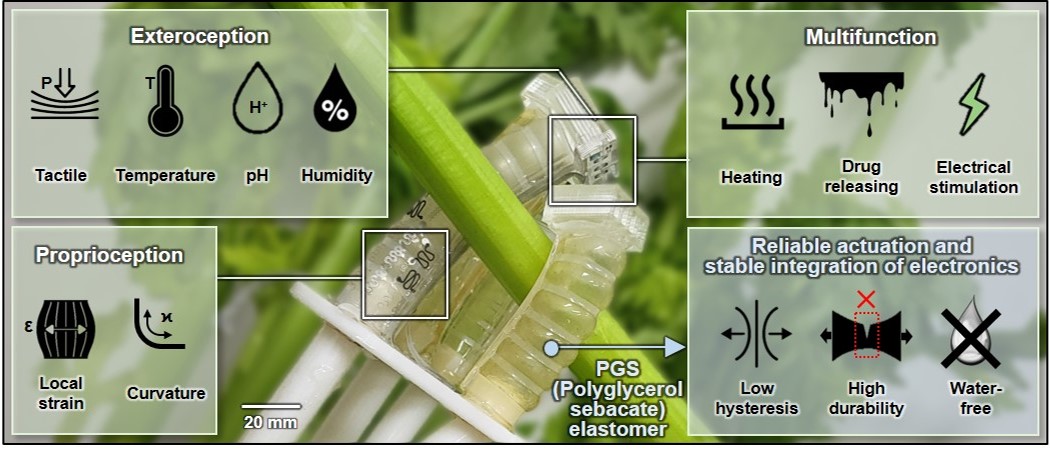
▲ Fig. 1. Fully compostable soft robot system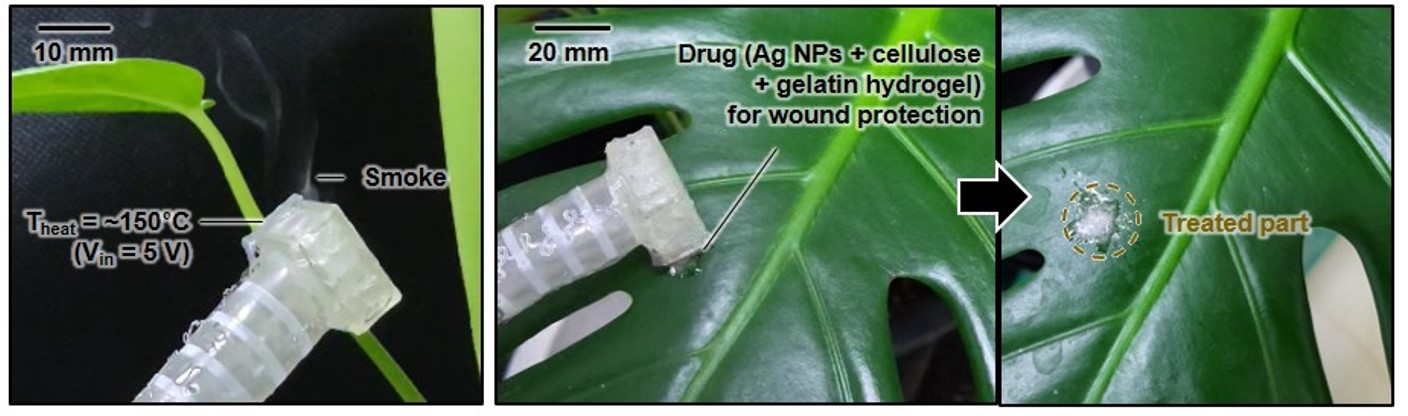
▲ Fig. 2. Branch pruning via joule heating (left) and a drug delivery system for plant treatment (center and right)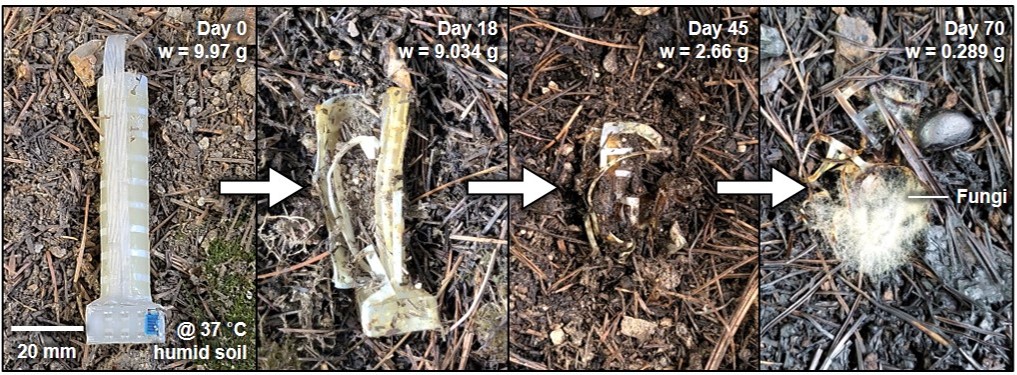
▲ Fig. 3. Biodegradation of the soft robotic finger
[Reference Materials]
- Video Demonstration : https://youtu.be/AFVIGgntKm8?si=t6gc0rbqwgoCnCQu
- Title/Journal : Biodegradable yet hyperdurable robotic fingers for zero-waste soft electronics, Nature Sustainability
- DOI : https://doi.org/10.1038/s41893-026-01780-4
[Contact Information]
Prof. Seung-Kyun Kang, Department of Materials Science and Engineering, Seoul National University / +82-2-880-5756 / kskg7227@snu.ac.kr